Representative Walter Franklin Horan
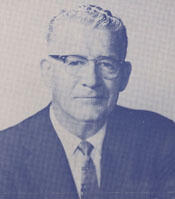
Here you will find contact information for Representative Walter Franklin Horan, including email address, phone number, and mailing address.
| Name | Walter Franklin Horan |
| Position | Representative |
| State | Washington |
| District | 5 |
| Party | Republican |
| Status | Former Representative |
| Term Start | January 6, 1943 |
| Term End | January 3, 1965 |
| Terms Served | 11 |
| Born | October 15, 1898 |
| Gender | Male |
| Bioguide ID | H000786 |
About Representative Walter Franklin Horan
Walter Franklin Horan (October 15, 1898 – December 19, 1966) was an American politician and fruit grower who represented Eastern Washington in the United States House of Representatives for 22 years. A member of the Republican Party, he was first elected in 1942 and served eleven consecutive terms from January 3, 1943, to January 3, 1965, representing Washington’s Fifth Congressional District, which included Spokane and Wenatchee. Over more than two decades in Congress, Horan contributed to the legislative process during a significant period in American history and consistently represented the interests of his largely agricultural constituency.
Horan was born near Wenatchee, Washington, the younger son of Michael and Margaret A. (Rankin) Horan. His father, Mike Horan, was a pioneer fruit grower in the Wenatchee Valley and the son of Irish immigrants, and the family’s livelihood and identity were closely tied to the development of the region’s orchard industry. Raised in this agricultural environment, Walter Horan grew up working in the fruit business, gaining firsthand experience in growing, packing, and marketing produce. This background would later shape both his professional life and his political priorities.
During World War I, Horan served in the United States Navy as a gunner’s mate, contributing to the nation’s war effort as a young man. After his military service, he pursued higher education and attended Washington State College in Pullman (now Washington State University), where he earned a bachelor’s degree in 1925. While in college he met Helen L. “Sally” Campbell of Eureka, Montana, who was a classmate; the two later married and built a family life that remained rooted in central Washington even as Horan’s public career expanded.
Following his graduation, Horan returned to the Wenatchee area and, together with his older brother John, operated one of the largest fruit ranches in the state. The Horan brothers’ enterprise became a major fruit-growing and packing operation, reflecting both the growth of the Wenatchee Valley as a leading apple-producing region and the family’s entrepreneurial skill. Their business, known as Horan Brothers, later evolved into what became McDougall & Sons after John suffered a stroke and died in 1954, when his eldest daughter Jacquelyn (1924–2008) and her husband Robert D. McDougall (1924–2012) assumed management. For a period, Walter Horan’s son Michael ran the family orchard until the property was taken by the government and converted into a park, at which point all of the fruit trees were cut down.
Horan’s entry into politics was closely tied to his agricultural background and his belief that the farming sector needed stronger representation in Washington, D.C. He first ran for Congress in 1940 from the Fifth Congressional District but lost the general election to the two-term Democratic incumbent, Charles H. Leavy. When Leavy resigned in August 1942 to accept appointment as a federal judge on the U.S. District Court for the Western District of Washington, the seat was left vacant. In the September 1942 Republican primary, Horan defeated Spokane attorney and civic leader Joe Albi, then went on to win the November general election, easily defeating former two-term U.S. Senator and 1940 gubernatorial candidate Clarence Dill. His victory marked the first time in twenty years that a Republican had captured the district, signaling a significant political shift in Eastern Washington.
As a member of the House of Representatives from 1943 to 1965, Horan participated actively in the legislative process during World War II, the postwar era, and the early years of the Cold War and civil rights movement. He served as chairman of the House District of Columbia Committee, where he played a role in overseeing the administration and governance of the nation’s capital. He also served on the powerful House Appropriations Committee, sitting on its Agriculture, Legislative, State, Commerce, Justice, and Judiciary subcommittees. These assignments allowed him to influence federal spending priorities in areas directly affecting his district, including agricultural programs and other domestic initiatives. Reflecting a moderate stance on civil rights for his time, Horan voted in favor of the Civil Rights Acts of 1957, 1960, and 1964, as well as the 24th Amendment to the U.S. Constitution, which abolished the poll tax in federal elections.
In 1964, at age 66, Horan sought a twelfth term in Congress. He won the Republican primary over Sam C. Parks but was defeated in the general election by Democrat Tom Foley, a 35-year-old Spokane lawyer. Foley’s victory ended Horan’s 22-year tenure in the House; Foley would go on to hold the seat for the next thirty years, serving as Speaker of the House during his final six years in office until his own defeat in 1994 at age 65 by George Nethercutt. On election night in 1964, while in Wenatchee, Horan suffered acute pulmonary edema and was hospitalized for several weeks. Earlier that year, in January, he had been treated at Bethesda Naval Hospital for a pleurisy attack, a health issue that was publicly known and suggested growing concerns about his physical condition near the end of his congressional service.
After leaving Congress in January 1965, Horan largely withdrew from public office but remained associated with the Wenatchee area and its agricultural community. Two years out of office, in December 1966, he and his wife Sally (1904–1995) traveled to the Philippines to visit their daughter and her family. While in Manila, Horan suffered a fatal heart attack on December 19, 1966, at the age of 68. He and his wife are buried in Wenatchee City Cemetery, underscoring the enduring connection between the Horan family and the region they helped to develop. His legacy in Eastern Washington is reflected in the naming of the plaza at the federal courthouse in Spokane in his honor, as well as in the continued prominence of the fruit industry that shaped his early life and political career.