Senator Wayne Allard
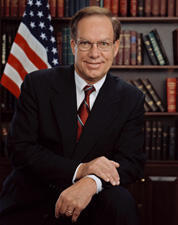
Here you will find contact information for Senator Wayne Allard, including email address, phone number, and mailing address.
| Name | Wayne Allard |
| Position | Senator |
| State | Colorado |
| Party | Republican |
| Status | Former Representative |
| Term Start | January 3, 1991 |
| Term End | January 3, 2009 |
| Terms Served | 9 |
| Born | December 2, 1943 |
| Gender | Male |
| Bioguide ID | A000109 |
About Senator Wayne Allard
Alan Wayne Allard (born December 2, 1943) is an American veterinarian and Republican politician who represented Colorado in the United States Congress from 1991 to 2009. He served as a United States representative from Colorado’s Fourth Congressional District from 1991 to 1997 and as a United States senator from 1997 to 2009, following earlier service in the Colorado State Senate from 1983 to 1991. Over the course of five terms in Congress—three in the House and two in the Senate—Allard participated actively in the legislative process and represented the interests of his Colorado constituents during a significant period in American political history.
Allard was born in Fort Collins, Colorado, the son of Sibyl Jean (née Stewart) and Amos Wilson Allard. He is descended from immigrants from Canada and Scotland and was raised on a ranch near Walden, Colorado, an upbringing that exposed him early to agriculture, livestock, and rural life. He attended Colorado State University in Fort Collins, where he pursued veterinary studies and received a Doctor of Veterinary Medicine (D.V.M.) degree in 1968. While completing veterinary school, he married Joan Malcolm, who earned a degree in microbiology from Colorado State University. The couple later founded the Allard Animal Hospital, a veterinary practice, and settled in Loveland, Colorado, where they raised two daughters, Christi and Cheryl, and eventually welcomed five grandsons. Allard is a Protestant.
Before entering full-time public service, Allard built a career as a practicing veterinarian. He and his wife operated their veterinary practice in northern Colorado, and he continued to run this practice even after entering elective office. In 1982 he was elected to the Colorado State Senate, where he represented Larimer and Weld counties from 1983 to 1991. During his tenure in the state legislature, Allard was known as a strong supporter of fiscal responsibility and of preserving Colorado’s tradition of a citizen legislature, in which lawmakers maintain careers outside government. He sponsored the state law limiting Colorado’s legislative sessions to 120 days, a measure that has had a lasting influence on the structure and rhythm of state governance.
In 1990, Allard successfully sought election to the United States House of Representatives from Colorado’s Fourth Congressional District and took office on January 3, 1991. He served three consecutive terms in the House, from 1991 to 1997. As a Colorado representative, he served on the Joint Committee on Congressional Reform, which recommended many of the procedural and institutional changes later incorporated into the Republican Party’s “Contract with America.” These reforms became some of the first measures passed by the Republican-controlled Congress in 1995 and formed a key part of the party’s legislative platform. His House service coincided with major national debates over budget policy, government reform, and the role of the federal government in domestic affairs.
In 1996, Allard ran for the United States Senate seat from Colorado. In the Republican primary, he defeated Colorado Attorney General Gale Norton, winning 57 percent of the vote to Norton’s 43 percent. In the general election he prevailed over Democratic nominee Tom Strickland by approximately five percentage points. At the time of his initial Senate campaign, Allard pledged to serve only two terms in the Senate before retiring. He was re-elected in 2002, again defeating Strickland by roughly the same margin as in 1996. During his Senate career, he served on several key committees, including the Committee on Appropriations—where he sat on the Interior, Legislative Branch, Energy and Water Development, Financial Services and General Government, Military Construction and Veterans Affairs, and Transportation and Housing and Urban Development subcommittees—and the Committee on the Budget. He also served on the Committee on Banking, Housing, and Urban Affairs, where he was ranking member of the Securities, Insurance, and Investment Subcommittee and sat on the Financial Institutions and Housing, Transportation, and Community Development subcommittees, as well as on the Committee on Health, Education, Labor, and Pensions, with assignments on the Subcommittee on Children and Families and the Subcommittee on Employment and Workplace Safety. One of the legislative staffers in his Capitol Hill office during his Senate tenure was Cory Gardner, who would later be elected to the U.S. Senate from Colorado and succeed Allard in that body.
Allard’s Senate record reflected a consistently conservative voting pattern. In March 2008, the National Journal ranked him the second most conservative U.S. senator based on his 2007 votes. He was an early and prominent supporter of a constitutional amendment to define marriage as between one man and one woman. In 2003, he introduced the Federal Marriage Amendment in the Senate, seeking to ban same-sex marriage nationwide; the amendment failed to advance to the House. He reintroduced the measure in 2004 with minor changes, arguing that there was a broader effort to undermine the institution of marriage. The proposal again failed, receiving 227 votes in favor and 186 against in the House, short of the two-thirds majority (290 votes) required to send a constitutional amendment to the states. In April 2006, Time magazine named him one of “America’s 5 Worst Senators,” characterizing him as relatively low-profile and dubbing him “The Invisible Man,” while acknowledging his willingness to take on unglamorous tasks, such as overseeing the construction of the Capitol Visitor Center. Colorado newspapers, including the Rocky Mountain News and The Gazette of Colorado Springs, defended Allard as a hardworking advocate for Colorado interests, and upon his retirement The Denver Post noted that, although it did not always agree with his policy positions, it did not doubt his diligence on behalf of the state. In April 2007, he endorsed Mitt Romney for the Republican presidential nomination and later shifted his support to John McCain once McCain became the presumptive Republican nominee.
Allard also developed a legislative portfolio on public lands and energy policy. He was a co-sponsor of the James Peak Wilderness Bill, which created a 14,000-acre preserve around James Peak and added 3,000 acres to the Indian Peaks Protection Area. He sponsored legislation establishing Colorado’s Great Sand Dunes National Park and Preserve, protecting approximately 85,000 acres of unique dune and mountain ecosystems in the San Luis Valley. He founded and chaired the Senate Renewable Energy and Efficiency Caucus, reflecting an interest in energy efficiency and alternative energy within a broader pro-development stance. In 2006, the environmental group Republicans for Environmental Protection praised him for supporting legislation to make the U.S. Army Corps of Engineers more accountable for the environmental and economic impacts of its projects, while criticizing his support for expanded oil drilling offshore and in Alaska’s Arctic National Wildlife Refuge. The nonpartisan League of Conservation Voters gave him a 29 percent rating for his 2006 environmental voting record. During his Senate years he also supported efforts to honor emergency first responders; a statement released by his office in 2007 in support of a day to recognize first responders included a widely noted, awkwardly phrased quotation attributed to him regarding the relative significance of Colorado first responders’ recent work compared with responses to other natural disasters.
Honoring his 1996 pledge, Allard announced on January 15, 2007, that he would not seek a third Senate term and would retire in January 2009. His service in Congress thus spanned five terms—three in the House of Representatives and two in the Senate—covering the years from 1991 to 2009. After leaving office, he transitioned to work in government relations and advocacy. In February 2009, he joined The Livingston Group, a Washington, D.C.–based government relations consulting and lobbying firm. In 2011, he took a government relations role with the American Motorcyclist Association, representing the interests of motorcyclists and the motorcycle industry in federal policy debates. In addition to his political and lobbying work, Allard authored a reference volume, Colorado’s U.S. Senators: A Biographical Guide, published in 2007 by Fulcrum Publishing, reflecting his longstanding interest in the history of his state’s representation in the Senate.