Representative Wayne T. Gilchrest
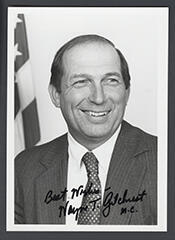
Here you will find contact information for Representative Wayne T. Gilchrest, including email address, phone number, and mailing address.
| Name | Wayne T. Gilchrest |
| Position | Representative |
| State | Maryland |
| District | 1 |
| Party | Republican |
| Status | Former Representative |
| Term Start | January 3, 1991 |
| Term End | January 3, 2009 |
| Terms Served | 9 |
| Born | April 15, 1946 |
| Gender | Male |
| Bioguide ID | G000180 |
About Representative Wayne T. Gilchrest
Wayne Thomas Gilchrest (born April 15, 1946) is an American politician and educator who served as a Republican member of the United States House of Representatives representing Maryland’s 1st congressional district from January 3, 1991, to January 3, 2009. Over nine consecutive terms in Congress, he was known as a moderate Republican with an independent voting record, particularly on environmental protection, social issues, and foreign policy. In 2008, he was defeated in the Republican primary by State Senator Andy Harris. Following his departure from elective office, Gilchrest devoted himself to environmental education and advocacy, later joining the ReFormers Caucus of Issue One and, in 2019, becoming a registered Democrat.
Gilchrest was born in Rahway, New Jersey, the fourth of six sons of Elizabeth and Arthur Gilchrest. He grew up in a working-class family and attended local schools in New Jersey, graduating from high school in 1964. Soon after graduation, he enlisted in the United States Marine Corps. His military service included deployment during the U.S. intervention in the Dominican Republic and later combat duty in the Vietnam War. In Vietnam, he rose to the rank of sergeant and served as a platoon leader. During his service he was wounded in the chest and was decorated for valor and meritorious service, receiving the Purple Heart, the Bronze Star, and the Navy Commendation Medal. In later life he remained active in veterans’ organizations, including the American Legion, the Veterans of Foreign Wars, and the Military Order of the Purple Heart.
After leaving active duty, Gilchrest pursued higher education under the G.I. Bill. In 1969 he earned an associate’s degree from Wesley College in Dover, Delaware. He then spent a semester in Kentucky studying rural poverty in Appalachia, an experience that informed his later interest in public policy and social issues. He continued his studies at Delaware State College (now Delaware State University), where he received a bachelor’s degree in history in 1973. Gilchrest subsequently undertook graduate coursework toward a master’s degree at Loyola College in Baltimore, Maryland, though he did not complete the degree. He eventually settled on Maryland’s Eastern Shore, where he embarked on a career in education.
Before entering Congress, Gilchrest worked as a high school teacher, notably at Kent County High School on Maryland’s Eastern Shore, where he taught history and government. His classroom experience and interest in civic life led him to seek public office. In 1988, he ran as a Republican against four-term Democratic incumbent Roy Dyson in Maryland’s 1st congressional district. Dyson’s campaign was hampered by allegations of improper contributions from defense contractors, questions about his personal life, and the suicide of a top staffer. Despite being badly outspent, Gilchrest narrowly lost that race. Undeterred, he sought a rematch in 1990 and this time defeated Dyson decisively, winning by approximately 14 percentage points and securing a seat in the U.S. House of Representatives.
Gilchrest took office in January 1991 and would represent Maryland’s 1st congressional district for nine terms, serving until January 2009. The district, encompassing the Eastern Shore and parts of central Maryland, had a strong Republican lean, with a Cook Partisan Voting Index of R+13 and support for President George W. Bush’s 2004 re-election exceeding 60 percent. Nonetheless, party registration in 2006 was nearly evenly split between Democrats and Republicans. Gilchrest quickly established himself as a pragmatic and moderate Republican, often willing to break with party leadership. In 1992, he survived a close contest against Democrat Tom McMillen, a former representative from Maryland’s 4th district who had been redrawn into the 1st; Gilchrest prevailed by about 3 percent, largely by running up substantial margins on the Eastern Shore. After that race, he did not face serious electoral opposition for more than a decade.
During his congressional career, Gilchrest was particularly active on environmental and natural resources issues. He served on the House Committee on Natural Resources and chaired its Subcommittee on Fisheries, Wildlife and Oceans from 2001 to 2007, where he focused on marine conservation, fisheries management, and coastal protection. He also served on the House Committee on Transportation and Infrastructure, including the Subcommittee on Coast Guard and Maritime Transportation, the Subcommittee on Railroads, Pipelines, and Hazardous Materials, and the Subcommittee on Water Resources and Environment. Reflecting his deep interest in the Chesapeake Bay and environmental policy, he founded and co-chaired the Chesapeake Bay Watershed Task Force, co-chaired the House Oceans Caucus, chaired the House Corps Reform Caucus, and co-founded and co-chaired both the House Organic Caucus and the House Dialogue Caucus. He was also a co-founder and co-chair of the Congressional Climate Change Caucus, working alongside Democrat John Olver of Massachusetts, and became known as a leading Republican voice on climate and conservation issues.
Gilchrest’s voting record placed him among the most moderate, and at times most liberal, Republicans in the House. He was a member of centrist and reform-oriented Republican organizations, including the Republican Main Street Partnership, Republicans for Environmental Protection, and the Republican Majority for Choice. On social issues, he frequently departed from the party line. He was a Republican co-sponsor of Representative Marty Meehan’s “Military Readiness Enhancement Act,” which sought to repeal the “Don’t ask, don’t tell” policy governing gay and lesbian service members. He publicly supported same-sex marriage while the Maryland General Assembly was considering its legalization, describing it as a question of “social justice, civil rights and a more viable democracy.” In 1993, he was the lone Republican in the House to vote in favor of legislation that would have granted statehood to the District of Columbia. By 2007, he broke ranks with his party more often than any other House member, and in 2008 the National Journal ranked him as the House’s most liberal Republican, placing him to the left of eight Democratic representatives.
Gilchrest also gained prominence for his evolving stance on foreign policy, particularly the Iraq War. He initially supported the 2003 U.S. invasion of Iraq, consistent with most of his party. As the occupation grew more protracted and violent, however, he became increasingly critical of the administration’s strategy. He endorsed the recommendations of the bipartisan Iraq Study Group and advocated setting a timetable for the withdrawal of U.S. forces. In 2007, he joined 16 Republicans and 229 Democrats in voting for House Concurrent Resolution 63, a nonbinding measure expressing disapproval of President Bush’s proposed troop surge in Iraq. His positions on Iraq and other issues contributed to growing dissatisfaction among conservative activists in his district, who viewed him as a “Republican in Name Only.”
By the mid-2000s, Gilchrest’s moderate record had attracted a series of Republican primary challenges, though none succeeded until 2008. In that election cycle, he faced multiple opponents in the Republican primary, including State Senator Andrew (Andy) Harris, State Senator E. J. Pipkin, Joe Arminio, and Robert Banks. Harris, strongly backed by the anti-tax group Club for Growth and other conservative organizations, ran to Gilchrest’s right on fiscal and social issues. In the February 2008 primary, Harris defeated Gilchrest, with Pipkin finishing third. After his primary loss, Gilchrest broke with his party and endorsed the Democratic nominee, Queen Anne’s County State’s Attorney Frank Kratovil, in the general election, pointedly framing his decision as a choice between “the Republican Party, or my eternal soul” and between “party loyalty, or integrity.” Kratovil went on to win the seat in November.
In the 2008 presidential race, Gilchrest further distanced himself from his party’s national leadership. On September 18, 2008, he made radio comments praising the Democratic ticket of Barack Obama and Joe Biden, prompting some media outlets to suggest he had endorsed them. He later clarified that his remarks did not constitute a formal endorsement, but in an October 2 Washington Post article he sharply criticized the Republican Party and its nominee, Senator John McCain, saying the party had become “more narrow, more self-serving” and contrasting McCain’s approach unfavorably with Obama’s. Gilchrest stated that McCain “recites memorized pieces of information in a narrow way, whereas Barack Obama is constantly evaluating information, using his judgment.” He subsequently told WBAL-TV that he voted for Obama in the November 2008 election.
After leaving Congress in January 2009, Gilchrest turned his attention primarily to environmental education and conservation, particularly in the Chesapeake Bay region. He became involved in outdoor and environmental programs that sought to educate students and citizens about watershed health, habitat restoration, and sustainable land use. He also joined the ReFormers Caucus of Issue One, a bipartisan group of former elected officials dedicated to reducing the influence of money in politics and strengthening democratic institutions. In addition, he served as a board member of the National Iranian American Council (NIAC), reflecting an ongoing interest in foreign affairs and U.S.–Middle East relations. In 2019, after years of estrangement from the increasingly conservative Republican Party, Gilchrest formally changed his voter registration and became a Democrat, underscoring the ideological journey that had marked his long public career.