Representative Wes Watkins
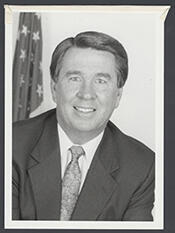
Here you will find contact information for Representative Wes Watkins, including email address, phone number, and mailing address.
| Name | Wes Watkins |
| Position | Representative |
| State | Oklahoma |
| District | 3 |
| Party | Republican |
| Status | Former Representative |
| Term Start | January 4, 1977 |
| Term End | January 3, 2003 |
| Terms Served | 10 |
| Born | December 15, 1938 |
| Gender | Male |
| Bioguide ID | W000194 |
About Representative Wes Watkins
Wesley Wade Watkins (December 15, 1938 – March 26, 2025) was an American politician from the state of Oklahoma who served as a Representative from Oklahoma in the United States Congress from 1977 to 2003. Over the course of 10 terms in office, he represented Oklahoma’s 3rd congressional district for 14 years as a Democrat and then for six years as a Republican. His long tenure in the U.S. House of Representatives spanned a significant period in late twentieth- and early twenty-first-century American history, during which he participated actively in the legislative process and represented the interests of his constituents in a predominantly rural district.
Watkins was born on December 15, 1938, in Oklahoma, where he was raised and developed a strong identification with the agricultural and small-town communities that would later form the core of his political base. Growing up in modest circumstances, he became closely acquainted with the economic challenges facing rural Oklahomans, experiences that shaped his later emphasis on economic development, education, and infrastructure. His early life in the state’s heartland helped establish the populist and pragmatic outlook that characterized much of his public service.
Watkins pursued his education in Oklahoma, where he studied subjects that prepared him for a career in public affairs and economic development. His academic training, combined with his familiarity with local issues, positioned him to engage with questions of trade, industry, and workforce preparation that would later become central themes of his legislative and institutional work. These educational experiences also forged lasting ties with Oklahoma’s higher education community, particularly Oklahoma State University, which would later honor him in multiple ways.
Before and alongside his congressional career, Watkins was involved in public service and economic development efforts within Oklahoma, gaining a reputation as an advocate for job creation, vocational training, and rural advancement. His work brought him into close collaboration with state and local officials, business leaders, and educational institutions, reinforcing his belief that government, education, and industry should work together to expand opportunity. This focus on practical economic outcomes would remain a hallmark of his approach in Washington.
Watkins was first elected to the United States House of Representatives in 1976 and took office in January 1977 as a Democrat representing Oklahoma’s 3rd congressional district. Over the next 14 years, he built a record as a legislator attentive to agriculture, transportation, and economic development, while navigating the shifting political landscape of the late Cold War and post–Vietnam era. During this period, he participated in the democratic process as a member of the House of Representatives, contributing to debates on national policy while ensuring that the needs of his largely rural constituency—such as farm support, infrastructure investment, and access to education and training—were represented in federal decision-making.
After leaving Congress and later returning, Watkins reentered the House as a member of the Republican Party, ultimately serving six additional years as a Republican representative for the same district. His party switch reflected broader political realignments in Oklahoma and the South and underscored his continuing commitment to conservative approaches to fiscal policy, business development, and limited government, while maintaining his long-standing emphasis on local economic growth. In total, he served from 1977 to 2003, a span that covered 10 terms in office and saw him engage with issues ranging from the end of the Cold War to the early years of the twenty-first century. Throughout, he remained closely identified with the interests of his district’s farmers, small businesses, and educational institutions.
Beyond his formal legislative duties, Watkins left a lasting institutional legacy in Oklahoma through his advocacy for education, technology, and international trade. The Wes Watkins Center for International Trade Development at Oklahoma State University, established in 1990, was named in his honor and created to increase the economic competitiveness of the state of Oklahoma and to assist Oklahoma-based businesses in engaging in global trade. As an extension unit within the School of Global Studies and Partnerships at Oklahoma State University, the center reflects Watkins’s conviction that international markets and global engagement were essential to the state’s long-term prosperity. In addition, the Wes Watkins Technology Center, a career and technology education institution, and the naming of the Wes Watkins Reservoir in central Oklahoma further commemorate his contributions to workforce development, infrastructure, and resource management.
Watkins’s commitment to career and technical education was recognized formally when he was inducted into the Oklahoma CareerTech Hall of Fame in 1991. This honor highlighted his sustained efforts to expand vocational training opportunities and to link education more directly to employment and economic growth. In his later years, he remained an influential figure in Oklahoma public life, associated with initiatives that bridged government, education, and business. Wesley Wade Watkins died on March 26, 2025, leaving behind a legacy marked by long congressional service, a distinctive role in Oklahoma’s political evolution, and enduring institutions dedicated to trade, technology, and economic development.