Representative Wesley Lloyd
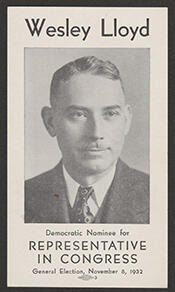
Here you will find contact information for Representative Wesley Lloyd, including email address, phone number, and mailing address.
| Name | Wesley Lloyd |
| Position | Representative |
| State | Washington |
| District | 6 |
| Party | Democratic |
| Status | Former Representative |
| Term Start | March 9, 1933 |
| Term End | January 3, 1937 |
| Terms Served | 2 |
| Born | July 24, 1883 |
| Gender | Male |
| Bioguide ID | L000383 |
About Representative Wesley Lloyd
Wesley Lloyd (July 24, 1883 – January 10, 1936) was an American attorney and Democratic politician from Tacoma, Washington, most notable for his service as a United States Representative from Washington from 1933 until his death in 1936. A member of the Democratic Party, he served in the 73rd and 74th Congresses and contributed to the legislative process during two terms in office, representing the interests of his constituents during a significant period in American history.
Lloyd was born in Arvonia, Osage County, Kansas, on July 24, 1883, the son of John Q. Lloyd and Mary Anne (Roberts) Lloyd. He was educated in the public schools of Osage County and then pursued higher education at Baker University in Baldwin, Kansas, and at Washburn College in Topeka. His early academic training provided the foundation for a career that combined journalism, law, and public service.
Before entering the legal profession, Lloyd worked as a newspaper reporter, gaining experience with newspapers in Kansas City, Missouri, Topeka, Kansas, and Butte, Montana. While employed as a reporter, he undertook legal studies at the Kansas City Law School, attending courses that culminated in his receipt of an LL.B. degree in 1906. That same year he was admitted to the bar and moved to Tacoma, Washington, where he continued to work as a reporter while establishing a law practice. By 1908 he had transitioned to the full-time practice of law in Tacoma, beginning a long association with the legal and political life of Pierce County.
Lloyd became active in Democratic politics soon after settling in Washington. In 1908 he was the unsuccessful Democratic nominee for prosecuting attorney of Pierce County, and in 1910 he ran unsuccessfully for a seat in the Washington House of Representatives. He remained engaged in public affairs and, during World War I, served in the Washington National Guard. He joined Company F, 3rd Infantry Regiment, serving from 1918 to 1920 and attaining the rank of corporal. After the war he continued to seek public office, again running unsuccessfully as the Democratic nominee for county prosecutor in 1920 and as a candidate for judge of the Washington Superior Court in 1924. In 1931 he was appointed special assistant prosecuting attorney for Thurston County, a position he notably held without pay, while maintaining his law practice and his role as one of the leaders of the Democratic Party in Pierce County, including service as president of the county’s Men’s Democratic Club.
In the 1932 elections, amid the economic crisis of the Great Depression and the national shift toward Democratic leadership, Lloyd was elected to the United States House of Representatives. He took his seat on March 4, 1933, in the 73rd Congress and was reelected in 1934 to the 74th Congress, serving continuously until his death on January 10, 1936. As a member of the House of Representatives from Washington, he participated actively in the democratic process during a transformative era in federal policy. Lloyd served on the House Judiciary Committee and was appointed to a leadership role as regional whip for Washington, Oregon, and California, helping to coordinate party support for legislation across the Pacific Coast delegation.
Lloyd’s congressional service coincided with the depths of the Great Depression, and he aligned himself with efforts to address economic inequality and financial instability. On May 9, 1933, he proposed a constitutional amendment that would have placed a maximum limit on individual net worth, an initiative that, although unsuccessful, reflected contemporary concerns about wealth concentration and economic justice. Throughout his tenure, he worked within the framework of New Deal–era policymaking, contributing to debates and votes that shaped federal responses to the national emergency.
In his personal life, Lloyd married Iva Reedy of Spokane, Washington, in 1910. The couple had three children. Outside of law and politics, he was known as an avid hunter and fisherman, undertaking several lengthy excursions to remote areas of western Washington. He was active in civic and fraternal organizations, including membership in the Fraternal Order of Eagles and the Benevolent and Protective Order of Elks. A committed Freemason, he belonged to the Shriners and the Order of the Eastern Star and received the 32nd degree of the Scottish Rite, reflecting a broad engagement with community and fraternal life.
Wesley Lloyd died in Washington, D.C., on January 10, 1936, while still serving in the House of Representatives, placing him among the members of Congress who died in office in the first half of the twentieth century. His remains were returned to Washington State, and he was interred at Tacoma Cemetery in Tacoma. His career spanned journalism, law, military service, and elective office, and his years in Congress marked his most prominent role in public life during a critical period in the nation’s history.