Senator Wilbert Lee O’Daniel
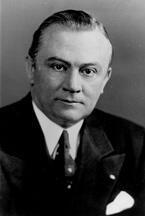
Here you will find contact information for Senator Wilbert Lee O’Daniel, including email address, phone number, and mailing address.
| Name | Wilbert Lee O’Daniel |
| Position | Senator |
| State | Texas |
| Party | Democratic |
| Status | Former Representative |
| Term Start | January 3, 1941 |
| Term End | January 3, 1949 |
| Terms Served | 2 |
| Born | March 11, 1890 |
| Gender | Male |
| Bioguide ID | O000034 |
About Senator Wilbert Lee O’Daniel
Wilbert Lee “Pappy” O’Daniel (March 11, 1890 – May 11, 1969) was an American Democratic Party politician from Texas who rose to prominence as a flour company executive and radio personality before serving as the 34th governor of Texas from 1939 to 1941 and as a United States senator from Texas from 1941 to 1949. Known for his populist appeal, his support of Texas’s business community, and his distinctive radio persona, he became one of the most recognizable political figures in Texas in the late 1930s and 1940s. A member of the Democratic Party, O’Daniel served two terms in the Senate and chose not to run for reelection in 1948, after which he was succeeded by his 1941 Democratic primary opponent and future U.S. president Lyndon B. Johnson. In addition to his political career, O’Daniel was also a songwriter who composed the popular tune “Beautiful Texas.”
O’Daniel was born in Malta, Ohio, on March 11, 1890. His early life was marked by hardship: his father was killed in an accident while O’Daniel was still a boy, and his mother later remarried. The family subsequently moved to a cattle ranch near Arlington, Kansas, where he spent his youth. He attended local schools in Kansas and went on to graduate from the two-year program at Salt City Business College in Hutchinson, Kansas, acquiring the business and clerical training that would underpin his early career. In 1909 he relocated to Anthony, Kansas, where he began work as a stenographer and bookkeeper for a flour milling company, entering an industry that would define both his business success and his later public persona.
Over the next decade and a half, O’Daniel advanced in the flour business, working for companies in Kansas City, Missouri, and New Orleans, Louisiana. In 1925 he moved to Fort Worth, Texas, to work for the Burrus Mill and Elevator Company, a major flour producer. It was there that he emerged as a prominent advertising executive and public figure. In the late 1920s he assumed responsibility for the company’s radio advertising and began to use the new medium in innovative ways. To promote the company’s Light Crust Flour, he wrote songs, sang on the air, and organized a band of “old-timey” musicians that became known as the Light Crust Doughboys. The group included notable performers such as Bob Wills, who would later become a leading figure in Western swing music. After the Doughboys disbanded, O’Daniel formed a new Western swing band, Pat O’Daniel and His Hillbilly Boys, named for his own Hillbilly Flour Company.
O’Daniel’s radio program, broadcast at noontime and heard across Texas, made him a household name by the mid-1930s. On the show he mixed music, homespun commentary, and religious themes, frequently extolling the Ten Commandments, the Bible, and traditional moral values while promoting Hillbilly brand flour. His folksy catchphrase, “pass the biscuits, Pappy,” became widely known and earned him the enduring nickname “Pappy.” One national magazine writer observed that “at twelve-thirty sharp each day, a fifteen-minute silence reigned in the state of Texas, broken only by mountain music, and the dulcet voice of W. Lee O’Daniel.” This powerful radio presence created a direct bond with listeners and laid the foundation for his entry into electoral politics.
In 1938 O’Daniel ran for governor of Texas as a Democrat, capitalizing on his radio fame and populist image. His campaign promoted his flour products while emphasizing themes of pensions for the elderly, tax cuts, and opposition to a state sales tax. He promised to block a sales tax and to raise pensions, appealing to many Depression-era voters. In a crowded Democratic primary field of thirteen candidates, he won with 51 percent of the vote, defeating, among others, Texas Railroad Commissioner and former Amarillo mayor Ernest O. Thompson, who would also be his principal opponent in the 1940 reelection campaign. Once in office, however, O’Daniel appeared to reverse one of his key campaign positions by proposing a new transaction tax, which was rejected by the Texas Legislature. Despite this controversy and frequent clashes with legislators, he remained personally popular with the electorate and was handily reelected governor in 1940, again turning back Thompson’s challenge.
O’Daniel’s statewide popularity soon propelled him onto the national stage. In 1941, following the death of U.S. Senator Morris Sheppard, he ran in the special election to fill the vacant Senate seat. In one of the most closely contested and controversial elections in Texas history, he narrowly defeated U.S. Representative Lyndon B. Johnson by 1,311 votes. This contest, marred by allegations of irregularities on both sides, had a lasting impact on Texas politics; Johnson’s experience in 1941 influenced his strategy in the 1948 Senate race, when his supporters, including political boss George Parr, carefully managed vote reporting in anticipation of another razor-thin margin. O’Daniel resigned the governorship upon his election to the Senate and took office as Texas’s junior United States senator in 1941. He was subsequently elected to a full Senate term in 1942 and served in the chamber until 1949, participating in the legislative process and representing the interests of his Texas constituents during a period that encompassed World War II and the early years of the Cold War.
During his Senate tenure, O’Daniel aligned himself with conservative and anti–New Deal elements within the Democratic Party. He was generally regarded as an ineffective legislator; most of the bills he introduced failed to pass, and he did not attain significant committee leadership or major legislative achievements. In the 1944 presidential election he endorsed the Texas Regulars, a conservative Democratic faction that opposed President Franklin D. Roosevelt’s fourth-term bid and New Deal policies. His stance reflected his support for business interests and his skepticism of expansive federal programs. Although he remained a recognizable public figure, his influence in the Senate waned over time, and he declined to seek another term in 1948. He left office in January 1949, and the seat was subsequently won by Lyndon B. Johnson, his former rival from the 1941 special election.
After leaving the Senate, O’Daniel returned to private life in Texas. He purchased a ranch near Fort Worth and became active in various business ventures, including real estate investments in Dallas and work in the insurance industry. His political ambitions, however, did not entirely subside. In the 1950s he attempted a political comeback, running for governor of Texas in both 1956 and 1958. In these campaigns he took strongly segregationist positions, asserting that the Supreme Court’s 1954 decision in Brown v. Board of Education, which declared racial segregation in public schools unconstitutional, was part of a Communist conspiracy. These views, coupled with changing political currents in the state, failed to resonate with a majority of voters, and he finished third in the Democratic primaries on both occasions.
Wilbert Lee “Pappy” O’Daniel spent his later years largely out of public office but remained a figure of interest in Texas political lore and in the history of American popular culture, owing to his unusual trajectory from flour salesman and radio entertainer to governor and U.S. senator. He died in Dallas, Texas, on May 11, 1969, at the age of seventy-nine, and was buried at Sparkman-Hillcrest Memorial Park Cemetery in Dallas. His life and persona later inspired fictional portrayals, most notably the character of Governor Pappy O’Daniel, played by Charles Durning in the 2000 Coen Brothers film “O Brother, Where Art Thou?,” a loose and geographically transposed adaptation of his public image set in Mississippi.