Senator Willard Warner
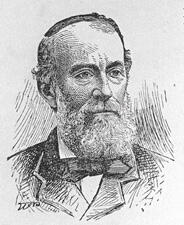
Here you will find contact information for Senator Willard Warner, including email address, phone number, and mailing address.
| Name | Willard Warner |
| Position | Senator |
| State | Alabama |
| Party | Republican |
| Status | Former Representative |
| Term Start | January 1, 1868 |
| Term End | March 3, 1871 |
| Terms Served | 1 |
| Born | September 4, 1826 |
| Gender | Male |
| Bioguide ID | W000159 |
About Senator Willard Warner
Willard Warner (September 4, 1826 – November 23, 1906) was a Union Army brevet brigadier general during the American Civil War and later served as a Republican United States senator from Alabama from 1867 to 1871. His single term in the Senate coincided with the critical Reconstruction era, during which he participated in the legislative process and represented the interests of his constituents in a state newly readmitted to the Union.
Warner was born on September 4, 1826, in Granville, Licking County, Ohio. He came from a family with deep roots in early American history; his great-grandfather, Luke Knowlton, was a founder of Newfane, Vermont, and a prominent leader in Vermont during the American Revolution. Warner pursued higher education at Marietta College in Marietta, Ohio, from which he graduated before embarking on a career in manufacturing and business. He founded the Newark Machine Works in Newark, Ohio, an enterprise that reflected the region’s growing industrial base. Through family ties he was connected to other notable figures of the era, including his brother-in-law, future Union general Charles R. Woods of Newark.
At the outbreak of the Civil War, Warner entered the Union volunteer forces in December 1861 as a major in the 76th Ohio Infantry. He served in the western theater and took part in several important campaigns and engagements, including the Battle of Fort Donelson in Tennessee, the siege of Corinth in Mississippi, and the Vicksburg campaign along the Mississippi River. In 1863 he was promoted to lieutenant colonel of the 76th Ohio Infantry and led the regiment in operations from Vicksburg to Chattanooga, contributing to the Union’s efforts to secure control of the western Confederacy. During the Atlanta campaign he served on the staff of Major General William T. Sherman as inspector general, a position that placed him in a key administrative and oversight role during one of the war’s decisive offensives.
In October 1864 Warner was appointed colonel of the 180th Ohio Infantry, continuing his service in the Union Army through the final phases of the conflict. In recognition of his performance and contributions, he received the brevet ranks of brigadier general and major general of volunteers, both to rank from March 13, 1865. He was mustered out of the volunteer service in July 1865, concluding nearly four years of continuous wartime duty. His military record, marked by steady advancement and participation in major campaigns, established his public reputation and provided a foundation for his subsequent political career.
Immediately after the war, Warner entered state politics in Ohio, serving one term in the Ohio State Senate. In 1867 he moved to the South, settling in Alabama, where he engaged in cotton planting at a time when the region’s economy was being reconstructed after emancipation and the devastation of war. He quickly became involved in local politics and was elected to the Alabama House of Representatives in 1868, participating in the reorganization of state government under Reconstruction policies. That same year he was a member of the Republican National Convention of 1868, reflecting his growing prominence within the party.
Upon the readmission of Alabama to the Union, Warner was elected as a Republican to the United States Senate. He served as a senator from Alabama from July 13, 1868, to March 3, 1871, alongside Senator George E. Spencer. His tenure in Congress thus ran from 1867 to 1871, encompassing one full term in office during a significant period in American history, when the federal government was shaping the terms of Reconstruction, civil rights, and the reintegration of former Confederate states. As a member of the Senate, Warner contributed to the legislative process, participated in the democratic governance of the reunited nation, and represented the interests of his Alabama constituents. He did not win reelection at the end of his term, and his departure marked the end of Republican representation for that Senate seat until the election of Jeff Sessions in 1996.
After leaving the Senate, Warner continued to receive offers of public service from the national administration. He was appointed collector of customs at Mobile, Alabama, serving from July 1871 until February 1872. During this period he declined President Ulysses S. Grant’s offer to appoint him governor of the Territory of New Mexico, and he also declined a diplomatic post as United States minister to Argentina, choosing instead to focus on private business pursuits. Remaining in the South, he returned to Alabama and later moved to Tennessee, where he became a significant figure in the region’s emerging industrial economy. In 1873 he organized the Tecumseh Iron Company, contributing to the development of the iron industry in the postwar South, and in 1887 he was elected president of the Nashville Iron, Steel, and Charcoal Company, further cementing his role in Southern industrialization.
In his later years Warner divided his time between his business interests and life in Tennessee. He died on November 23, 1906, in Chattanooga, Tennessee. His remains were returned to his native Ohio, and he was buried in Cedar Hill Cemetery in Newark, Licking County, thus closing a life that had spanned the antebellum era, the Civil War, Reconstruction, and the industrial transformation of the United States.