Representative William Charles Adamson
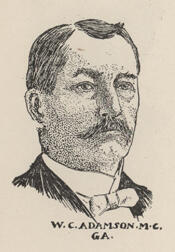
Here you will find contact information for Representative William Charles Adamson, including email address, phone number, and mailing address.
| Name | William Charles Adamson |
| Position | Representative |
| State | Georgia |
| District | 4 |
| Party | Democratic |
| Status | Former Representative |
| Term Start | March 15, 1897 |
| Term End | March 3, 1919 |
| Terms Served | 11 |
| Born | August 13, 1854 |
| Gender | Male |
| Bioguide ID | A000051 |
About Representative William Charles Adamson
William Charles Adamson (August 13, 1854 – January 3, 1929) was a United States Representative from Georgia, an Associate Justice of the United States Customs Court, and a member of the Board of General Appraisers. A Democrat, he served in the United States House of Representatives from 1897 to 1919, contributing to the legislative process during 11 terms in office and representing the interests of his Georgia constituents during a significant period in American history.
Adamson was born on August 13, 1854, in Bowdon, Georgia, the son of John W. Adamson and Mary A. McDaniel, and the grandson of William C. Adamson and John McDaniel. He spent his youth on a farm and engaged in hauling cotton and goods between Atlanta and Bowdon, Georgia, experiences that acquainted him early with the economic and transportation conditions of the post–Civil War South. He attended the common schools of his native region before pursuing higher education. On January 29, 1885, he married Minna Reese of Carrollton, Georgia, establishing a family base in the community that would remain central to his professional and political life.
Adamson received an Artium Baccalaureus degree from Bowdon College in 1874. He then read law in the office of the Honorable S. W. Harris and was admitted to the bar in October 1876. Shortly thereafter he commenced the practice of law in Carrollton, Georgia. His legal career advanced rapidly at the local level: he served as judge of the city court of Carrollton from 1885 to 1889 and acted as attorney for the city of Carrollton for a number of years. His growing prominence in Democratic Party affairs was reflected in his role as a delegate to the Democratic National Convention in 1892 and as a presidential elector in the 1892 presidential election.
Building on his legal and party experience, Adamson was elected as a Democrat to the United States House of Representatives for the 55th Congress and to the ten succeeding Congresses. He served from March 4, 1897, until December 18, 1917, when he resigned to accept a federal judicial appointment. Over these 11 terms in office, he participated actively in the legislative process during an era marked by industrial expansion, progressive reform, and the nation’s entry into World War I. Adamson became particularly influential in matters of transportation and commerce. He served as Chairman of the Committee on Interstate and Foreign Commerce during the 62nd through 65th Congresses, a position from which he helped shape federal regulatory policy. The Adamson Act, which regulated the hours of railroad workers and established an eight-hour workday for interstate railroad employees, was named for him and became one of his most notable legislative achievements.
Adamson’s long congressional service coincided with major national debates over economic regulation, labor rights, and federal authority. As a member of the House of Representatives, he participated in the democratic process on behalf of his Georgia district, reflecting both regional interests and broader national concerns. His leadership on the Committee on Interstate and Foreign Commerce placed him at the center of legislative efforts to modernize and regulate the nation’s transportation infrastructure, particularly the railroads, which were critical to commerce and national defense in the early twentieth century.
In 1917, Adamson transitioned from legislative to judicial service. He was nominated by President Woodrow Wilson on September 20, 1917, to a seat on the Board of General Appraisers, succeeding Henderson M. Somerville. The United States Senate confirmed his nomination on the same day, and he received his commission on September 24, 1917. In this capacity, he adjudicated disputes involving customs and tariff matters, applying his legislative experience to the interpretation of federal trade and revenue laws. On May 28, 1926, he was reassigned by operation of law to the newly created United States Customs Court, to an Associate Justice seat authorized by 44 Stat. 669. He served as an Associate Justice of the United States Customs Court until January 20, 1928, when his service terminated due to his retirement. He was succeeded in that position by Associate Justice Genevieve R. Cline.
Following his retirement from the federal bench, Adamson resumed the practice of law in Carrollton, Georgia, returning to the community where his legal and political career had begun. He died while on a visit to New York City, New York, on January 3, 1929. His remains were returned to Georgia, and he was interred in City Cemetery in Carrollton. In recognition of his long public service and his prominence in local and national affairs, Adamson Square in downtown Carrollton was named in his honor.