Representative William Barksdale
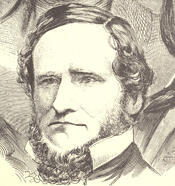
Here you will find contact information for Representative William Barksdale, including email address, phone number, and mailing address.
| Name | William Barksdale |
| Position | Representative |
| State | Mississippi |
| District | 3 |
| Party | Democratic |
| Status | Former Representative |
| Term Start | December 5, 1853 |
| Term End | March 3, 1861 |
| Terms Served | 4 |
| Born | August 21, 1821 |
| Gender | Male |
| Bioguide ID | B000147 |
About Representative William Barksdale
William Barksdale (August 21, 1821 – July 3, 1863) was an American lawyer, newspaper editor, U.S. Representative, and Confederate general in the American Civil War. A member of the Democratic Party, he served four terms in the United States House of Representatives as the representative from Mississippi’s 3rd congressional district from 1853 to 1861. A staunch secessionist, he became one of the most ardent pro-slavery “Fire-Eaters” in Congress and later a prominent brigade commander in the Army of Northern Virginia. He was mortally wounded during the Battle of Gettysburg on July 2, 1863, during an attack on United States forces near Cemetery Ridge.
Barksdale was born in Smyrna, Rutherford County, Tennessee, the son of William Barksdale and Nancy Hervey Lester Barksdale. The Barksdale family was of English ancestry and had come to America in the 1600s. He was the older brother of Ethelbert Barksdale, who would later serve in the antebellum U.S. Congress representing Mississippi’s 7th district and subsequently in the Confederate States Congress during the Civil War. Little is recorded of William Barksdale’s early youth, but his family background and regional upbringing placed him firmly within the culture of the antebellum South.
Barksdale attended and graduated from the University of Nashville. Around the age of 21 he moved to Mississippi, where he was admitted to the bar and began practicing law. He soon left the legal profession to become editor of the Columbus Democrat, a pro-slavery newspaper published in Columbus, Mississippi. Through his legal work, his influential editorial position, and his marriage into a wealthy family, Barksdale became relatively prosperous; by 1860, contemporary reports indicate that he owned 36 enslaved people and a large plantation. His early public career thus combined law, journalism, and slaveholding plantation agriculture, aligning him closely with the dominant pro-slavery elite of Mississippi.
During the Mexican–American War, Barksdale enlisted in the 2nd Mississippi Infantry Regiment and served as a captain and quartermaster. Although his formal duties were in supply, he often participated directly in infantry fighting. His wartime service enhanced his public standing in Mississippi and provided him with military experience that would later prove significant. After returning from Mexico, he became increasingly active in Democratic politics. He advocated for the Compromise of 1850, and his combination of military record, newspaper prominence, and strong pro-Southern views made him a viable candidate for national office.
In 1852 Barksdale successfully ran for a seat in the U.S. House of Representatives from Mississippi’s 3rd district. He entered Congress on March 4, 1853, and would be re-elected three times, serving four consecutive terms until March 3, 1861. His service in Congress thus extended over a critical period in American history, as sectional tensions over slavery and states’ rights intensified. Representing Mississippi, Barksdale quickly immersed himself in national debates over slavery, where he consistently advanced a pro-slavery, white supremacist position and opposed efforts at restriction or compromise that he believed threatened Southern interests. He was also a strong supporter of low tariffs, reflecting the economic priorities of the plantation South. Known as one of the most fiery of the “Fire-Eaters” in the House, he developed a reputation for personal combativeness and a readiness to resort to physical confrontation when debates grew heated.
Barksdale’s notoriety in Congress was reinforced by several episodes that illustrated both the intensity and the volatility of antebellum legislative politics. He was reportedly present and standing by the side of Representative Preston S. Brooks of South Carolina during Brooks’s infamous 1856 caning of Senator Charles Sumner of Massachusetts in the Senate chamber, although Barksdale was not among those whom the House later attempted to censure. On February 5, 1858, during a large brawl on the House floor between pro- and anti-slavery legislators, Barksdale swung at Illinois Representative Elihu Washburne. In the ensuing scuffle, Washburne’s brother, Representative Cadwallader Washburn of Wisconsin, grabbed at Barksdale and accidentally knocked off his wig. When Barksdale hastily replaced it backward, the spectacle provoked laughter from both sides of the aisle and helped defuse what might have become one of the most serious incidents of violence in congressional history. Throughout his tenure, Barksdale participated in the legislative process and represented the interests of his Mississippi constituents, but he did so as an uncompromising advocate of secessionist and pro-slavery policies.
Following the election of Abraham Lincoln and the secession crisis, Mississippi declared its secession from the Union in early 1861. Barksdale, a staunch secessionist, resigned from Congress and returned to his home state. He was appointed adjutant general and then quartermaster general of the Mississippi Militia with the rank of brigadier general, his date of rank being March 1, 1861. On May 1, 1861, he entered Confederate national service as colonel of the 13th Mississippi Infantry Regiment. He led the regiment at the First Battle of Bull Run (First Manassas) in July 1861 and at the Battle of Ball’s Bluff in October. In 1862 he and his regiment were engaged in the Peninsula Campaign and the Seven Days Battles in Virginia. When Brigadier General Richard Griffith, commander of the Mississippi brigade to which the 13th Mississippi belonged, was mortally wounded at the Battle of Savage’s Station on June 29, 1862, Barksdale assumed command of the brigade. He led it in a costly assault at the Battle of Malvern Hill, after which the formation became widely known as “Barksdale’s Mississippi Brigade.” He was promoted to brigadier general in the Confederate States Army on August 12, 1862.
As a brigade commander in Major General Lafayette McLaws’s division of Lieutenant General James Longstreet’s First Corps, Army of Northern Virginia, Barksdale participated in several major campaigns. During the Northern Virginia Campaign of August 1862, his brigade was stationed at Harpers Ferry and did not take part in the Second Battle of Bull Run. In the Maryland Campaign that followed, his brigade was among the Confederate units that attacked Maryland Heights, contributing to the surrender of the U.S. garrison at Harpers Ferry. At the Battle of Antietam on September 17, 1862, McLaws’s division, including Barksdale’s brigade, defended the West Woods and helped protect the Confederate left flank against the assault of Major General John Sedgwick’s division. In December 1862, at the Battle of Fredericksburg, Barksdale’s brigade held the riverfront of the town, firing from buildings and rubble at Union engineers and infantry attempting to cross the Rappahannock River, and then participated in the defense of the heights behind the city.
In May 1863, during the Chancellorsville Campaign, Barksdale’s brigade was one of the few units of Longstreet’s corps present with the main Confederate army, as most of the corps had been detached for operations near Suffolk, Virginia. Once again his Mississippians defended the heights above Fredericksburg, this time against Major General Sedgwick’s VI Corps, which outnumbered them more than ten to one. Sedgwick’s assault eventually succeeded, forcing Barksdale to withdraw after delaying the Union advance, but he later rallied his brigade and helped retake much of the lost ground the following day. His conduct at Fredericksburg and Chancellorsville further enhanced his reputation for aggressive leadership and personal bravery.
Barksdale’s most famous and final action occurred during the Battle of Gettysburg. His brigade arrived with McLaws’s division after the first day of fighting, on July 1, 1863. General Robert E. Lee’s plan for July 2 called for Longstreet’s corps to attack northeast along the Emmitsburg Road to roll up the Union left flank. Barksdale’s sector placed his brigade at the tip of the salient in the Union line anchored at the Peach Orchard, defended by the Union III Corps. At about 5:30 p.m. on July 2, Barksdale’s brigade surged from the woods and launched a powerful assault that observers described as one of the most dramatic charges of the war; a Union colonel later called it “the grandest charge that was ever made by mortal man.” Although Barksdale ordered his subordinate commanders to advance on foot, he rode in front of his men on horseback, hat off, his thin white hair streaming and likened by one Confederate staff officer to “the white plume of Navarre.”
In the fierce fighting that followed, Barksdale’s regiments overran the Peach Orchard position, capturing the Union brigade commander there, and some of his units turned north to smash the division of Major General Andrew A. Humphreys, while others pushed forward toward Plum Run. As the Confederate advance reached its furthest extent, a Union brigade under Colonel George L. Willard counterattacked. During this clash, Barksdale was struck in the left knee, then hit by a cannonball that shattered his left foot, and finally received a bullet wound to the chest that knocked him from his horse. The two bullet wounds were later reported to have been inflicted by soldiers of a New York brigade that his command had helped capture at Harpers Ferry in 1862. Lying on the field, he is said to have told his aide, W. R. Boyd, “I am killed! Tell my wife and children that I died fighting at my post.” His men were forced to leave him behind as the lines shifted. Barksdale was taken to a Union field hospital at the Joseph Hummelbaugh farmhouse, where he died the following morning, July 3, 1863. He was initially buried under a tree in the farmhouse yard, beneath a wooden headstone inscribed: “Brigadier General Barksdale of Mississippi McLaw’s Division, Longstreet’s Corps Died on the morning of 3rd July, 1863 Eight years a representative in United States Congress. Shot through the left breast, and leg broken below the knee.”
In January 1867, after the war, Barksdale’s remains were exhumed and sent first to South Carolina and later interred in the Barksdale family plot in Greenwood Cemetery in Jackson, Mississippi. His grave there is unmarked, but he is commemorated by cenotaphs in both Greenwood Cemetery and Friendship Cemetery in Columbus, Mississippi. His life and military career have continued to attract attention in historical writing and popular culture. Barksdale is portrayed by Lester Kinsolving, a relative, in the films Gettysburg and its prequel Gods and Generals, and he appears in the 2011 History Channel film Gettysburg. His name also endures in the landscape of Civil War memory; Barksdale Drive, the principal east–west street in the Potomac Crossing subdivision in Leesburg, Virginia, is named for him, reflecting his role as a regimental commander at the nearby Battle of Ball’s Bluff.