Representative William Jennings Bryan
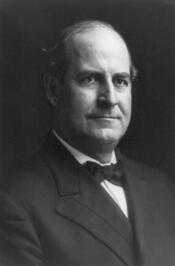
Here you will find contact information for Representative William Jennings Bryan, including email address, phone number, and mailing address.
| Name | William Jennings Bryan |
| Position | Representative |
| State | Nebraska |
| District | 1 |
| Party | Democratic |
| Status | Former Representative |
| Term Start | December 7, 1891 |
| Term End | March 3, 1895 |
| Terms Served | 2 |
| Born | March 19, 1860 |
| Gender | Male |
| Bioguide ID | B000995 |
About Representative William Jennings Bryan
William Jennings Bryan was born on March 19, 1860, in Salem, Marion County, Illinois, to Silas Lillard Bryan and Mariah Elizabeth (Jennings) Bryan. Of Scots-Irish and English ancestry, his father was an avid Jacksonian Democrat, an admirer of Andrew Jackson and Stephen A. Douglas, and a practicing lawyer who established his legal practice in Salem in 1851. Silas married Mariah, a former student at McKendree College, in 1852, and later won election as a state circuit judge. In 1866, he moved the family to a 520-acre farm north of Salem, where they lived in a ten-room house that was the envy of Marion County. William was the fourth child of Silas and Mariah, though his three older siblings died in infancy; he would have five younger siblings, four of whom survived to adulthood. Raised in a religious household—his father a Baptist and his mother a Methodist—Bryan was allowed to choose his own church, and at age 14 he experienced a religious conversion at a revival, which he later described as the most important day of his life. Demonstrating precocious talent for oratory, he was reported to have given public speeches as early as age four.
Bryan’s early education was largely overseen by his mother, who homeschooled him until he was 10 years old. At age 15, he was sent to Whipple Academy, a private preparatory school in Jacksonville, Illinois, where he began to refine the rhetorical and debating skills that would later make him nationally famous. He then enrolled at Illinois College in Jacksonville, where he served as chaplain of the Sigma Pi literary society and participated in numerous debates and oratorical contests. Bryan graduated from Illinois College at the top of his class in 1881. In 1879, while still a student, he met Mary Elizabeth Baird, the daughter of a local general store owner, and began a courtship that culminated in their marriage on October 1, 1884. Mary Elizabeth Bryan became an essential partner in his public life, managing his correspondence and assisting in the preparation of speeches and articles.
After college, Bryan studied law in Chicago at Union Law College (now Northwestern University School of Law), working under former U.S. Senator Lyman Trumbull, a friend of his father who became an important political ally until his death in 1896. Bryan received his Bachelor of Laws degree in 1883 and returned to Jacksonville, Illinois, to join a local law firm. Frustrated by limited economic and political opportunities there, he and his wife moved west in 1887 to Lincoln, Nebraska, the capital of a rapidly growing state. In Lincoln, Bryan established a successful legal practice with Adolphus Talbot, a Republican acquaintance from law school, and became active in Democratic politics, campaigning for figures such as Julius Sterling Morton and Grover Cleveland. His effective speeches during the 1888 campaign season brought him local prominence and laid the groundwork for his entry into elective office.
In the 1890 elections, Bryan ran for the United States House of Representatives from Nebraska. Campaigning on a platform that called for reduced tariff rates, the coinage of silver at parity with gold, and measures to curb the power of trusts, he defeated incumbent Republican William James Connell, who had run on a conventional Republican program centered on protective tariffs. Bryan’s victory made him only the second Democrat ever to represent Nebraska in Congress. Nationwide, Democrats gained 76 seats and secured a House majority, while the Populist Party—drawing agrarian support from the West—also won several seats. With the assistance of Representative William McKendree Springer, Bryan secured a coveted position on the House Ways and Means Committee, where he quickly earned a reputation as a talented orator and a serious student of economic policy. During this period, he aligned himself with the agrarian and reformist wing of the Democratic Party, advocating free coinage of silver (“free silver”) and a progressive federal income tax, positions that appealed to many reformers but alienated conservative “Bourbon Democrats,” including Morton and other Nebraska party leaders.
William Jennings Bryan served as a Representative from Nebraska in the United States Congress from March 4, 1891, to March 3, 1895, completing two terms in the House of Representatives. A member of the Democratic Party, he contributed actively to the legislative process during a significant period in American history marked by economic upheaval and intense debate over monetary policy. In the 1892 election, he sought re-election with strong support from Populists and notably backed Populist presidential candidate James B. Weaver over Democratic nominee Grover Cleveland. Bryan won his House race by just 140 votes, while Cleveland prevailed nationally over President Benjamin Harrison and Weaver. After Cleveland took office, the Panic of 1893 triggered widespread bank failures and economic distress. Cleveland convened a special session of Congress to repeal the Sherman Silver Purchase Act of 1890, which required the federal government to buy millions of ounces of silver each month. Bryan led the fight to preserve the act, but a coalition of Republicans and conservative Democrats secured its repeal. He did, however, succeed in attaching an amendment establishing the first peacetime federal income tax. As the depression deepened after 1893, Bryan’s reform agenda—shared with many Populists—gained broader popular support among farmers and workers. Rather than seek a third House term in 1894, he ran unsuccessfully for the U.S. Senate, losing to Republican John Mellen Thurston after Republicans captured the Nebraska legislature, but he emerged from the election pleased that the conservative Cleveland wing of the party had been discredited and that his preferred gubernatorial candidate, Silas A. Holcomb, had won with Democratic-Populist backing.
After leaving Congress in March 1895, Bryan became editor-in-chief of the Omaha World-Herald, while continuing to build his national profile through oratory and political organizing. Following the 1894 elections, he embarked on a nationwide speaking tour to promote free silver, distance the Democratic Party from the Cleveland administration’s conservative policies, attract Populists and free-silver Republicans, and elevate his own standing before the 1896 presidential contest. By 1896, free-silver forces dominated the Democratic Party, and at the Democratic National Convention in Chicago, Bryan emerged as the leading spokesman for inflationary silver policies and agrarian reform. On July 9, 1896, he delivered his famous “Cross of Gold” speech, denouncing the gold standard as “not only un-American but anti-American” and casting the monetary debate as a struggle for democracy and the welfare of the “common man.” The speech electrified the convention and, after several ballots, secured Bryan the Democratic presidential nomination on July 10, 1896, at age 36, making him the youngest major-party presidential nominee in U.S. history. He was also endorsed by the Populist Party, though conservative “Gold Democrats” bolted to back a separate ticket or tacitly supported Republican nominee William McKinley. In the ensuing campaign, Bryan pioneered the national stumping tour, delivering some 600 speeches to an estimated 5 million people in 27 states, but McKinley, aided by Mark Hanna’s well-financed “front porch” campaign, won the election with 51 percent of the popular vote and 271 electoral votes. Bryan would run again as the Democratic nominee in 1900 and 1908, losing to McKinley in 1900 and to William Howard Taft in 1908, and he remains, along with Henry Clay, one of the two men to receive electoral votes in three post–12th Amendment presidential elections without ever winning the presidency.
In the years surrounding his presidential campaigns, Bryan remained a central figure in national politics and in the evolving progressive movement. During the Spanish–American War in 1898, he raised and led the 3rd Nebraska Infantry Regiment as a colonel in the Nebraska National Guard, though the regiment saw no combat before the war ended. Bryan supported the war as a means to secure Cuban independence but opposed the subsequent annexation of the Philippines, which he viewed as American imperialism. He nonetheless urged ratification of the Treaty of Paris in 1898 to end the war quickly, intending to press for Philippine independence thereafter. By 1900, he made anti-imperialism the “paramount issue” of his second presidential campaign, arguing that the United States should be a moral exemplar rather than a colonial power. Although his influence within the Democratic Party waned after his 1900 defeat and the nomination of conservative Alton B. Parker in 1904, Bryan’s progressive ideas on regulation of corporations, income taxation, and democratic reforms gained increasing acceptance among voters of both parties, enabling him to regain stature and secure the Democratic nomination once more in 1908.
Bryan’s long public career culminated in his service as Secretary of State under President Woodrow Wilson from March 5, 1913, to June 9, 1915. Rewarded for his crucial support in the 1912 election, he played a significant role in helping Wilson advance progressive domestic reforms through Congress. In foreign affairs, Bryan favored arbitration treaties and a cautious, peace-oriented diplomacy. As World War I unfolded in Europe, he grew increasingly concerned that Wilson’s stance toward Germany was too confrontational. Following the sinking of the British liner RMS Lusitania by a German U-boat on May 7, 1915, Wilson sent a strongly worded note of protest to Germany, which Bryan believed carried an implicit threat of war. Unable to reconcile his pacifist principles with the administration’s policy, he resigned as Secretary of State on June 9, 1915. In his later years, Bryan remained an influential voice in the Democratic Party but devoted much of his energy to causes such as Prohibition, religious advocacy, and opposition to the teaching of evolution. He became the most prominent lay spokesman for anti-evolutionism, opposing Darwinism on religious and humanitarian grounds. In July 1925, he served as a volunteer prosecutor in the famous Scopes “Monkey” Trial in Dayton, Tennessee, which challenged a state law barring the teaching of evolution in public schools. William Jennings Bryan died in Dayton on July 26, 1925, just days after the trial concluded. Remembered as “the Great Commoner” for his faith in the wisdom of ordinary citizens and “the Boy Orator” for his extraordinary rhetorical gifts, he is widely regarded by historians as one of the most influential figures of the Progressive Era and a dominant force in American political life from the 1890s through the early 20th century.