Representative William Claflin
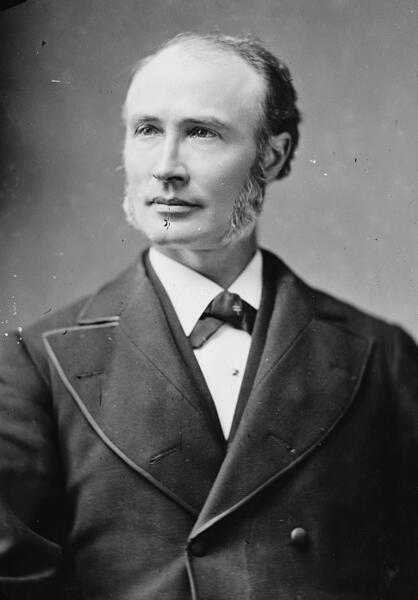
Here you will find contact information for Representative William Claflin, including email address, phone number, and mailing address.
| Name | William Claflin |
| Position | Representative |
| State | Massachusetts |
| District | 8 |
| Party | Republican |
| Status | Former Representative |
| Term Start | October 15, 1877 |
| Term End | March 3, 1881 |
| Terms Served | 2 |
| Born | March 6, 1818 |
| Gender | Male |
| Bioguide ID | C000398 |
About Representative William Claflin
William Claflin (March 6, 1818 – January 5, 1905) was an American politician, industrialist, and philanthropist from Massachusetts whose public career spanned the formative decades before, during, and after the Civil War. He was born in Milford, Massachusetts, to Lee and Sarah Watkins (Adams) Claflin. His father, a self‑made proprietor of a tannery and shoe factory in Milford, was a politically active abolitionist and a devout Methodist, influences that strongly shaped William’s later commitments to antislavery politics, social reform, and religious philanthropy. Claflin first attended local schools and then Milford Academy, absorbing both the commercial milieu of his father’s enterprise and the reformist currents that animated many New England Protestants of his generation.
In 1833 Claflin enrolled at Brown University in Providence, Rhode Island, but his studies were cut short by ill health and by the death of his mother in 1834. He left Brown and entered his father’s shoe and leather business, gaining practical experience in manufacturing and trade. After three years, with his health still fragile, he moved west to St. Louis, Missouri, where from 1838 to 1844 he worked in the wholesale leather goods business. This period broadened his commercial experience and perspective on the national economy. When his health improved, he returned to Massachusetts, rejoined the family enterprise, and settled in Hopkinton. There he entered into partnership with his father and Nathan Parker Coburn, helping to expand what became one of New England’s most significant boot and shoe concerns, with major facilities in Framingham, Hopkinton, and Milford. The firm ultimately built one of New England’s largest boot factories in South Framingham in 1882; Claflin remained in active partnership with Coburn until 1878, and the partnership was formally dissolved in 1891 when Coburn retired and younger partners assumed control of the company’s assets.
Claflin followed his father not only into business but also into politics and Methodism, emerging as an early and consistent opponent of slavery and a supporter of broad social reforms. In 1848 he helped found the Free Soil Party in Massachusetts, a coalition opposed to the expansion of slavery into the western territories. Under the Free Soil banner he won election to the Massachusetts House of Representatives, serving from 1849 to 1853. During this period he became associated with the “Bird Club,” a circle of reform‑minded, largely business‑oriented Republicans organized by Francis W. Bird, whose members would dominate much of Massachusetts politics between the 1850s and 1870s. Refusing to join the nativist Know Nothing movement that swept away older parties in the early 1850s, Claflin instead helped organize the new Republican Party in Massachusetts in 1854 and 1855 and served for a number of years as state party chairman. Elected to the Massachusetts Senate in 1859 as a Republican, he rose to become President of the Senate in 1861 and developed a close political alliance and friendship with fellow Free Soiler Henry Wilson, later vice president of the United States.
Claflin’s prominence in state politics led to higher executive office. In 1865 he was elected Lieutenant Governor of Massachusetts on the ticket headed by Governor Alexander Hamilton Bullock and was twice reelected to that post. In 1868 he was elected the 27th governor of Massachusetts, assuming office in January 1869, and he served three consecutive one‑year terms through 1872, defeating Democrat John Quincy Adams II in each election. As governor, Claflin became the first in the state’s history to actively and publicly support full women’s suffrage. He backed legislation extending to women greater rights in divorce and contract law and advocated broader property and voting rights for women. His administration also advanced significant institutional reforms: he promoted prison reform and oversaw the creation of a Board of Prison Commissioners; he supported the establishment of Massachusetts’ first state board of public health; and, in response to emerging labor issues and to retain support threatened by the nascent Labor Reform Party, he signed legislation creating the first state bureau of labor statistics in the nation. Claflin also took a firm stance on public finance, notably vetoing a state loan to the Boston, Hartford and Erie Railroad at a time when Massachusetts was otherwise extending financial support to major infrastructure projects such as the Hoosac Tunnel. This veto proved politically costly, contributing, along with labor defections, to the lowest margin of victory yet recorded for a Republican in a Massachusetts gubernatorial race in 1870. Perceived thereafter as a weakened candidate, Claflin declined to seek renomination in 1871 and did not attend the state Republican convention, which chose William B. Washburn, the eventual victor, marking the waning of the Bird Club’s unifying influence in state Republican politics.
Parallel to his state offices, Claflin played a significant role in national Republican politics. In 1864 he was appointed to the national executive committee of the Republican Party, where he acted as a mediating figure between radical and conservative factions. He supported the selection of Schuyler Colfax as Ulysses S. Grant’s running mate in the 1868 presidential election, reflecting his preference for moderate leadership. In 1868 he was elected chairman of the Republican National Committee, a position he held until the early 1870s. As national chairman he sought to balance the party’s Radical and moderate wings during Reconstruction. Although he reluctantly supported Grant’s reelection in 1872, he was displeased by the president’s decision to entrust federal patronage in Massachusetts to the controversial General Benjamin Butler. Claflin stepped back from the national chairmanship after his ally Henry Wilson was nominated for vice president in 1872, and he gradually refocused his energies on business, philanthropy, and, later, congressional service.
William Claflin served as a Representative from Massachusetts in the United States Congress from March 4, 1877, to March 3, 1881. A member of the Republican Party, he represented his Massachusetts constituency in the House of Representatives during two consecutive terms, participating in the legislative process at a critical juncture in American history as Reconstruction drew to a close and the nation entered the Gilded Age. In Congress he contributed to debates and policymaking consistent with his long‑standing commitments to Republican principles, social reform, and economic development, and he took part in the democratic process by representing and advancing the interests of his constituents in Massachusetts. His service in the House formed the capstone of a political career that had already included leadership in the state legislature, the governorship, and the national party organization.
Beyond elective office, Claflin was deeply engaged in philanthropy, higher education, and community development, much of it shaped by his Methodist faith. Along with his father, he provided funds to purchase land for the establishment of Claflin University in Orangeburg, South Carolina, a historically black Methodist institution founded in 1869 and named in honor of Lee Claflin. As governor, William Claflin supported higher education for women, signing the charters for Wellesley College and Mount Holyoke College, both women’s colleges in Massachusetts. Over the course of his life he served on the boards of trustees of several institutions, including Wellesley, Mount Holyoke, Wesleyan University, and Harvard University; both Wesleyan and Harvard conferred honorary degrees upon him. He was also a major force in the development of Newtonville, a village in Newton, Massachusetts. In 1854 he purchased a farm there that had once belonged to colonial governor Simon Bradstreet and to William Hull, governor of the Michigan Territory. Claflin moved Hull’s mansion to one side of the property, constructed a new residence on the original foundation, subdivided portions of the estate for residential and commercial development, and oversaw construction of the Claflin Block in Newtonville. After his death, the local civic improvement association acquired the remainder of his estate and donated it to the town; the land later became the site of the athletic fields for Newton North High School, and the Claflin School in Newtonville was named in his honor.
Claflin’s later years were devoted largely to his business interests and to philanthropic and religious work, particularly within the Methodist Church. Although he had withdrawn from active management of his shoe manufacturing partnership in 1878, he remained a respected figure in New England industry into the 1890s. He continued to support charitable causes, educational institutions, and civic improvements, and he maintained a prominent role in the social and religious life of Newton, where his country estate in Newtonville symbolized both his personal success and his commitment to community development. Claflin married twice: first, in 1839, to Nancy (Warren) Harding of Milford, with whom he had one daughter before Nancy’s death in 1842; and second, in 1845, to Mary Bucklin of Hopkinton, with whom he had five children, two of whom survived him. His son Adams Claflin became an important figure in the development of streetcar service in Newton, extending the family’s influence on the region’s urban growth. William Claflin died at his home in Newton, Massachusetts, on January 5, 1905, and was buried in Newton Cemetery, leaving a legacy as a leading Massachusetts industrialist, reform‑minded Republican, and benefactor of education and civic life.