Representative William Ruffin Cox
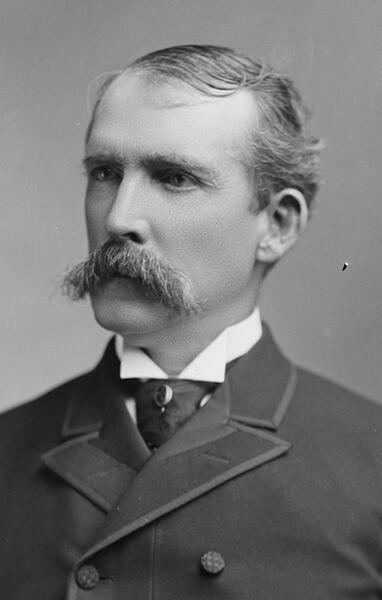
Here you will find contact information for Representative William Ruffin Cox, including email address, phone number, and mailing address.
| Name | William Ruffin Cox |
| Position | Representative |
| State | North Carolina |
| District | 4 |
| Party | Democratic |
| Status | Former Representative |
| Term Start | December 5, 1881 |
| Term End | March 3, 1887 |
| Terms Served | 3 |
| Born | March 11, 1831 |
| Gender | Male |
| Bioguide ID | C000841 |
About Representative William Ruffin Cox
William Ruffin Cox (March 11, 1831/1832 – December 26, 1919) was an American soldier, jurist, and politician from North Carolina whose public career spanned the Civil War, Reconstruction, and the Gilded Age. Born in Scotland Neck, Halifax County, North Carolina, into an aristocratic family long established in the state since colonial times, he spent his early years in eastern North Carolina. Following the death of his father, his mother moved the family to Nashville, Tennessee, where Cox was raised and continued his education, an experience that exposed him to both North Carolina and Tennessee political and social life in the antebellum South.
Cox attended Vine Hill Academy in Halifax County before relocating to Tennessee, where he graduated from Tolbert Fanning’s Franklin College in Franklin, Tennessee. He then studied law at Cumberland University, also in Tennessee, and, after passing the bar examination, entered into a successful legal partnership with a prominent Nashville attorney. In 1857 he ended his flourishing practice, married, and returned to North Carolina, purchasing and operating a plantation in Edgecombe County. Two years later, in 1859, he moved to Raleigh and entered politics as a Democrat, running for the state legislature. He was narrowly defeated in a hard-fought contest, losing the election in his district by just thirteen votes, but the campaign marked his emergence as a public figure in North Carolina.
With North Carolina’s secession and the outbreak of the Civil War in early 1861, Cox turned from law and politics to military service in the Confederate cause. He first raised and outfitted the “Ellis Artillery Company,” and soon afterward organized an infantry company. Governor John W. Ellis appointed him major of the 2nd North Carolina Infantry Regiment. Cox fought at the Battle of Antietam on September 17, 1862, where the regiment’s first colonel, Charles C. Tew, was killed; Cox and the then–lieutenant colonel were both promoted, with Cox becoming lieutenant colonel. After the new colonel resigned, Cox assumed command of the veteran regiment and was formally commissioned colonel of the 2nd North Carolina in March 1863. He was severely engaged at the Battle of Chancellorsville in May 1863, where he was wounded three times but remained in command until exhaustion forced his removal to a field hospital.
Because of his Chancellorsville wounds, Cox missed the Gettysburg Campaign and did not return to the field until the fall of 1863. While temporarily commanding Ramseur’s Brigade during General Stephen D. Ramseur’s leave for marriage, Cox was wounded in the face and right shoulder at the Battle of Kelly’s Ford on November 7, 1863, and was sent to a Richmond hospital, receiving a forty-day furlough to recuperate. Returning to duty, he fought with distinction in the Overland Campaign, particularly at the Battles of the Wilderness and Spotsylvania Court House in May 1864, where he was personally commended by General Robert E. Lee for his bravery on May 12. Despite being junior in rank to other colonels, he was assigned command of a brigade of North Carolina infantry. Cox led his brigade at the Battle of Cold Harbor in June 1864 and then accompanied Major General Jubal A. Early’s Army of the Valley in the Shenandoah Valley, where his brigade played a prominent role in the day-long fighting at the Battle of Monocacy on July 9, 1864. Returning to the Army of Northern Virginia, he served in the trench defenses during the Siege of Petersburg, including the Confederate counterattack on Fort Stedman on March 25, 1865. Promoted to brigadier general during the final year of the war, he commanded a brigade through the Appomattox Campaign and ultimately surrendered his men at Appomattox Court House, Virginia, in April 1865, having survived a total of eleven wounds over the course of the conflict.
After the war, Cox returned to Raleigh, North Carolina, where he resumed his legal practice and entered business as President of the Chatham Railroad. He served for six years as solicitor (prosecuting attorney) for metropolitan Raleigh, reinforcing his reputation as a capable lawyer and public official. From 1874 through 1877 he was chairman of the North Carolina Democratic Party, playing a key role in rebuilding Democratic strength in the state during the post-Reconstruction era. In January 1877 he was appointed Circuit Superior Court Judge of the Sixth Judicial District of North Carolina, a position he held until his election to the United States Congress. During this period he also endured personal loss with the death of his wife in 1880.
Cox entered national politics when he resigned his judgeship after being elected as a Democrat to the United States House of Representatives. He served as a Representative from North Carolina from March 4, 1881, to March 3, 1887, encompassing three consecutive terms in the Forty-seventh, Forty-eighth, and Forty-ninth Congresses. A member of the Democratic Party, William Ruffin Cox contributed to the legislative process during these six years in office. His service in Congress occurred during a significant period in American history marked by debates over civil service reform, economic policy, and the lingering effects of Reconstruction. As a member of the House of Representatives, he participated in the democratic process and represented the interests of his North Carolina constituents. In the House, he notably championed civil service reform, a position that placed him at odds with some prominent members of his own party and ultimately contributed to his failure to secure the Democratic nomination for re-election in 1886.
Following his departure from Congress in 1887, Cox remarried and retired for a time to his plantation in Edgecombe County, North Carolina. His retirement was interrupted in 1893 when he was appointed Secretary of the United States Senate, succeeding former Union Army general Anson G. McCook. In this influential administrative post, he oversaw the Senate’s clerical and record-keeping functions from 1893 until 1900, serving through a period of expanding federal activity at the close of the nineteenth century. At the turn of the century, he retired once more, this time permanently, returning again to his Edgecombe County plantation.
William Ruffin Cox died on December 26, 1919, and was buried in Historic Oakwood Cemetery in Raleigh, North Carolina. At the time of his death he was regarded as one of the last surviving generals of the Confederate Army, linking the living memory of the Civil War to the modern era of the early twentieth century. His legacy was later commemorated during World War II, when several United States Liberty ships—SS William R. Cox (launched November 1943), another William R. Cox (December 1943), and William Cox—were named in his honor.