Representative William Dorsheimer
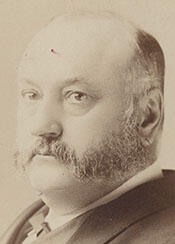
Here you will find contact information for Representative William Dorsheimer, including email address, phone number, and mailing address.
| Name | William Dorsheimer |
| Position | Representative |
| State | New York |
| District | 7 |
| Party | Democratic |
| Status | Former Representative |
| Term Start | December 3, 1883 |
| Term End | March 3, 1885 |
| Terms Served | 1 |
| Born | February 5, 1832 |
| Gender | Male |
| Bioguide ID | D000442 |
About Representative William Dorsheimer
William Dorsheimer (February 5, 1832 – March 26, 1888) was an American lawyer, journalist, newspaper publisher, and politician who served as a Representative from New York in the United States Congress from 1883 to 1885. He was born on February 5, 1832, in Lyons, Wayne County, New York, the son of Sarah Gorgas and Philip Dorsheimer (1797–1868), who later served as New York State Treasurer. Raised in New York, he was educated in the common schools before advancing to more formal preparatory study.
Dorsheimer continued his education at Phillips Academy and then enrolled at Harvard College, where he studied from 1849 to 1851. His time at Harvard was cut short when a protracted illness forced him to leave without taking a degree. In recognition of his later accomplishments, Harvard awarded him an honorary Master of Arts degree in 1859. After leaving Harvard, he settled in Buffalo, New York, where he studied law and was admitted to the bar in 1854, beginning a legal career that would underpin his subsequent public service.
By 1859, Dorsheimer had formed a law partnership with Solomon G. Haven in Buffalo. His political affiliations evolved over time: he began as a Democrat, joined the Republican Party in 1856, and supported the Republican ticket again in 1860. With the outbreak of the Civil War, he entered military service in 1861 as an aide-de-camp with the rank of major on the staff of General John C. Frémont. After the close of the Missouri campaign, he returned to civilian life and drew on his wartime experience to publish a series of articles in the Atlantic Monthly titled “Frémont’s Hundred Days in Missouri.” From 1867 to 1871, he served, as a Republican, as United States Attorney for the Northern District of New York. He was a delegate to the Liberal Republican National Convention at Cincinnati, Ohio, in 1872, and thereafter rejoined the Democratic Party. As a Democrat, he was elected Lieutenant Governor of New York and served from 1875 to 1879, during which time he helped implement measures against the so‑called Canal Ring. He was also a delegate to the 1876 Democratic National Convention and later resumed the practice of law in New York City in partnership with the prominent attorney David Dudley Field.
Dorsheimer’s congressional career came during a significant period in American history, as the nation continued to grapple with the political and economic consequences of the Civil War and Reconstruction. A member of the Democratic Party at this stage of his life, he was elected as a Democrat to the 48th United States Congress and represented New York in the U.S. House of Representatives from March 4, 1883, to March 3, 1885. During his single term in office, he participated in the legislative process, contributed to debates in the House, and represented the interests of his New York constituents, thereby taking part in the broader democratic process of the era.
Beyond Congress, Dorsheimer remained active in law, journalism, and public affairs. In 1884, he published a campaign biography of Grover Cleveland, then the Democratic candidate for the presidency, reflecting his continued engagement with national politics and the Democratic Party. In July 1885, President Grover Cleveland appointed him United States Attorney for the Southern District of New York, a post he held until his resignation in March 1886. Also in 1885, he purchased the New York Star and began its publication as a daily newspaper on September 15, expanding his influence into journalism and newspaper publishing. In Buffalo, he was one of the founders of the Buffalo Fine Arts Academy and the Buffalo Historical Society, contributing to the city’s cultural and historical institutions.
Dorsheimer also played a notable role in American architecture and urban design. In Buffalo, he commissioned the prominent American architect Henry Hobson Richardson to design a residence for him on Delaware Avenue, a structure now known as the William Dorsheimer House, which still stands and was listed on the National Register of Historic Places in 1980. He helped Richardson secure the commission to design the New York State Asylum in Buffalo, and he was chiefly responsible for bringing landscape architect Frederick Law Olmsted to Buffalo to design its park system, thereby shaping the city’s built and natural environment in lasting ways.
In his personal life, Dorsheimer suffered the loss of his only daughter, who died in 1874. On March 26, 1888, he died in Savannah, Chatham County, Georgia, while traveling by train to Florida with his wife. William Dorsheimer was interred at Forest Lawn Cemetery in Buffalo, New York. His career as a lawyer, public official, legislator, and patron of the arts and urban planning left a multifaceted legacy in both state and national history.