Representative William Elliott
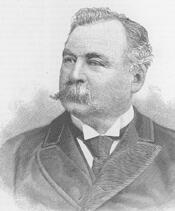
Here you will find contact information for Representative William Elliott, including email address, phone number, and mailing address.
| Name | William Elliott |
| Position | Representative |
| State | South Carolina |
| District | 1 |
| Party | Democratic |
| Status | Former Representative |
| Term Start | December 5, 1887 |
| Term End | March 3, 1903 |
| Terms Served | 7 |
| Born | September 3, 1838 |
| Gender | Male |
| Bioguide ID | E000129 |
About Representative William Elliott
William Elliott, a Democratic politician from South Carolina, was born on September 3, 1838, in Beaufort, Beaufort County, South Carolina. He was a member of a prominent Lowcountry family and grew up in a region deeply shaped by the antebellum plantation economy and coastal commerce. His early years were spent in an environment where public affairs, agriculture, and local leadership were closely intertwined, experiences that would later inform his political outlook and his long service as a public representative of his state.
Elliott received his early education in local schools before pursuing higher studies at Harvard University in Cambridge, Massachusetts. He graduated from Harvard in 1859. His education in the North, on the eve of the Civil War, exposed him to a broad range of political and intellectual currents, contrasting sharply with the sectional tensions then intensifying between North and South. After completing his degree, he returned to South Carolina, where he studied law. He was admitted to the bar and began the practice of law in his native Beaufort, establishing himself professionally just as the nation descended into conflict.
During the Civil War, Elliott served in the Confederate States Army, aligning with his home state after its secession from the Union. Following the war and the upheavals of Reconstruction, he resumed his legal practice in Beaufort and became increasingly active in public life. He entered state politics as a member of the South Carolina House of Representatives, serving from 1865 to 1866, and later served in the South Carolina Senate from 1877 to 1882. In these roles, he participated in the complex and often contentious process of rebuilding state government and public institutions in the postwar era, representing the interests of his coastal constituency during a period of political realignment and economic adjustment.
Elliott’s national political career began when he was elected as a Democrat to the Fiftieth Congress. He served as a Representative from South Carolina in the United States House of Representatives from March 4, 1887, to March 3, 1893, and again from March 4, 1899, to March 3, 1903, for a total of seven terms in office. His service in Congress thus extended over a significant period in American history, spanning the late Gilded Age and the early stirrings of the Progressive Era. As a member of the House of Representatives, William Elliott contributed to the legislative process and participated in the democratic governance of the nation, representing the interests of his South Carolina constituents in debates over economic policy, regional development, and federal authority. Throughout his tenure, he was aligned with the Democratic Party, which at that time was the dominant political force in the South and was deeply engaged in questions of states’ rights, agricultural policy, and the evolving relationship between the federal government and the states.
Elliott’s congressional service was marked by his role as a steady representative of a coastal, largely rural district during a time of rapid industrialization and social change in the United States. While not nationally prominent as a legislative leader, he was part of the Democratic contingent that shaped the House’s response to issues such as tariffs, currency, and internal improvements, and he consistently sought to reflect the priorities and concerns of South Carolina voters. His repeated elections to Congress over multiple nonconsecutive terms testified to the confidence his constituents placed in his judgment and advocacy.
After concluding his final term in Congress on March 3, 1903, Elliott returned to South Carolina and resumed the practice of law in Beaufort. In his later years, he remained a respected figure in state and local affairs, embodying a generation of Southern politicians whose careers bridged the antebellum, Civil War, Reconstruction, and post-Reconstruction eras. William Elliott died on December 7, 1907, in Beaufort, South Carolina. He was interred in St. Helena’s Churchyard in Beaufort, leaving behind a record of long public service at both the state and national levels, and a legacy as a South Carolinian who represented his community in the United States Congress during a transformative period in American history.