Representative Bill Frenzel
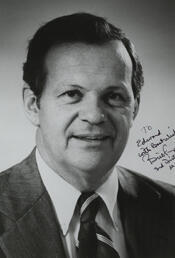
Here you will find contact information for Representative Bill Frenzel, including email address, phone number, and mailing address.
| Name | Bill Frenzel |
| Position | Representative |
| State | Minnesota |
| District | 3 |
| Party | Republican |
| Status | Former Representative |
| Term Start | January 21, 1971 |
| Term End | January 3, 1991 |
| Terms Served | 10 |
| Born | July 31, 1928 |
| Gender | Male |
| Bioguide ID | F000380 |
About Representative Bill Frenzel
William Eldridge Frenzel (July 31, 1928 – November 17, 2014) was an American politician and businessman who represented Minnesota’s 3rd congressional district in the United States House of Representatives from 1971 to 1991. A member of the Republican Party, he served ten consecutive terms in Congress and became known as a key moderate Republican within the post–World War II GOP. Before his election to the U.S. House, Frenzel built a career in business and public affairs that informed his later work on economic and budgetary issues at both the state and federal levels.
Frenzel was born on July 31, 1928, and came of age during the Great Depression and World War II, experiences that shaped his views on government, economic stability, and public service. He pursued higher education in the years following the war, entering adulthood in an era marked by rapid economic growth and evolving national institutions. His early professional life was rooted in business, and he developed a reputation as a pragmatic, fiscally minded executive. This background in the private sector provided him with practical experience in management and finance that he later brought to his legislative work.
By the early 1960s, Frenzel had entered elective office at the state level. He served in the Minnesota House of Representatives from 1963 to 1971, representing his constituents during a period of significant social and economic change in both Minnesota and the nation. In the state legislature he gained experience in lawmaking, budget questions, and the day-to-day work of representing a diverse constituency. His performance in St. Paul helped establish him as a rising Republican figure with a reputation for moderation, attention to detail, and a willingness to engage in complex policy issues.
In 1970, Frenzel was elected to the United States House of Representatives from Minnesota’s 3rd congressional district, taking office in January 1971. He would hold this seat for twenty years, serving until January 1991. During his ten terms in Congress, he participated actively in the legislative process and represented the interests of his suburban Minneapolis–area constituents through periods that included the end of the Vietnam War, the Watergate crisis, the economic turbulence of the 1970s, and the conservative ascendancy of the 1980s. As a member of the House of Representatives, William Eldridge Frenzel contributed to the democratic process and took part in debates over federal spending, taxation, trade, and the proper scope of the federal government.
Frenzel became particularly associated with fiscal and economic policy, and he was widely regarded as a thoughtful voice on budgetary matters. His business background and methodical approach to legislation made him a respected figure in committee work and in negotiations that required detailed understanding of complex financial issues. Historian Geoffrey Kabaservice later identified Frenzel as a key moderate Republican within the post-war GOP, reflecting his inclination toward centrist, pragmatic solutions rather than ideological extremes. He was known for valuing institutional stability and the constitutional system of checks and balances, and he articulated a distinctive defense of legislative gridlock as a safeguard against abrupt policy swings.
Reflecting his constitutional outlook, Frenzel argued that the separation of powers and competition among branches and levels of government served to protect a centrist form of governance. He observed that “gridlock is the natural gift the Framers of the Constitution gave us so that the country would not be subjected to policy swings resulting from the whimsy of the public,” and he welcomed the fact that the United States did not “have a government that nationalizes one year and privatizes next year, and so on ad infinitum.” This perspective informed his approach to lawmaking, in which he often emphasized incremental change, bipartisan cooperation, and the long-term stability of national policy.
After leaving Congress in 1991, Frenzel remained active in public life and policy circles. He continued to be consulted on budget and ethics matters and lent his experience to institutional efforts to strengthen congressional accountability. His career and papers, including materials from his years in both the Minnesota House of Representatives and the U.S. House of Representatives, were preserved for research use at the Minnesota Historical Society, reflecting his significance in Minnesota and national political history. He also appeared on C-SPAN and was profiled in official congressional records, including the Biographical Directory of the United States Congress, and was later associated with the Office of Congressional Ethics, underscoring his ongoing engagement with issues of legislative conduct and institutional integrity.
William Eldridge Frenzel died on November 17, 2014. His long tenure in public office, spanning from his service in the Minnesota House of Representatives beginning in 1963 through his ten terms in the U.S. House ending in 1991, left a record of sustained engagement with fiscal policy, institutional reform, and the responsibilities of representative government. His career has been remembered as emblematic of a moderate, policy-focused Republican tradition that played a significant role in the governance of the United States in the latter half of the twentieth century.