Senator William Branch Giles
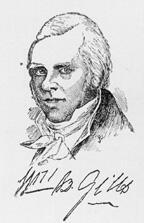
Here you will find contact information for Senator William Branch Giles, including email address, phone number, and mailing address.
| Name | William Branch Giles |
| Position | Senator |
| State | Virginia |
| Party | Republican |
| Status | Former Representative |
| Term Start | December 7, 1790 |
| Term End | March 3, 1815 |
| Terms Served | 10 |
| Born | August 12, 1762 |
| Gender | Male |
| Bioguide ID | G000183 |
About Senator William Branch Giles
William Branch Giles (August 12, 1762 – December 4, 1830) was an American politician, long-term Senator from Virginia, and the 24th Governor of Virginia. A leading figure in the Jeffersonian Republican movement, he served in the United States House of Representatives from 1790 to 1798 and again from 1801 to 1803, in the United States Senate from 1804 to 1815, and later as Governor of Virginia from March 4, 1827, to March 4, 1830. Over the course of a public career spanning four decades, he was a prominent critic of Federalist policies and later of the nationalist economic program associated with Henry Clay and John Quincy Adams.
Giles was born in Amelia County, Virginia, where he also died and where he built his longtime residence, an 18-room house known as “The Wigwam.” He attended Prince Edward Academy, now Hampden–Sydney College, and then the College of New Jersey, now Princeton University. He probably followed the noted Presbyterian educator Samuel Stanhope Smith, who left Prince Edward Academy to become president of the College of New Jersey in 1779. After completing his collegiate studies, Giles read law under Chancellor George Wythe and pursued further legal study at the College of William and Mary. He was admitted to the bar in 1786 and began practicing law in Virginia. During the debates over ratification of the United States Constitution in 1788, Giles supported the new federal charter, although he was not himself a member of the Virginia ratifying convention.
Giles entered national politics when he was elected to the United States House of Representatives in a special election in 1790 to fill the vacancy caused by the death of Representative Theodorick Bland on June 1 of that year. He is believed to have been the first member of the United States Congress elected in a special election. A member of the Republican (Democratic-Republican) Party, he was re-elected three times and served continuously until his resignation on October 2, 1798, which he attributed both to ill health and to his disgust with the Alien and Sedition Acts. During this first period in Congress, Giles became a fervent supporter of fellow Virginians James Madison and Thomas Jefferson in their opposition to Alexander Hamilton’s financial program, particularly the establishment of a national bank. Favoring Jefferson’s vision of an agrarian republic, he worked closely with Jefferson and Madison and in 1793 introduced three sets of resolutions in the House of Representatives that sought to censure Hamilton’s “administration of finances” under the Funding Act of 1790. These resolutions effectively accused Hamilton of maladministration in office and were tied to efforts to compel the United States to honor debts to France following the French Revolution. Giles opposed the pro-British Jay’s Treaty, resisted naval appropriations intended for use against France during the Quasi-War, and, after returning to state politics, voted in the Virginia House of Delegates for the Kentucky and Virginia Resolutions declaring the Alien and Sedition Acts unconstitutional.
Between his House terms, Giles served in the Virginia House of Delegates and was chosen as a presidential elector in 1800, casting his vote for Thomas Jefferson and Aaron Burr. He returned to the U.S. House of Representatives for another term from 1801 to 1803. In 1804, following the resignation of Senator Wilson Cary Nicholas, Giles was appointed to the United States Senate from Virginia. He served in the Senate from 1804 and was reappointed in 1810, remaining in office until his resignation on March 3, 1815. His service in Congress thus extended over a significant period in early American history, and as a member of the Senate he participated actively in the legislative process and represented the interests of his Virginia constituents during ten terms in national office when his House and Senate service are combined. In the Senate, Giles strongly advocated the removal of Supreme Court Justice Samuel Chase after Chase’s impeachment, urging that the Senate treat the matter as a political question—whether the people could continue to repose confidence in Chase—rather than as a narrow legal trial. Deeply disappointed by Chase’s acquittal, Giles nonetheless remained a central Republican figure, supporting James Madison’s election to the presidency in 1808 over Federalist candidate Charles Cotesworth Pinckney and serving as Madison’s chief advocate in Virginia.
Giles’s relationship with the Madison administration soon became strained. After 1808 he joined with Senator Samuel Smith of Maryland and Smith’s brother, Secretary of State Robert Smith, in criticizing Madison—first for being, in their view, too weak in confronting Britain, and then, by 1812, for moving too precipitately toward war. Despite these criticisms, Giles ultimately voted for the declaration of war against Britain in 1812. He also developed a strong dislike for Secretary of the Treasury Albert Gallatin, whom he blamed for blocking his own prospects for appointment as Secretary of State and whose 1811 bill to charter a new Bank of the United States he helped to defeat. Giles’s refusal to comply with instructions issued by the Virginia General Assembly to its senators contributed to his rejection by the legislature when he next came up for re-election to the Senate, at a time when state legislatures still chose U.S. senators. After leaving the Senate in 1815, he served a relatively uneventful term in the Virginia House of Delegates in 1816–1817 and then withdrew from public office for several years.
During his period out of office, Giles remained an influential voice in Virginia and national politics through his prolific writing. He published opinion pieces and columns, chiefly in the Richmond Enquirer, in which he denounced what became known as the Era of Good Feelings as a period of false prosperity built on banks, protective tariffs, and internal improvements that he regarded as fraudulent and corrupting. He argued that such measures would centralize power, corrupt government, and ultimately ruin the agrarian interests of farmers. Extending his long-standing hostility to Hamiltonian-style finance, he attacked John Quincy Adams and Henry Clay as corrupt Anglophiles and opponents of true republican principles. Giles also published a pointed criticism of Thomas Jefferson’s proposed system of public education in Virginia, contending that it was unjust to tax one man to educate another man’s children and warning that publicly employed teachers would form a self-interested class inclined to support higher taxes and expanded government spending. He argued further that providing three years of schooling to every boy in Virginia would have limited practical benefit, would deprive farm families of much-needed labor, and would leave many students ill-prepared to return to the hard physical work that awaited them.
With the presidential election of 1824, Giles emerged as a vocal opponent of John Quincy Adams and Henry Clay, aligning himself with southern critics of their nationalist economic program. In 1825, when James Barbour vacated his seat in the United States Senate, Giles sought appointment by the Virginia legislature but was passed over in favor of John Randolph of Roanoke. He returned to elective office in 1826 when he was again chosen to the Virginia House of Delegates. The following year, in 1827, he was elected Governor of Virginia and served three consecutive one-year terms, from March 4, 1827, to March 4, 1830. As governor, Giles encouraged Virginia Senator Littleton Waller Tazewell to organize a southern resistance to Henry Clay’s American System, centered on a boycott of northern manufactures, although Tazewell found little support among other southern senators for such a coordinated effort.
In his final years in public life, Giles played a significant role in the Virginia Constitutional Convention of 1829–1830, to which he was elected while still serving as governor. At the convention he strongly supported the existing apportionment of the Virginia House of Delegates, which gave the eastern, slaveholding counties control of the legislature despite their having a minority of the state’s voters. He did, however, favor some reform of suffrage requirements. Giles also opposed proposals to strengthen the office of governor, including his own, arguing that powerful executive offices in other states, such as New York, had become centers of political machines sustained by patronage and corruption. He maintained that Virginia had been spared such abuses precisely because its governorship was relatively weak and closely accountable to the General Assembly, and he urged retention of the executive model associated with George Mason. Although the convention left the governor’s term short and the office still answerable to the legislature, it did abolish the privy council, thereby making the governorship somewhat more independent than Giles preferred.
Giles’s personal life was closely tied to his Amelia County estate. In 1797 he married Martha Peyton Tabb, for whom he built The Wigwam; they had three children before her death in 1808. In 1810 he married Frances Ann Gwynn, with whom he had three additional children. Giles remained at The Wigwam during his later years, continuing to write and to correspond on political matters. He died in Amelia County on December 4, 1830, the same year in which his gubernatorial successor, John Floyd, took office. His home, The Wigwam, was later recognized for its historical significance and was added to the National Register of Historic Places in 1969. In honor of his long public service, counties in two states—Giles County, Virginia, and Giles County, Tennessee—were named for him, and a residence hall at the College of William and Mary bears his name. His historical reputation has been mixed: some contemporaries and later commentators, such as Frederick Scott Oliver, criticized his combative style and alleged disregard for accuracy, while others, including Joseph Story and later historian Claude Bowers, emphasized his intellectual force, rhetorical power, and the respect he commanded from figures such as Patrick Henry and John Randolph of Roanoke.