Representative William Thomas Granahan
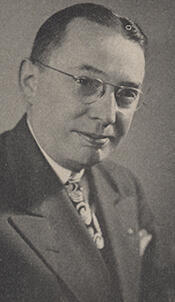
Here you will find contact information for Representative William Thomas Granahan, including email address, phone number, and mailing address.
| Name | William Thomas Granahan |
| Position | Representative |
| State | Pennsylvania |
| District | 2 |
| Party | Democratic |
| Status | Former Representative |
| Term Start | January 3, 1945 |
| Term End | January 3, 1957 |
| Terms Served | 5 |
| Born | July 26, 1895 |
| Gender | Male |
| Bioguide ID | G000369 |
About Representative William Thomas Granahan
William Thomas Granahan (July 26, 1895 – May 25, 1956) was a Democratic politician from the U.S. state of Pennsylvania who served as a Representative from Pennsylvania in the United States Congress from 1945 to 1947 and from 1949 to 1956. Over the course of five terms in office, he contributed to the legislative process during a significant period in American history, participating in the democratic process and representing the interests of his constituents as a member of the House of Representatives.
Granahan was born on July 26, 1895, in Philadelphia, Pennsylvania. All four of his grandparents were Irish immigrants, and he was raised in a community shaped by the experiences and traditions of the Irish American population in Philadelphia. He attended local parochial schools, receiving a religiously oriented primary and secondary education that reflected the city’s strong Catholic institutional presence. Seeking further training while working, he later studied through La Salle Extension University in Chicago, Illinois, an institution that specialized in correspondence and extension courses for working adults.
During World War I, Granahan served in the United States Army as a private. He was assigned to the Army of Occupation in Germany following the end of hostilities, an experience that exposed him to postwar European conditions and the responsibilities of American forces abroad. After returning to civilian life, he entered the building business, working in construction and related enterprises. This postwar career in the private sector provided him with practical experience in business and urban development in Philadelphia during a period of growth and change.
Granahan’s involvement in Democratic Party politics began in the late 1930s. He emerged as an active party figure in Pennsylvania, serving as a member of the state Democratic committee from 1938 to 1942. His work within the party organization coincided with the New Deal era, as Democrats consolidated influence in state and local government. In 1940, he entered state government service as the state supervisor of the inheritance tax, a position that placed him in the administrative structure of Pennsylvania’s revenue system. The following year, in 1941, he advanced to become chief disbursing officer of the state treasury, overseeing the distribution of state funds and gaining further experience in public finance and administration.
Building on his party and governmental experience, Granahan was elected to the U.S. House of Representatives as a Democrat in the 1944 elections. He took his seat in the 79th Congress and served from 1945 to 1947, representing his Pennsylvania district during the closing months of World War II and the beginning of the postwar era. In the 1946 election, he was defeated in his bid for reelection by Republican Robert N. McGarvey, temporarily interrupting his congressional career. Nevertheless, Granahan remained a prominent Democratic figure in his district and successfully reclaimed the seat from McGarvey in the 1948 election.
Granahan returned to Congress in 1949 and went on to serve four additional consecutive terms, remaining in the House of Representatives from 1949 until his death in 1956. His service thus spanned the 81st through the 84th Congresses, a period marked by the early Cold War, domestic economic adjustment, and evolving federal social and fiscal policies. As a member of the Democratic Party, he participated in debates and legislation affecting both national and local interests, contributing to the work of Congress on behalf of his Pennsylvania constituents during a transformative era in American political and economic life.
William Thomas Granahan died in office on May 25, 1956, at Fitzgerald Mercy Hospital in Darby, Pennsylvania, following a heart seizure that occurred after minor abdominal surgery. His death brought an end to more than a decade of intermittent but influential service in the U.S. House of Representatives. He was succeeded in Congress by his wife, Kathryn E. Granahan, who won election to complete his unfinished term, thereby continuing the family’s representation of their Pennsylvania district in the national legislature.