Senator William Thomas Hamilton
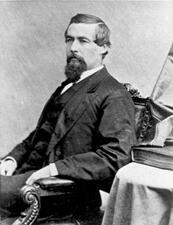
Here you will find contact information for Senator William Thomas Hamilton, including email address, phone number, and mailing address.
| Name | William Thomas Hamilton |
| Position | Senator |
| State | Maryland |
| Party | Democratic |
| Status | Former Representative |
| Term Start | December 3, 1849 |
| Term End | March 3, 1875 |
| Terms Served | 4 |
| Born | September 8, 1820 |
| Gender | Male |
| Bioguide ID | H000118 |
About Senator William Thomas Hamilton
William Thomas Hamilton (September 8, 1820 – October 26, 1888), a member of the United States Democratic Party, was the 38th Governor of Maryland from 1880 to 1884. He also served in the United States Senate, representing the State of Maryland from 1868 to 1874, and in the United States House of Representatives, representing Maryland’s second district from 1849 to 1853 and fourth district from 1853 to 1855. In total, William Thomas Hamilton served in the United States Congress from 1849 to 1875, during which, as a Democratic member of Congress, he contributed to the legislative process over four terms in office and participated in the democratic process during a significant period in American history.
Hamilton was born in Boonsboro, Washington County, Maryland, on September 8, 1820. He received his early education from a local tutor, John Brown, and later attended Hagerstown Academy in nearby Hagerstown, Maryland. In 1836 he entered Jefferson College in Canonsburg, Pennsylvania, where he studied from 1836 to 1840. After completing his collegiate studies, Hamilton read law under former Maryland Congressman John Thomson Mason Jr. He was admitted to the bar in 1845 and commenced the practice of law in Hagerstown. During this period he also engaged in farming in Western Maryland. Hamilton was a slaveholder; he owned enslaved people and maintained slave quarters at his home in Hagerstown.
Hamilton’s formal political career began in the Maryland House of Delegates, to which he was elected in 1846. He failed to win reelection in 1847 but soon moved onto the national stage. A Democrat, he was elected to the Thirty-first, Thirty-second, and Thirty-third Congresses, serving in the U.S. House of Representatives from March 4, 1849, to March 3, 1855. During this time he represented Maryland’s second congressional district from 1849 to 1853 and the fourth district from 1853 to 1855. Although his constituency was heavily composed of manufacturers and miners, Hamilton supported tariffs only as a means of raising revenue for the federal government rather than as a broad protectionist measure. In the Thirty-third Congress he served as chairman of the Committee on the District of Columbia, giving him a role in legislation affecting the federal capital.
After leaving the House in 1855, Hamilton withdrew from active politics for more than a decade. From 1855 until 1868 he resumed the practice of law and devoted himself to farming in Hagerstown and the surrounding region. During these years he became widely known throughout Western Maryland as an accomplished trial lawyer, building a substantial legal reputation while remaining outside elective office. His congressional service and subsequent legal career unfolded against the backdrop of mounting sectional tensions and the Civil War, though he did not hold public office during the conflict itself.
Following this extended absence from public life, Hamilton returned to national politics when he was elected by the Maryland General Assembly as a Democrat to the United States Senate. He served in the Senate from March 4, 1869, to March 3, 1875, representing Maryland during the Reconstruction era. In the Senate he was a strong advocate of restoring what he regarded as southern sovereignty after the Civil War and opposed key elements of Radical Reconstruction. Reflecting these views, he voted against the Fifteenth Amendment to the United States Constitution, which granted voting rights to men regardless of race. His Senate tenure thus placed him at the center of postwar debates over federal authority, civil rights, and the political reintegration of the former Confederate states.
During his years in the Senate, Hamilton remained active in Maryland state politics. In 1871 he endorsed fellow Democrat William Pinkney Whyte in the Maryland gubernatorial campaign, a decision he later regretted after becoming dissatisfied with Whyte’s actions as governor. As his own Senate term neared its end, Hamilton’s relationship with the state Democratic organization deteriorated. In 1874 the Maryland Democratic Party abandoned him during the nomination process for his Senate seat, and he was not considered for reelection. Instead, he sought the Democratic nomination for governor in 1875 but lost to John Lee Carroll, another prominent Democrat. These reversals marked a temporary setback in his political ambitions and led him once again to step back from public office.
After failing to secure the gubernatorial nomination in 1875, Hamilton returned to his legal and agricultural pursuits in Western Maryland but did not relinquish his interest in state leadership. Over the next several years he persistently sought the Democratic nomination for governor. His efforts were ultimately successful in 1879, when he secured the party’s nomination. In the general election he faced Republican James Albert Gary, a future U.S. Postmaster General, and defeated him by more than 22,000 votes. Hamilton took office as the 38th Governor of Maryland in 1880, bringing to the executive branch decades of legislative and legal experience.
As governor, Hamilton frequently clashed with the Maryland General Assembly, which he believed was neglecting the state’s economic interests and tolerating governmental inefficiency. He advocated a program of retrenchment and reform aimed at reducing public expenditures and eliminating what he considered unnecessary offices and sinecures. Among the positions he sought to abolish was the office of Weighers of Grain and Hay, which he viewed as an example of wasteful patronage. The legislature, however, often resisted his proposals, and many of his recommended reforms were not enacted. Despite these conflicts, Hamilton retained considerable popular support among the electorate and completed his term, retiring from the governorship on January 8, 1884. His combative stance toward the legislature, however, left many party leaders unreceptive to his further advancement within the state Democratic Party.
After leaving the governor’s office, Hamilton returned permanently to Hagerstown and withdrew from both state and national politics. He resumed the practice of law and devoted substantial energy to local civic improvement. In Hagerstown and Washington County he worked to advance public works projects, including improvements to streets and the municipal water supply, and remained a respected and popular figure in the community. Hamilton’s personal life connected him to several notable American families in subsequent generations. His daughter Josephine married inventor Hiram Percy Maxim. Another daughter, Clare, married Hayden Eames, brother of the opera singer Emma Eames. His granddaughter was the actress Clare Eames; his great-granddaughter was actress Jennifer Howard; and his great-great-grandson is the actor Tony Goldwyn.
William Thomas Hamilton died in Hagerstown on October 26, 1888, following a prolonged illness. His death was widely mourned in Hagerstown and throughout Western Maryland, where he had long been a prominent public figure. He was interred in Rose Hill Cemetery in Hagerstown.