Representative William Summerville Haymond
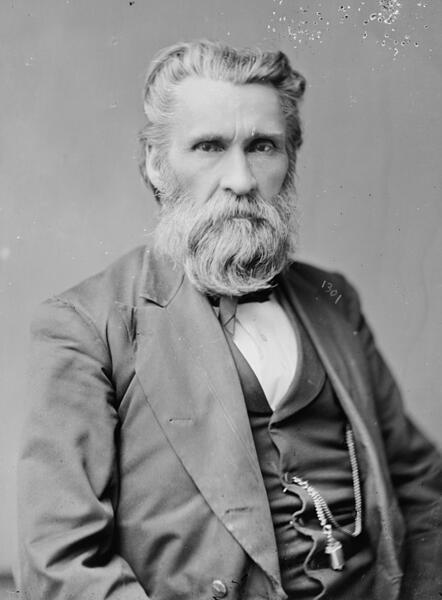
Here you will find contact information for Representative William Summerville Haymond, including email address, phone number, and mailing address.
| Name | William Summerville Haymond |
| Position | Representative |
| State | Indiana |
| District | 10 |
| Party | Democratic |
| Status | Former Representative |
| Term Start | December 6, 1875 |
| Term End | March 3, 1877 |
| Terms Served | 1 |
| Born | February 20, 1823 |
| Gender | Male |
| Bioguide ID | H000396 |
About Representative William Summerville Haymond
William Summerville Haymond (February 20, 1823 – December 24, 1885) was an American physician, Civil War veteran, and Democratic politician who served one term as a U.S. Representative from Indiana from 1875 to 1877. Over the course of his career he combined medical practice, military service, and public office, representing the interests of his Indiana constituents in the House of Representatives during a significant period in American history.
Haymond was born on February 20, 1823, and came of age in the antebellum United States, a time of rapid territorial expansion and growing sectional tension. Details of his early family life and upbringing are sparse in surviving records, but like many professionals of his generation he pursued formal study in the medical field as a path to both personal advancement and public service. His early years were shaped by the broader social and political changes of the Jacksonian and post-Jacksonian eras, which framed his later engagement in public life.
Educated as a physician, Haymond entered the medical profession at a time when formal medical training and institutional standards were becoming more widespread in the United States. He established himself in practice in Indiana, where he became part of the emerging professional class that often played leading roles in local civic and political affairs. His medical work would have brought him into close contact with a broad cross-section of the community, reinforcing his familiarity with the concerns and conditions of the people he would later represent.
During the American Civil War, Haymond served as a Civil War veteran, reflecting his participation in the Union war effort at a moment when the nation’s future was in question. His service in the conflict placed him among the many professionals who contributed their skills and leadership to the military cause. The experience of war, and the profound political and social transformations it produced, informed his later perspective as a public official in the Reconstruction era.
Following the war, Haymond continued his medical and civic activities in Indiana and became increasingly involved in Democratic Party politics. As Reconstruction policies and questions of national reconciliation, economic development, and civil rights dominated public debate, he aligned with the Democratic Party, which was reasserting its strength in many northern states. His professional standing and wartime experience helped position him as a credible candidate for higher office.
Haymond was elected as a Democrat to the United States House of Representatives and served one term in the Forty-fourth Congress, from 1875 to 1877, representing an Indiana district. His service in Congress occurred during a significant period in American history, as the federal government grappled with the final phases of Reconstruction, contested presidential politics, and the economic aftershocks of the Panic of 1873. As a member of the House of Representatives, William Summerville Haymond contributed to the legislative process, participated in the democratic governance of the nation, and represented the interests of his Indiana constituents during his single term in office.
After leaving Congress in 1877, Haymond returned to private life in Indiana, resuming his role as a physician and community figure. Like many one-term members of the House in the nineteenth century, he remained engaged in local affairs rather than pursuing a long national political career, drawing on his combined experience in medicine, military service, and legislation. He lived out his later years in the state he had served both professionally and politically.
William Summerville Haymond died on December 24, 1885. His life spanned from the era of Jacksonian democracy through the Civil War and Reconstruction, and his career reflected the intertwined paths of professional service, military duty, and democratic representation that characterized many nineteenth-century American public figures.