Representative William Steele Holman
Here you will find contact information for Representative William Steele Holman, including email address, phone number, and mailing address.
| Name | William Steele Holman |
| Position | Representative |
| State | Indiana |
| District | 4 |
| Party | Democratic |
| Status | Former Representative |
| Term Start | December 5, 1859 |
| Term End | March 3, 1899 |
| Terms Served | 17 |
| Born | September 6, 1822 |
| Gender | Male |
| Bioguide ID | H000732 |
About Representative William Steele Holman
William Steele Holman (September 6, 1822 – April 22, 1897) was an American lawyer, judge, and Democratic politician from Dearborn County, Indiana, who became one of the most influential fiscal watchdogs in the history of the United States House of Representatives. Over the course of four separate periods of service—1859 to 1865, 1867 to 1877, 1881 to 1895, and 1897—he represented Indiana in Congress during sixteen Congresses, spanning much of the Civil War, Reconstruction, and the Gilded Age. In all, he served seventeen terms between 1859 and 1899, and at the time of his final election he was regarded as the longest-serving congressman in American history. He is best known for originating the “Holman Rule,” which allowed amendments to appropriations bills to cut specific federal programs or the salaries of individual federal employees, and for his unrelenting opposition to what he viewed as unnecessary government spending.
Holman was born at Veraestau, a family estate near Aurora in Dearborn County, Indiana, on September 6, 1822. He was a son of Jesse Lynch Holman (1784–1842), a prominent Indiana jurist, clergyman, and early political figure. Growing up in a household steeped in law, public service, and religion, Holman absorbed the Jacksonian democratic ethos that would shape his political career. His upbringing on the Ohio River, at a point where Indiana meets Ohio and Kentucky, later informed his attachment to his home region and his preference for a simple, rural life even as his national prominence grew.
Holman pursued formal education at Franklin College in Franklin, Indiana, which he attended from 1840 to 1842. After leaving college, he read law and prepared for the bar, reflecting the common mid-nineteenth-century path into the legal profession. In 1843, he was admitted to the Dearborn County bar association and quickly established himself in local legal circles. That same year, he married Abigail Knapp; the couple had five children. His early professional and family life remained centered in Dearborn County, where he combined legal practice with a growing involvement in public affairs.
Holman’s public career began in the Indiana judiciary and legislature. From 1843 to 1846, he served as probate judge, gaining experience in the administration of estates and local legal matters. He then held a two-year term as prosecuting attorney from 1847 to 1849, further enhancing his reputation as a capable and diligent lawyer. Turning to elective office, Holman was elected to the Indiana House of Representatives in 1851 and 1852. During this period he aligned firmly with the Democratic Party. From 1852 to 1856 he served as judge of the Court of Common Pleas, a position that broadened his judicial experience and deepened his understanding of statutory law and procedure, skills that later underpinned his mastery of congressional rules.
In 1858 Holman was elected to the United States House of Representatives as a Democrat from Indiana, beginning a congressional career that would stretch, with interruptions, across nearly four decades. He first served from 1859 to 1865, encompassing the secession crisis and the Civil War. After a brief absence, he returned to the House from 1867 to 1877, participating in Reconstruction debates. He again served from 1881 to 1895, and, after a defeat in 1894, won a final term and returned to Congress in 1897. Over these four distinct periods—1859 to 1865, 1867 to 1877, 1881 to 1895, and 1897—Holman took part in the legislative process during a transformative era in American history, representing the interests of his Indiana constituents while becoming a nationally recognized figure in debates over federal expenditures. By his own account, as of 1884 he had missed only one vote in twenty years of service, a testament to his diligence and close attention to House business.
Holman’s congressional service was marked above all by his fierce opposition to government spending that he considered excessive or unwarranted. He objected to subsidies and aid to private enterprises, most notably the transcontinental railroad companies, and throughout the 1880s he worked to have the federal government reclaim public lands granted to railroads that had failed to complete their lines on schedule. As chairman of the House Committee on Public Lands in the 1880s, he used his position to force railroad corporations to surrender millions of acres, which were then made available to settlers. He was equally hostile to the practices of cattle barons who fenced off public lands as private range. Holman opposed a wide range of appropriations, from river and harbor improvements to salary increases for officeholders, and he became one of the most vocal critics of congressional pay raises. In 1873 he emerged as a leading opponent of the so‑called “back pay” grab, in which members of Congress voted themselves a retroactive salary increase; he later tried, with limited success, to rally the Democratic caucus behind a formal repudiation of the measure.
Holman’s name became permanently associated with congressional procedure through the adoption of the Holman Rule in 1876. This rule empowered any member of Congress to propose an amendment to an appropriations bill that would single out a specific federal employee for a reduction in pay or eliminate a particular program altogether. Originally aimed at curbing patronage positions, especially customs collectors and other politically appointed posts, the rule reflected Holman’s determination to scrutinize individual expenditures rather than accept broad spending measures. Over time, as the federal workforce evolved into a more professional civil service, the rule’s practical impact changed, and it was eventually suspended in 1983 when House Speaker Thomas P. “Tip” O’Neill Jr. objected to its use for spending cuts. The rule was later revived in early 2017 at the urging of Representative H. Morgan Griffith of Virginia, underscoring Holman’s lasting influence on congressional budgetary practice. Holman also played a role in the development of federal conservation policy; one of his legislative hallmarks was his contribution to the Forest Reserve Act of 1891, which repealed the Timber Culture Act of 1873 and authorized the President to set aside timber reserves to be “managed for the people.” Although authorship of the key provision is uncertain, Holman had introduced an 1888 bill using similar language to protect public forests, suggesting his influence on the final statute.
Holman’s personal style and habits became legendary in Washington and contributed to his reputation as the “watchdog of the Treasury” and the “Treasury Cerberus.” He lived simply, avoided Washington social life, and, when Congress adjourned, returned to his homestead in Indiana, where he spent his time among his cattle, horses, books, and flowers. His estate, situated on a high bluff along a bend of the Ohio River with views of Indiana, Ohio, and Kentucky, was often described as a model southern-style property. Visitors recalled his enthusiasm for livestock breeding, his pride in his flower gardens and transplanted shade trees, and his indifference to wealth or notoriety. Stories circulated about his frugality: on one occasion, when interests attempted to push a bill through the House while he was in the Capitol barber shop, he reportedly rushed to the floor with his face still covered in lather to voice his objection. During an 1885 inspection tour with the Committee on Indian Affairs, he refused to travel by sleeping car to save government funds and instead slept upright in his seat. Later, when faced with a five‑dollar steamer fare from Fort Yates in Dakota Territory to Bismarck, he insisted on using idle Army mules and ambulances rather than incur the expense, to the irritation of his colleague Joseph G. Cannon of Illinois.
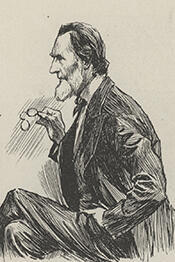
Contemporaries often commented on Holman’s appearance and manner. He habitually chewed tobacco, and reporters noted the conspicuous evidence of this habit around his seat in the House chamber. His voice was described as “pining, but not strong,” yet his speeches were praised as concise and substantive; colleagues observed that he could “say more in fewer words than any man in the House.” Personally, he was regarded as kindly and approachable, especially to new members, whom he instructed in the practical workings of legislation. Many members, uncertain how to vote on complex measures, would declare, “Well, I’ll vote with Holman. Then I’m dead sure to be right.” At the same time, his deep knowledge of House rules and procedures made him a formidable adversary. He kept a close watch on the daily order of business—“something that not one man in fifty in Congress can say,” a reporter wrote—and as of the mid‑1880s he claimed to have missed only a single vote in two decades.
Holman’s long tenure was not uninterrupted. He was defeated in 1894 and briefly considered remaining in Washington to practice law, where he could have earned substantial fees prosecuting claims before the federal government. When press reports suggested that such a move might be seen as trading on his congressional experience and influence, he abandoned the idea and returned to Indiana. There he stood for election once more, won, and returned to the House in 1897 for what proved to be his final term. His cumulative service from 1859 to 1865, 1867 to 1877, 1881 to 1895, and 1897, totaling seventeen terms and sixteen Congresses, made him a central figure in the legislative life of his era and, by the time of his last election, the longest-serving member of the House in American history.
William Steele Holman died in office on April 22, 1897, in Washington, D.C., a month after his final election. He was 74 years old and, despite decades at the center of national politics, remained a man of modest means, having consistently refused opportunities for personal enrichment. His body was returned to Indiana and interred in the Holman family plot at River View Cemetery near Aurora in Dearborn County, not far from his birthplace at Veraestau. His papers are preserved in the William Steele Holman collection in the Rare Books and Manuscripts Division of the Indiana State Library, and his name appears among those members of the United States Congress who died in office between 1790 and 1899.