Representative William L. Hungate
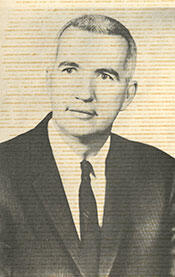
Here you will find contact information for Representative William L. Hungate, including email address, phone number, and mailing address.
| Name | William L. Hungate |
| Position | Representative |
| State | Missouri |
| District | 9 |
| Party | Democratic |
| Status | Former Representative |
| Term Start | January 9, 1963 |
| Term End | January 3, 1977 |
| Terms Served | 7 |
| Born | December 14, 1922 |
| Gender | Male |
| Bioguide ID | H000965 |
About Representative William L. Hungate
William Leonard Hungate (December 14, 1922 – June 22, 2007) was a Democratic member of the United States House of Representatives from Missouri and later a United States district judge of the United States District Court for the Eastern District of Missouri. He represented Missouri’s Ninth Congressional District from November 3, 1964, when he was elected in a special election following the death of Congressman Clarence Cannon, until January 3, 1977, serving seven terms in Congress. Appointed to the federal bench by President Jimmy Carter in 1979, he served as a district judge until assuming senior status in 1991 and retiring in 1992. He was also the father of musician David Hungate, the original bass player for the rock band Toto.
Hungate was born in Benton, Illinois, on December 14, 1922. His family later moved to Missouri, and he graduated from Bowling Green High School in Bowling Green, Missouri, in 1940. He initially attended the University of Michigan before transferring to the University of Missouri in Columbia, Missouri, where he received an Artium Baccalaureus degree in 1943. Pursuing a legal career, he enrolled at Harvard Law School and earned a Bachelor of Laws degree in 1948. In 1969, Harvard Law School awarded him a Doctor of Jurisprudence degree, reflecting the transition in nomenclature from the LL.B. to the J.D.
During World War II, Hungate served in the United States Army from 1943 to 1946. He saw combat in the European Theater, serving in England, France, and Germany. For his service, he received the Combat Infantryman Badge, three battle stars, and the Bronze Star, distinctions that recognized his participation in multiple campaigns and his meritorious service in ground combat.
After the war and his admission to the bar, Hungate embarked on a legal career in Missouri. He was admitted to the Missouri bar in 1948 and the Illinois bar in 1949. He immediately entered private practice in Troy, Missouri, where he practiced law from 1948 to 1968. He was elected prosecuting attorney of Lincoln County, Missouri, serving from 1951 to 1956, and later served as a Missouri Special Assistant Attorney General from 1958 to 1964. These roles established his reputation in state and local legal circles and provided a foundation for his subsequent political career.
Hungate’s congressional service began on November 3, 1964, when he was elected as a Democrat both to the 88th Congress, to fill the vacancy caused by the death of Representative Clarence Cannon, and to the 89th Congress. He was subsequently reelected to the five succeeding Congresses, serving continuously until January 3, 1977. As a member of the House of Representatives during a significant period in American history, he participated in the legislative process and represented the interests of his Missouri constituents. He voted in favor of the Voting Rights Act of 1965, supporting landmark protections for minority voting rights, but voted against the Civil Rights Act of 1968. Hungate served on the House Judiciary Committee and played a prominent role in the 1974 impeachment proceedings against President Richard Nixon, sponsoring the second article of impeachment charging Nixon with abuse of power. Later that year, as chairman of the Judiciary Committee’s Subcommittee on Criminal Justice, he led the congressional review of President Gerald Ford’s pardon of Nixon. Reflecting on the changing political climate, he remarked that politics had gone “from the age of Camelot, where all things were possible, to the age of Watergate, when all things were suspect,” and he chose not to run for reelection to the 95th Congress in 1976. He was succeeded by Harold Volkmer.
Following his retirement from the House of Representatives, Hungate was nominated by President Jimmy Carter on May 17, 1979, to a new seat on the United States District Court for the Eastern District of Missouri, created by 92 Stat. 1629. He was confirmed by the United States Senate on September 25, 1979, and received his commission the following day, September 26, 1979. He assumed senior status on October 1, 1991, and his service on the bench terminated on June 30, 1992, upon his retirement. As a federal district judge, Hungate presided over the St. Louis public school desegregation case, Liddell et al. v. Board of Education of the City of St. Louis, et al., and was instrumental in designing a voluntary desegregation plan for the St. Louis City and County school districts. In a significant finding, he held that with respect to school segregation in St. Louis City and County, the “State of Missouri, which prior to 1954 mandated school segregation, never took any effective steps to dismantle the dual system it had compelled by constitution, statutory law, practice and policy.” He concluded that “the State defendants stand before the Court as primary constitutional wrongdoers who have abdicated their remedial duty. Their efforts to pass the buck among themselves and other state instrumentalities must be rejected.” His rulings in the case were affirmed by the United States Court of Appeals for the Eighth Circuit, and the Supreme Court denied certiorari.
In retirement, Hungate turned to writing and reflection on his varied life experiences. He authored It Wasn’t Funny at the Time, published in 1994, a collection of photographs and anecdotes drawn from his college years, World War II service, time in Congress, and tenure on the federal bench. In 1996, he published Glimpses of Politics (Red, White & Blue Jokes), which offered a more lighthearted perspective on political life. His personal life included his marriage to his wife, Dorothy, with whom he had two children: a son, David, and a daughter, Katie Wood. David Hungate achieved prominence as a professional musician and was the original bass player for the rock band Toto.
Hungate was hospitalized on June 6, 2007, at St. Luke’s Hospital in Chesterfield, Missouri, for a hematoma likely caused by a fall at his home. He died there in intensive care on June 22, 2007. He was survived by his wife, Dorothy; his son, David; his daughter, Katie Wood; and four grandchildren. His papers and photographs, documenting his congressional and judicial careers, are preserved in collections at the University of Missouri–St. Louis and in the biographical directories of the United States Congress and the Federal Judicial Center.