Senator William Langer
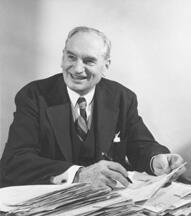
Here you will find contact information for Senator William Langer, including email address, phone number, and mailing address.
| Name | William Langer |
| Position | Senator |
| State | North Dakota |
| Party | Republican |
| Status | Former Representative |
| Term Start | January 3, 1941 |
| Term End | November 8, 1959 |
| Terms Served | 4 |
| Born | September 30, 1886 |
| Gender | Male |
| Bioguide ID | L000070 |
About Senator William Langer
William “Wild Bill” Langer (September 30, 1886 – November 8, 1959) was an American lawyer and politician who served as the 17th governor of North Dakota from 1932 to 1934 and the 21st governor from 1937 to 1939, and as a United States senator from North Dakota from 1941 until his death in 1959. A member of the Republican Party, he was a dominant and controversial figure in North Dakota politics for more than four decades, known for his populist style, his fierce non-interventionism in foreign affairs, and a governorship marked by scandal and protracted legal battles that reached both the state and federal levels.
Langer was born on September 30, 1886, near Everest, in what was then Dakota Territory, to German-American parents Frank and Mary (Weber) Langer. His father, a Catholic, served in the first legislature of the state of North Dakota, and the family’s background in public life and German-speaking rural communities shaped William Langer’s political outlook. He grew up speaking German fluently and excelled academically, graduating as valedictorian of Casselton High School in 1904. He went on to obtain a bachelor of laws degree from the University of North Dakota in Grand Forks. Because he was too young upon graduation to be admitted to the bar, he continued his education at Columbia University in New York City, where he graduated at the top of his class in 1910. Although offered a position at a prominent New York law firm, he chose to return to North Dakota, beginning a law practice in Mandan that soon became the base for his entry into politics.
Langer married Lydia Cady, daughter of New York architect J. Cleaveland Cady, in 1918. The couple had four daughters: Emma, Lydia, Mary, and Cornelia. Cornelia later married the abstract painter Kenneth Noland, linking the family to the American modern art world. Lydia Langer herself became politically active and, during one of the most turbulent periods of her husband’s career, ran for governor of North Dakota in 1934, though she was defeated by Democratic candidate Thomas H. Moodie.
Langer’s political career began at the county level. In 1914 he was appointed state’s attorney for Morton County, North Dakota, and quickly gained a reputation as a combative and theatrical public figure. He emerged as one of the few non-farmers on the Nonpartisan League (NPL) Republican state ticket in 1916, when the newly formed agrarian reform movement swept to power. That year he was elected attorney general of North Dakota, serving from 1916 to 1920. During this period he clashed with the NPL’s founder and leader, Arthur C. Townley, and by 1920 Langer was publicly accusing Townley of Bolshevism. His attempt to replace incumbent NPL governor Lynn Frazier in the 1920 Republican primary failed, reflecting the factional infighting that ultimately limited the NPL’s long-term influence. Although he broke with the NPL leadership in the early 1920s, Langer later mended the rift, reestablishing ties that would prove crucial to his return to statewide office.
Langer was elected governor of North Dakota in 1932 as the NPL regained prominence during the Great Depression. His first term, beginning in 1933, was soon overshadowed by a major political and legal crisis. He required state employees to donate a portion of their annual salaries to the NPL and to the Leader, a weekly newspaper owned by senior officials in his administration. While such political assessments were not prohibited by state law and were a traditional practice in North Dakota politics, controversy arose when donations were collected from highway department employees whose salaries were paid through federal relief programs. United States Attorney P. W. Lanier charged that the arrangement constituted a conspiracy to defraud the federal government. In 1934 Langer and five co-defendants were tried in federal court before Judge Andrew Miller, one of Langer’s chief political adversaries, and were convicted. On September 19, 1934, citing the felony conviction, the North Dakota Supreme Court ordered Langer removed from office and declared Lieutenant Governor Ole H. Olson the legitimate governor. In response, Langer signed a “Declaration of Independence of North Dakota,” declared martial law in Bismarck, and barricaded himself in the governor’s mansion. He ultimately yielded when state officers refused to recognize his authority, and Olson served out the remainder of the term. The conviction, however, did not stand. On appeal, the first trial was invalidated due to serious procedural errors, including improper and allegedly rigged jury selection and biased jury instructions. Two retrials followed in 1935. In the first retrial, Miller refused to recuse himself despite a motion from Langer, and the case ended in a hung jury. Between the second and third trials, Lanier brought unprecedented perjury charges against Langer based on his recusal affidavit; that case ended in a directed verdict of acquittal. A second retrial of the original charges, this time before a different judge, resulted in Langer’s acquittal. Throughout the ordeal, Langer insisted he was the victim of a political vendetta by Miller and Lanier. His political resilience was underscored when he was reelected governor in 1936, serving a second term from 1937 to 1939. Historian Lawrence Larsen later described him as “a master of political theater,” a characterization borne out by his dramatic confrontations with both state and federal authorities.
Langer’s ambitions soon turned to the United States Senate. In 1938 he ran for the Senate as an independent and received 42 percent of the vote, losing to Republican incumbent Gerald Nye. Two years later, in the 1940 election, he mounted a more successful bid. He defeated former ally and incumbent senator Lynn Frazier in the Republican primary, then faced both Democratic nominee Charles Joseph Vogel and Republican/NPL Congressman William Lemke, who ran as an independent rather than seek reelection to the House. In a three-way race, Langer won with 38 percent of the vote. His election, however, was immediately clouded by questions about his past legal troubles. Under Article I, Section 5 of the Constitution, the Senate is the judge of the elections, returns, and qualifications of its members. Langer was seated conditionally while the Committee on Privileges and Elections investigated his record. The committee found him guilty of “moral turpitude” and recommended that he be denied his seat, but the full Senate reversed the committee’s findings, refused to expel him, and voted to seat him permanently when the expulsion resolution failed to achieve the required two-thirds majority. Langer formally began his Senate service in 1941 and remained in office until his death in 1959, serving four terms and representing North Dakota during a period that spanned World War II, the early Cold War, and the beginnings of the modern civil rights era.
As a senator, Langer was widely regarded as an isolationist and a leading non-interventionist voice in Congress, a stance that reflected the sentiments of many German American and Scandinavian American constituents in the Dakotas who remembered World War I bitterly and distrusted both Britain and emerging international organizations. Biographer Glenn H. Smith has described Langer’s Senate career as “a study in isolationism, 1940–1959.” Langer championed minimizing American military involvement in world affairs and was one of only two senators, along with Henrik Shipstead of Minnesota, to vote against the United Nations Charter in 1945. He was also one of seven senators who opposed full U.S. entry into the United Nations. At the same time, he was attentive to domestic concerns, especially those of North Dakota’s farmers. He worked to raise wheat prices, expand government relief, and improve conditions for rural communities. He advocated for affordable health care for all Americans and served on several key committees, including the Committee on Post Office and Civil Service and the Committee on Indian Affairs. His legislative interests extended to questions of race and international humanitarian issues. At the request of African American organizations, he introduced S. 1800, a bill proposing that the federal government fund the voluntary repatriation of African Americans to Africa; the measure did not pass. Langer was also a supporter of Zionism and backed the establishment of the State of Israel, and during World War II he favored American efforts to rescue Jewish refugees from Nazi persecution.
Langer’s Senate career was marked by additional episodes that highlighted both his independence and his controversies. In September 1950 he conducted a five-hour filibuster in an unsuccessful attempt to prevent the Senate from overriding President Harry S. Truman’s veto of the McCarran Internal Security Act; he collapsed on the Senate floor at the end of the effort. In 1951 he lobbied John J. McCloy, the U.S. High Commissioner for Germany, to commute the death sentence of Martin Sandberger, a high-ranking SS officer convicted at the Einsatzgruppen trial of crimes against humanity and war crimes for his role in the mass murder of Jews and others in Estonia during the Holocaust. Largely as a result of such lobbying, Sandberger’s sentence was reduced, and he ultimately served only 13 years in custody before his release. Despite the controversies surrounding his foreign policy positions and his interventions in postwar clemency cases, Langer maintained strong political support in North Dakota. After the Nonpartisan League merged with the state Democratic Party, he remained on the Republican ticket and in 1958 won reelection to the Senate without making a single campaign appearance in the state. During his final term he supported key civil rights legislation, including a vote in favor of the Civil Rights Act of 1957.
In addition to his public offices, Langer was an author and commentator on political and international issues. His works included “The Nonpartisan League; Its Birth, Activities and Leaders” (Mandan, ND: Morton County Farmers Press, 1920), reflecting on the agrarian reform movement that had shaped his early career, and “The Famine in Germany” (Washington, DC: U.S. Government Printing Office, 1946), which addressed postwar conditions in Europe and underscored his complex stance as an isolationist who nonetheless engaged with questions of humanitarian relief and ethnic cleansing. His life and career later became the subject of extensive scholarly study, including John M. Holzworth’s “The Fighting Governor: The Story of William Langer and the State of North Dakota” (1938) and Glenn H. Smith’s “Langer of North Dakota: A Study in Isolationism, 1940–1959” (1979), as well as essays in collections on North Dakota’s political tradition and twentieth-century European ethnic cleansing.
William Langer died in office in Washington, D.C., on November 8, 1959, while still serving as a United States senator. He was the last senator to lie in state in the Senate Chamber until Robert C. Byrd of West Virginia received that honor in 2010. His long and turbulent career—spanning service as Morton County state’s attorney from 1914 to 1916, attorney general of North Dakota from 1916 to 1920, governor from 1933 to 1934 and again from 1937 to 1939, and U.S. senator from 1941 to 1959—left a lasting imprint on both North Dakota and the national legislative record.