Representative William Henry Fitzhugh Lee
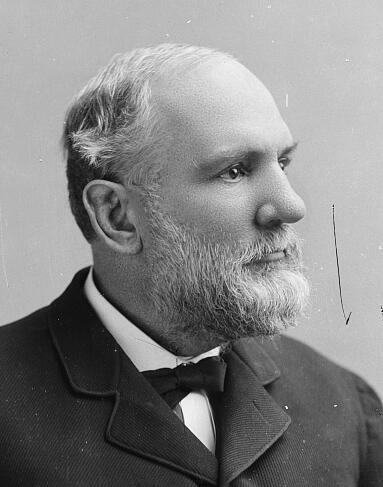
Here you will find contact information for Representative William Henry Fitzhugh Lee, including email address, phone number, and mailing address.
| Name | William Henry Fitzhugh Lee |
| Position | Representative |
| State | Virginia |
| District | 8 |
| Party | Democratic |
| Status | Former Representative |
| Term Start | December 5, 1887 |
| Term End | March 3, 1893 |
| Terms Served | 3 |
| Born | May 31, 1837 |
| Gender | Male |
| Bioguide ID | L000208 |
About Representative William Henry Fitzhugh Lee
William Henry Fitzhugh Lee (May 31, 1837 – October 15, 1891), known as Rooney Lee (often spelled “Roony” among friends and family) or W. H. F. Lee, was a Virginia planter, a Confederate cavalry general in the American Civil War, and later a Democratic Representative from Virginia in the United States Congress. He was the second son of General Robert E. Lee and Mary Anna Randolph Custis Lee and was born at Arlington House in Arlington, Virginia. He was named for William Henry Fitzhugh (d. 1830), his mother’s uncle. At an early age, his father began to call him “Rooney,” a nickname whose precise origin is unknown but which served to distinguish him from his cousin, Confederate cavalry general Fitzhugh Lee. Through his mother, he was the only surviving grandson of George Washington Parke Custis and Mary Lee Fitzhugh, making him a step-great-grandson of President George Washington through Martha Dandridge Custis Washington. He was also a descendant of Charles II of England through Lady Charlotte Lee, granddaughter of Barbara Villiers, and, possibly, a descendant of George I of Great Britain through Benedict Swingate Calvert, an illegitimate grandson of Lady Charlotte Lee.
Lee received his early education in Virginia and then attended Harvard University. While at Harvard he formed a close friendship with Henry Adams, later a prominent historian and memoirist, who wrote about their relationship in chapter four of his autobiography, The Education of Henry Adams. After completing his studies, Lee chose a military career, following in the path of his father. In 1857 he entered the United States Army as a second lieutenant and was assigned to the 6th U.S. Infantry under the command of Colonel Albert Sidney Johnston. He served in the Utah War against the Mormons, gaining his first experience of field service on the western frontier.
In 1859, Lee resigned his commission in the U.S. Army and returned to Virginia to manage White House Plantation, his estate on the south shore of the Pamunkey River in New Kent County, Virginia. That same year he married Charlotte Georgiana Wickham, daughter of George and Charlotte Carter Wickham and a descendant of the noted attorney John Wickham. The couple had two children: Robert Edward Lee (March 11, 1860 – June 30, 1862) and Charlotte Carter Lee (October 19, 1862 – December 6, 1862). Both children died in infancy during the Civil War years, and Charlotte Georgiana Wickham Lee herself died on December 26, 1863, leaving Lee a widower amid the conflict.
With the outbreak of the Civil War in 1861, Lee entered Confederate service and was commissioned a captain in the cavalry. He was soon promoted to major and initially served as a cavalry commander under Brigadier General William W. Loring in the mountains of western Virginia during his father’s Western Virginia Campaign. When Loring’s forces were transferred to the lower Shenandoah Valley late in 1861 and placed under the command of Thomas J. “Stonewall” Jackson, they occupied Romney early in 1862. Lee was then reassigned to the command of Major General J. E. B. Stuart, who led the cavalry of General Joseph E. Johnston’s Army of Northern Virginia during the Peninsula Campaign. Under Stuart, Rooney Lee’s regiment took part in Stuart’s first celebrated ride around the Union Army and in the Seven Days Battles around Richmond. During this period, Union forces burned his White House Plantation, and his young son Robert died of typhoid fever, compounding his personal losses.
Lee’s prominence as a cavalry officer increased during the Northern Virginia and Maryland campaigns of 1862. He played a leading role in Stuart’s attack on Major General John Pope’s supply base at Catlett’s Station on August 22, 1862, capturing a paymaster’s safe filled with Union currency. His regiment was assigned to the brigade of his cousin, Brigadier General Fitzhugh Lee, for the Maryland Campaign. Shortly after the Battle of South Mountain, he was knocked unconscious when his horse fell, which prevented his participation in the Battle of Antietam. Upon his recovery, he temporarily commanded Fitzhugh Lee’s cavalry brigade during Stuart’s Chambersburg Raid, and his performance earned him promotion to brigadier general. He subsequently commanded the 3rd Brigade of Stuart’s Cavalry Division at the Battle of Fredericksburg in December 1862, only weeks after the death of his infant daughter. During the Chancellorsville Campaign in 1863, he was detached from Stuart’s main force to help counter Union Major General George Stoneman’s cavalry raid.
At the outset of the Gettysburg Campaign, Lee was severely wounded in the thigh during the cavalry battle at Brandy Station on June 9, 1863. While recuperating at Hickory Hill, Virginia, he was captured by Union forces and sent as a prisoner of war to Fort Monroe in Virginia and later to New York. He remained in captivity until February 25, 1864, when he was exchanged for Union Brigadier General Neal S. Dow. Returning to duty, Lee was promoted in April 1864 to major general and given command of a cavalry division in the Army of Northern Virginia. He led his division in the Overland Campaign, including the battles of the Wilderness, Todd’s Tavern, Spotsylvania Court House, and North Anna. After the death of J. E. B. Stuart in May 1864, Lee’s responsibilities increased. During the Siege of Petersburg, his division guarded the extreme right of the Confederate lines and took part in actions against the Wilson–Kautz Raid, including engagements at Staunton River Bridge, Sappony Church, and First Ream’s Station. His command was briefly sent north to assist in the defense of Richmond at the Second Battle of Deep Bottom, then supported General Wade Hampton III’s “Beefsteak Raid,” and returned to the Petersburg front for the Battle of Boydton Plank Road.
By the final year of the war, Lee had risen to second-in-command of the Confederate cavalry in Virginia. With Hampton transferred to South Carolina to raise troops and Fitzhugh Lee promoted to overall command, Rooney Lee’s division played a key role in screening the Confederate evacuation of Petersburg in April 1865, notably at the Battle of Namozine Church during the Appomattox Campaign. He ultimately surrendered with his father at Appomattox Court House, commanding only about 300 officers and men—roughly one-tenth of the strength his division had possessed during the height of the Petersburg operations.
After the war, Lee returned to agricultural pursuits in Virginia. He resumed planting at White House Plantation, while his younger brother Robert (“Rob”) Lee lived nearby at Romancoke Plantation across the Pamunkey River in King William County. On November 28, 1867, Lee married his second wife, Mary Tabb Bolling. They had two sons who survived to adulthood: Robert Edward Lee III (born February 11, 1869, in Petersburg, Virginia; died September 7, 1922, in Roanoke, Virginia) and George Bolling Lee (born August 30, 1872, in Lexington, Virginia; died July 13, 1948, in New York, New York). Following the death of his mother in 1873, Lee inherited Ravensworth Plantation, the old Fitzhugh family estate near present-day Springfield in Fairfax County, Virginia, comprising approximately 563 acres. He moved his family from White House to Ravensworth and became a leading landowner in northern Virginia.
Lee soon entered public life in the postwar Commonwealth. In 1875 he was elected to the Virginia Senate, where he served until 1878, participating in the political reconstruction and economic readjustment of the state in the decade following the Civil War. A member of the Democratic Party, he later sought national office and was elected as a Democrat to the United States House of Representatives in 1887. William Henry Fitzhugh Lee served as a Representative from Virginia in the United States Congress from 1887 to 1893, holding his seat for three consecutive terms. His service in Congress occurred during a significant period in American history marked by industrial expansion, sectional reconciliation, and debates over tariffs, veterans’ issues, and federal economic policy. As a member of the House of Representatives, William Henry Fitzhugh Lee participated in the legislative process, represented the interests of his Virginia constituents, and contributed to the work of the Democratic majority and minority during his tenure.
Lee died in office at Ravensworth Plantation in Fairfax County, Virginia, on October 15, 1891, during his third term in the House of Representatives. His death placed him among the members of the United States Congress who died in office in the nineteenth century. He was interred in the University Chapel at Washington and Lee University in Lexington, Virginia, where he rests alongside his parents and siblings, linking his final resting place to the institution that bears his family’s name and to the broader legacy of the Lee and Custis families in Virginia and American history.