Representative William Lemke
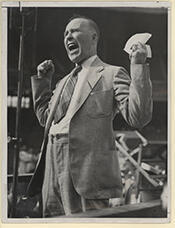
Here you will find contact information for Representative William Lemke, including email address, phone number, and mailing address.
| Name | William Lemke |
| Position | Representative |
| State | North Dakota |
| District | At-Large |
| Party | Republican |
| Status | Former Representative |
| Term Start | March 9, 1933 |
| Term End | January 3, 1951 |
| Terms Served | 8 |
| Born | August 13, 1878 |
| Gender | Male |
| Bioguide ID | L000238 |
About Representative William Lemke
William Frederick Lemke (August 13, 1878 – May 30, 1950) was an American politician who represented North Dakota in the United States House of Representatives and served eight terms in Congress between 1933 and 1951. A member of the Republican Party for most of his congressional career, he was also closely associated with the Nonpartisan League in North Dakota and emerged as a prominent agrarian radical and progressive populist. Nationally, he is remembered as the presidential candidate of the short-lived Union Party in the 1936 election.
Lemke was born in Albany, Stearns County, Minnesota, on August 13, 1878, the son of Fred Lemke and Julia Anna Kleir. His parents were pioneer farmers who later settled in Towner County, North Dakota, where they accumulated approximately 2,700 acres of land. Raised in this frontier farming environment, Lemke worked long hours on the family farm and attended a common school for only about three months each summer. In a boyhood accident he lost an eye, a disability he carried throughout his life. Despite these hardships, his family reserved enough resources to send him to the University of North Dakota, reflecting their commitment to education and his evident intellectual promise.
At the University of North Dakota, Lemke distinguished himself as a superior student and became well known on campus for his sharp wit and talent for impersonating professors. He graduated in 1902 and remained at the university for his first year of law school. Seeking broader legal training, he then moved to Georgetown University and subsequently to Yale Law School, where he completed his law degree and earned the praise of the dean for his academic performance. After being admitted to the bar, Lemke returned to North Dakota in 1905 and established a law practice in Fargo. He became active in civic and political affairs and was a member of the Freemasons, reflecting his integration into the professional and fraternal life of the growing state.
During the 1910s, Lemke emerged as a central figure in the Nonpartisan League (NPL), a powerful farmers’ reform movement that quickly gained traction in North Dakota politics. He was widely regarded as one of the League’s top leaders and was often described as the “bishop” or “political bishop” of the NPL, a reference to his strategic role and influence within the organization. In 1920 he was elected attorney general of North Dakota, despite an NPL rule, advanced by League leader A. C. Townley, that its principal leaders should not themselves run for office. By this time, however, the NPL was beset by internal conflicts and mounting public controversy. In 1921, opponents organized as the Independent Voters Association (IVA) successfully forced a special recall election that removed all three members of the state’s Industrial Commission—Governor Lynn Frazier, Commissioner of Agriculture and Labor John N. Hagan, and Attorney General William Lemke—replacing them with IVA-backed candidates. Lemke remained a significant political figure; in 1922 he received the NPL nomination for governor of North Dakota but was defeated by the incumbent, Ragnvald Nestos.
Lemke’s national political career began with his election to the United States House of Representatives in 1932. Running as a Nonpartisan League candidate aligned with the Republican Party, he won a seat from North Dakota and entered Congress at the outset of the New Deal era. That same year he campaigned actively for Franklin D. Roosevelt for president in North Dakota and other Midwestern states, reflecting his early support for New Deal reforms. He took office in March 1933 and went on to serve eight terms in the House, from 1933 until his death in 1950, his service spanning the Great Depression, World War II, and the early postwar period. Throughout his tenure, he formally sat as a Republican, but he maintained his identity as a progressive populist and agrarian advocate.
In Congress, Lemke quickly earned a reputation as a strong supporter of the New Deal’s efforts to aid struggling farmers and rural communities. He championed legislation to protect family farmers from foreclosure during the depths of the Great Depression and became best known for co-sponsoring the Frazier–Lemke Farm Bankruptcy Act of 1934. This measure restricted the ability of banks and other creditors to repossess farms, giving heavily indebted farmers a chance to retain their land under more favorable terms. President Franklin D. Roosevelt signed the act into law on June 28, 1934. The Supreme Court later struck it down in Louisville Joint Stock Land Bank v. Radford, but Lemke pressed Congress to reenact a modified version. Although the Roosevelt administration privately warned members of Congress that it would veto a renewed bill, a revised act was ultimately passed and later upheld as constitutional by the Supreme Court. During this period Lemke was also a political friend and ally of Louisiana Senator Huey Long, sharing Long’s populist orientation until Long’s assassination in 1935.
Lemke’s break with Roosevelt over farm mortgage policy helped set the stage for his national third-party candidacy. In June 1936 he accepted the presidential nomination of the Union Party, a new coalition of populist and protest elements that included figures such as radio priest Father Charles Coughlin. Running as the Union Party’s candidate for President of the United States in the 1936 election, Lemke received 892,378 votes nationwide, just under two percent of the popular vote, and no electoral votes. In six counties in North Dakota he outpolled Republican nominee Alf Landon, and he remained the last third-party presidential candidate to outpoll a major-party nominee in any non-Southern county until George Wallace in 1968 and John G. Schmitz in 1972 achieved similar localized showings. Many observers have interpreted Lemke’s decision to run on the Union Party ticket as an expression of bitterness toward the Roosevelt administration over its handling of the farm mortgage issue. Despite his national third-party campaign, he was simultaneously reelected to the House of Representatives in 1936 as a Republican, and he continued to represent North Dakota in Congress.
Lemke’s later congressional career reflected both ambition and sustained legislative activity. In 1940, after securing the Republican nomination for a fifth term in the House, he withdrew from that race to pursue an independent candidacy for the United States Senate from North Dakota, a bid that proved unsuccessful. He returned to the House in 1942, winning election again as a Republican, and then served four additional terms. From 1943 to 1948 he was the leading advocate in Congress for the establishment of the Theodore Roosevelt National Memorial Park in western North Dakota, now Theodore Roosevelt National Park. Although the National Park Service did not initially support the proposal and Lemke himself was not an admirer of Theodore Roosevelt, he pressed the project as a means of promoting economic development and tourism in the region. His efforts culminated in the park’s creation by act of Congress in June 1948, marking one of his most enduring legislative achievements.
William Lemke died in office of a heart attack in Fargo, North Dakota, on May 30, 1950, while still serving as a member of the House of Representatives. His death placed him among the members of Congress who died in office in the mid-twentieth century. He was buried in Riverside Cemetery in Fargo. His extended family continued to achieve public notice in later generations; former Atlanta Braves baseball player Mark Lemke is his second cousin twice removed.