Representative William Walter Link
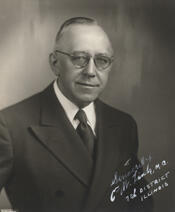
Here you will find contact information for Representative William Walter Link, including email address, phone number, and mailing address.
| Name | William Walter Link |
| Position | Representative |
| State | Illinois |
| District | 7 |
| Party | Democratic |
| Status | Former Representative |
| Term Start | January 3, 1945 |
| Term End | January 3, 1947 |
| Terms Served | 1 |
| Born | February 12, 1884 |
| Gender | Male |
| Bioguide ID | L000334 |
About Representative William Walter Link
William Walter Link (February 12, 1884 – September 23, 1950) was a Democratic U.S. Representative from Illinois who served one term in the Seventy-ninth Congress from 1945 to 1947. Born in Świecie (then Swiec), in what is now Poland, he immigrated to the United States in 1897 with his parents. The family settled in Chicago, Illinois, where Link spent the remainder of his life and built a career that combined business, civic administration, and ethnic community leadership with elective office.
Link was educated in Chicago’s parochial and public schools, reflecting the experience of many immigrant families who sought both religious and secular instruction for their children. He later attended the department of engineering of the Lewis Institute in Chicago, Illinois, an institution that would eventually become part of the Illinois Institute of Technology. His technical education there provided him with training suited to the city’s industrial economy and laid the groundwork for his early business pursuits.
Beginning in 1912, Link engaged in the enameling business in Chicago, a field closely tied to the city’s manufacturing base. He remained in this line of work for two decades, from 1912 to 1932, gaining experience as a businessman and employer during a period that spanned World War I, the postwar boom, and the onset of the Great Depression. During these years he also developed an interest in banking, an area in which he would later assume more formal responsibilities. His dual involvement in industry and finance positioned him as a figure familiar with both the practical concerns of small business and the broader financial structures of the city.
By the early 1930s, Link had become increasingly active in public affairs and in the political life of Chicago’s Polish-American community. Since 1932 he served as general secretary of the Polish-American Democratic Organization of Illinois, a role that placed him at the center of efforts to mobilize and represent Polish-American voters within the Democratic Party. In 1933 he was appointed president of the Board of Local Improvements of Chicago, Illinois, serving in that capacity until 1936. In this post he was involved in overseeing municipal improvement projects during the New Deal era, a time when public works and infrastructure development were central to local and federal economic recovery strategies.
Link continued to hold important administrative positions in Cook County government in the early 1940s. He served as chief clerk of the Superior Court of Cook County in 1942 and 1943, a role that involved managing the clerical and administrative functions of one of the state’s major trial courts. In 1943 and 1944 he served as vice president of the Board of Civil Service Commissioners of Cook County, Illinois, where he helped oversee the county’s merit-based employment system. These positions enhanced his visibility in local government and demonstrated his administrative competence, further strengthening his credentials for higher office.
In 1944, Link was elected as a Democrat to the Seventy-ninth Congress, representing an Illinois district in the U.S. House of Representatives. His term began on January 3, 1945, and concluded on January 3, 1947. Serving during the closing months of World War II and the initial phase of the postwar period, he participated in the legislative process at a time of significant transition in American domestic and foreign policy. As a member of the House of Representatives, William Walter Link represented the interests of his Chicago-area constituents and contributed to the work of Congress during a critical era in American history. He was an unsuccessful candidate for reelection in 1946 to the Eightieth Congress, ending his congressional service after a single term.
After leaving Congress, Link resumed his involvement in banking and business. He became a director of the Manufacturers’ National Bank of Chicago, reflecting the long-standing interest in banking he had cultivated alongside his earlier industrial and political activities. In addition to his professional and political work, he was noted as being interested in sociological work, indicating engagement with social issues and community welfare, particularly within the immigrant and ethnic communities that had shaped his early life and political base.
William Walter Link died in Chicago, Illinois, on September 23, 1950. He was interred in St. Adalbert’s Cemetery, a burial place long associated with the city’s Polish-American community. His life and career traced the trajectory of an immigrant who rose from modest beginnings to positions of influence in business, local government, ethnic political organizations, and ultimately the United States Congress.