Representative William McCulloch
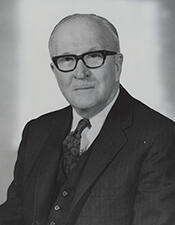
Here you will find contact information for Representative William McCulloch, including email address, phone number, and mailing address.
| Name | William McCulloch |
| Position | Representative |
| State | Ohio |
| District | 4 |
| Party | Republican |
| Status | Former Representative |
| Term Start | January 3, 1947 |
| Term End | January 3, 1973 |
| Terms Served | 13 |
| Born | November 24, 1901 |
| Gender | Male |
| Bioguide ID | M000393 |
About Representative William McCulloch
William Moore McCulloch (November 24, 1901 – February 22, 1980) was an American lawyer and politician who served as a Republican U.S. Representative from Ohio’s 4th congressional district from 1947 to 1973. A member of the Republican Party, he represented his western Ohio constituency for 13 consecutive terms, contributing significantly to the legislative process during a period of major social and political change in the United States.
McCulloch was born near Holmesville, Holmes County, Ohio, on November 24, 1901, to James H. and Ida M. McCulloch. He was educated in Ohio and went on to attend the College of Wooster in Wooster, Ohio, graduating in 1923. He then studied law at the Ohio State University College of Law in Columbus, Ohio, from which he graduated in 1925. Admitted to the bar that same year, he commenced the practice of law in Piqua, Miami County, Ohio, where he entered into partnership with attorney George Barry. On October 17, 1927, McCulloch eloped with Mabel Harris in Covington, Kentucky; the couple later had two daughters, Nancy and Ann.
McCulloch’s political career began in state government. He was elected to the Ohio House of Representatives in 1933 and served there until 1944. During his tenure he rose rapidly in leadership, serving as minority leader from 1936 to 1939 and as speaker of the Ohio House from 1939 to 1944. Representing a largely white, conservative constituency at a time when the Black population of his hometown of Piqua was only about 2.7 percent, he nonetheless emerged early as a supporter of equal rights and aligned himself with the National Association for the Advancement of Colored People (NAACP), identifying the goals of the emerging civil rights movement with the constitutional guarantees he believed it was his duty to uphold. His state legislative service was interrupted when he entered the United States Army on December 26, 1943, during World War II. He served until October 12, 1945, attaining the rank of captain in the Military Government Forces in Europe.
McCulloch entered national politics in the postwar era. He was elected as a Republican to the Eightieth Congress by special election on November 4, 1947, to fill the vacancy caused by the resignation of Representative Robert Franklin Jones. He was subsequently re-elected to twelve consecutive Congresses, serving continuously from 1947 to 1973. During his time in office, Ohio’s 4th Congressional District included the counties of Allen, Hardin, Mercer, Auglaize, Darke, Shelby, Miami, Preble, and part of Montgomery County, and he regularly secured between 65 and 70 percent of the vote in his elections. Known as a fiscal conservative, he was noted for returning any unused portion of his congressional office allowance to the U.S. Treasury at the end of each term.
Over the course of his congressional career, McCulloch became one of the most influential Republicans on legal and civil rights issues. In 1959 he became the ranking Republican member of the House Judiciary Committee, a position he held until his retirement in 1973. He also served on the Joint Committee on Atomic Energy, the Joint Committee on Immigration and National Policy, and the Select Committee on Small Business. In recognition of his expertise and reputation for integrity, President Lyndon B. Johnson appointed him to the National Advisory Commission on Civil Disorders in 1967 and to the Presidential Commission on the Causes and Prevention of Violence (often called the Eisenhower Commission) in 1968. His leadership in Congress took place during a significant period in American history, as the nation grappled with civil rights, social welfare, and questions of federal authority.
McCulloch’s most enduring legacy lies in his leadership on civil rights legislation. As the ranking member of the House Judiciary Committee, he took a leading role in shaping and advancing civil rights bills in the 1950s and 1960s, despite having relatively few African American constituents and thus little direct political gain from such efforts. In 1963 he joined Representatives John Lindsay of New York and Charles Mathias of Maryland in introducing a comprehensive civil rights bill, a move that helped pressure President John F. Kennedy to submit his own civil rights proposal to Congress several months later. McCulloch made clear to the Kennedy administration that he would support a strong civil rights bill in the House and work to bring fellow Republicans along, but only on the condition that the White House not dilute the bill’s key enforcement provisions in the Senate and that Republicans receive equal credit for its passage. His influence was such that President Kennedy reportedly said of the pending Civil Rights Act, “Without him it can’t be done,” and President Johnson later described him as “the most important and powerful political force” in securing the Act’s passage. McCulloch voted in favor of the Civil Rights Acts of 1957, 1960, 1964, and 1968, the Voting Rights Act of 1965, and the Open Housing Act of 1968, and in 1970 he opposed efforts by the Nixon administration to weaken temporary provisions of the Voting Rights Act that protected the voting rights of Black southerners. In 1971, Jacqueline Kennedy Onassis wrote to him crediting him as one of the most important figures behind the civil rights legislation of the 1960s.
Ideologically, McCulloch was a conservative Republican, particularly in his early congressional years. In 1961 he received a 0 percent rating from the liberal Americans for Democratic Action and a 100 percent rating from the conservative Americans for Constitutional Action, reflecting his belief that federal authority should not unduly usurp state and local powers. Nonetheless, his views moderated after 1964. He was one of six Republican House members from Ohio to support the creation of the Medicare program for the elderly and the Medicaid program for low-income individuals. By 1969 his rating from Americans for Constitutional Action had fallen to 33 percent. He supported the Gun Control Act of 1968 and backed the Comprehensive Child Development Act of 1971, a broad child-care initiative that was ultimately vetoed by President Richard Nixon. Earlier in his career, in the late 1940s, he had supported the Social Security Amendments of 1949 and an amendment to the National Housing Act of 1949 extending mortgage provisions. Despite his support for many social and civil rights measures, he, like his close friend and collaborator on civil rights legislation, Representative Emanuel Celler of New York, opposed the Equal Rights Amendment.
McCulloch chose not to seek re-election in 1972 and thus did not stand for the Ninety-third Congress. He left office in January 1973 and returned to Piqua, Ohio, where he resumed the practice of law. His long record in Congress, particularly his work on civil rights, continued to draw recognition in subsequent decades. In early 2010 the Ohio Historical Society proposed him as a finalist in a statewide vote for possible inclusion in the National Statuary Hall Collection at the United States Capitol. He was also the subject of the 2014 biography “McCulloch of Ohio: For the Republic” by Mark Bernstein. In 2017, a student, Daud Shad, won the John F. Kennedy Library Foundation’s Profiles in Courage Essay Contest with an essay highlighting McCulloch’s role in the civil rights era. His contributions have been praised by colleagues across party lines; Representative Richard Walker Bolling of Missouri stated upon McCulloch’s passing that “This country will always owe a major debt to Bill McCulloch. If it had not been for Bill McCulloch, there would have been no civil rights legislation.” Representative Thomas Railsback of Illinois similarly credited McCulloch, alongside Emanuel Celler, with having done more for civil rights than any other member of the House.
William Moore McCulloch died of a heart attack on February 22, 1980, in Washington, D.C. He was interred with his wife, Mabel, in Arlington National Cemetery. His life and work later received popular recognition as well; in the 2016 television film “All the Way,” which dramatized the Johnson administration’s struggle to pass the Civil Rights Act of 1964, McCulloch was portrayed by actor Dan Desmond.