Representative William Henry Meyer
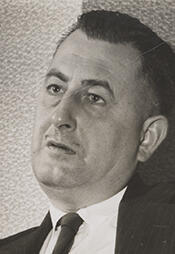
Here you will find contact information for Representative William Henry Meyer, including email address, phone number, and mailing address.
| Name | William Henry Meyer |
| Position | Representative |
| State | Vermont |
| District | At-Large |
| Party | Democratic |
| Status | Former Representative |
| Term Start | January 7, 1959 |
| Term End | January 3, 1961 |
| Terms Served | 1 |
| Born | December 29, 1914 |
| Gender | Male |
| Bioguide ID | M000682 |
About Representative William Henry Meyer
William Henry Meyer (December 29, 1914 – December 16, 1983) was an American politician, forester, and member of the United States House of Representatives from Vermont. A Democrat, he served one term in Congress from 1959 to 1961, during which he represented Vermont at a time of significant political and social change in the United States and contributed to the legislative process on behalf of his constituents.
Meyer was born in Philadelphia, Pennsylvania, where he attended the city’s public schools. He went on to Pennsylvania State University, graduating in 1936. Trained in forestry, he began his professional career immediately after college, working as a timber cruiser, state and federal forester, and Civilian Conservation Corps technician and supervisor between 1936 and 1940. In these capacities he served in several states, including West Virginia, Maryland, Wisconsin, and New Jersey, gaining practical experience in conservation, land management, and public service that would shape his later political outlook.
By 1940 Meyer was employed in Vermont with the Soil Conservation Service, where he worked for a decade, from 1940 to 1950, on programs aimed at improving land use and preventing erosion. In 1945 he moved to a farm in Bennington County, Vermont, establishing his long-term residence in the state he would later represent in Congress. In 1951 he entered private practice as a consulting forester and became executive director of the Vermont Forest and Farmland Foundation, a role that placed him at the center of statewide efforts to balance agricultural and forestry interests with conservation goals. His professional work in Vermont’s rural communities helped build his reputation as an advocate for farmers, landowners, and environmental stewardship.
Meyer’s political career developed alongside his professional activities. A member of the Democratic Party, he became active in Vermont politics at a time when the state was overwhelmingly Republican. He served as a delegate to the Vermont State Democratic conventions in 1956, 1960, 1964, and 1968, helping to build the party’s organizational strength and articulate a more progressive platform in a traditionally conservative state. His growing prominence within the party and his appeal to rural voters laid the groundwork for his eventual run for Congress.
In 1958 Meyer was elected as a Democrat to the Eighty-sixth Congress, serving from January 3, 1959, to January 3, 1961. He narrowly defeated the Republican candidate, former Governor Harold Arthur, by about 3,600 votes. His victory was historically significant: he became the first Democrat to win a statewide or congressional election in Vermont since the 1850s, and the first Democrat to represent Vermont in the U.S. House of Representatives since Thomas Bartlett Jr., who had served from 1851 to 1853. Observers attributed his election in part to a strong Republican vote against Arthur, and his race occurred in the same election cycle in which the gubernatorial contest was decided by an even slimmer margin, with Republican Robert Stafford defeating Democrat Bernard J. Leddy by only 781 votes. During his single term in Congress, Meyer participated fully in the democratic process and represented the interests of his Vermont constituents during a period marked by Cold War tensions and the emerging civil rights movement.
Meyer’s congressional record reflected a distinctly left-leaning and independent stance. By one measure, he was considered the most left-wing member to serve in Congress from 1937 to 2002. He supported the admission of the People’s Republic of China into the United Nations, opposed conscription and nuclear testing, and took progressive positions on foreign and defense policy. In domestic affairs, he voted in favor of the Civil Rights Act of 1960, aligning himself with efforts to strengthen federal protections for voting rights and civil liberties. These positions placed him on the liberal edge of the political spectrum for his era, particularly for a representative from a traditionally conservative state.
Meyer was an unsuccessful candidate for reelection in 1960 to the Eighty-seventh Congress. In that election he was defeated by Republican Governor Robert Stafford. The campaign was notable within Vermont politics because Meyer faced a challenge in the Democratic primary from dairy farmer Fred Richmond, in what was recognized as the first Democratic primary in modern Vermont political history. After leaving Congress, Meyer continued his involvement in public affairs. From May 1961 to December 1963 he served as a consultant for the Technical Review Staff of the United States Department of the Interior, applying his expertise in land use and conservation to federal policy review and program evaluation.
In the years following his congressional service, Meyer remained active in both electoral politics and party organization. He sought the Democratic nomination for United States Senator from Vermont in 1962, 1964, and 1970, but was unsuccessful in each attempt. In June 1970 he became one of the leading founders of the nonviolent socialist Liberty Union Party of Vermont, reflecting his continuing commitment to left-wing and pacifist principles. That same year he was the Liberty Union nominee for United States Senator after failing to secure the Democratic nomination, receiving 1,416 votes, or 0.91 percent of the vote, in the general election. Notably, he received more votes in the Democratic primary than he did in the general election as the Liberty Union candidate. He returned to the Democratic Party in 1972 and that year ran unsuccessfully for election to the Ninety-third Congress, losing to Republican incumbent Richard W. Mallary.
Meyer spent his later years in West Rupert, Vermont, where he continued to be identified with progressive causes and rural advocacy. He remained a resident of West Rupert until his death on December 16, 1983. He was cremated, and his ashes were interred at his home in West Rupert. His family also reflected his longstanding commitment to pacifism and social justice; his son, Karl Meyer, became known as a radical pacifist and tax resister.