Representative William Henry Moody
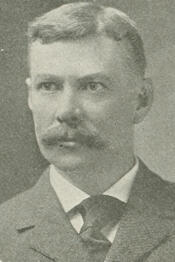
Here you will find contact information for Representative William Henry Moody, including email address, phone number, and mailing address.
| Name | William Henry Moody |
| Position | Representative |
| State | Massachusetts |
| District | 6 |
| Party | Republican |
| Status | Former Representative |
| Term Start | December 2, 1895 |
| Term End | March 3, 1903 |
| Terms Served | 4 |
| Born | December 23, 1853 |
| Gender | Male |
| Bioguide ID | M000883 |
About Representative William Henry Moody
William Henry Moody (December 23, 1853 – July 2, 1917) was an American politician and jurist who held positions in all three branches of the Government of the United States. A member of the Republican Party and a political progressive closely aligned with President Theodore Roosevelt, he represented parts of Essex County, Massachusetts, in the United States House of Representatives from 1895 until 1902, later serving in the president’s cabinet as Secretary of the Navy and Attorney General, and ultimately as an Associate Justice of the United States Supreme Court. Over the course of his public career, Moody became known for his opposition to racial segregation and his advocacy of African-American civil rights.
Moody was born in Newbury, Massachusetts, on December 23, 1853, and grew up in the coastal communities of northeastern Massachusetts. He attended the common schools and Phillips Academy in Andover, Massachusetts, reflecting the strong New England emphasis on classical education and civic responsibility. After his preparatory studies, he enrolled at Harvard University, where he studied liberal arts and developed an interest in law and public affairs. He graduated from Harvard in 1876. Following his graduation, he read law in the traditional manner and was admitted to the bar, beginning a legal career that would soon intersect with local and national politics.
After entering the legal profession, Moody established himself as a practicing attorney in Massachusetts and quickly became active in public service. He served as city solicitor of Haverhill, Massachusetts, and gained a reputation as a capable municipal lawyer. His prosecutorial career advanced when he was appointed district attorney for the Eastern District of Massachusetts, a position in which he handled significant criminal matters and further enhanced his public profile. His work as a prosecutor, combined with his standing in the Republican Party, positioned him as a rising figure in Massachusetts politics at the close of the nineteenth century.
Moody was elected as a Republican to the United States House of Representatives and served four consecutive terms, holding office from March 4, 1895, to March 3, 1903, and representing a district that included parts of Essex County, Massachusetts. His service in Congress occurred during a significant period in American history marked by industrial expansion, the Spanish–American War, and the emergence of the United States as a global power. As a member of the House of Representatives, he participated in the legislative process, represented the interests of his constituents, and contributed to debates on issues of national importance. During his tenure he served on key committees, including those dealing with naval affairs, which helped shape his later role in the Roosevelt administration. Although he left the House in 1903, his congressional service from 1895 to 1903 formed the foundation for his subsequent executive and judicial appointments.
In 1902, while still serving in Congress, Moody came to national prominence as one of the lead prosecutors in the federal government’s case against the leaders of the so‑called “Beef Trust,” a major antitrust prosecution that underscored the growing federal role in regulating large corporations. His performance in that case and his broader legislative record attracted the attention of President Theodore Roosevelt. In 1902 Roosevelt appointed Moody as Secretary of the Navy, a post he held until 1904. As Secretary of the Navy, Moody oversaw a period of modernization and expansion of the fleet, reflecting the administration’s commitment to a strong naval presence on the world stage in the aftermath of the Spanish–American War.
In 1904, Roosevelt appointed Moody Attorney General of the United States, a position he held until 1906. As Attorney General, Moody continued the administration’s vigorous enforcement of federal antitrust laws and supported other progressive reforms designed to curb the power of large corporations and protect the public interest. His tenure at the Department of Justice further solidified his reputation as a principled and energetic public servant. In 1906, Roosevelt elevated Moody to the United States Supreme Court as an Associate Justice. He took his seat on the Court that same year and served for just under four years, until 1910, when deteriorating health compelled his retirement. On the Court, he was regarded as a progressive voice, and consistent with his broader political views, he opposed racial segregation and spoke out in favor of African-American civil rights, aligning himself with contemporary efforts to resist the entrenchment of Jim Crow policies.
After leaving the Supreme Court, Moody returned to Massachusetts, where he lived in relative retirement due to his ongoing health problems. Although no longer in public office, he remained a respected figure in legal and political circles, remembered for having served in all three branches of the federal government and for his contributions to progressive reform at the turn of the twentieth century. William Henry Moody died on July 2, 1917, in Haverhill, Massachusetts. His career, spanning legislative, executive, and judicial service, reflected both the opportunities and the challenges of the Progressive Era and left a distinct mark on the legal and political history of the United States.