Representative William Ralls Morrison
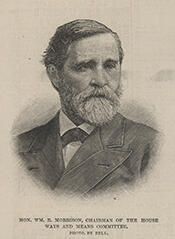
Here you will find contact information for Representative William Ralls Morrison, including email address, phone number, and mailing address.
| Name | William Ralls Morrison |
| Position | Representative |
| State | Illinois |
| District | 18 |
| Party | Democratic |
| Status | Former Representative |
| Term Start | December 7, 1863 |
| Term End | March 3, 1887 |
| Terms Served | 8 |
| Born | September 14, 1824 |
| Gender | Male |
| Bioguide ID | M001000 |
About Representative William Ralls Morrison
William Ralls Morrison (September 14, 1824 – September 29, 1909) was an American lawyer, soldier, and Democratic politician who served eight terms as a U.S. Representative from Illinois between 1863 and 1887. Over a long public career, he held influential committee chairmanships in the House of Representatives and later served as a member and chairman of the Interstate Commerce Commission.
Morrison was born on a farm at Prairie du Long, near the present town of Waterloo, Monroe County, Illinois. He grew up in a rural setting and attended the local schools before enrolling at McKendree College in Lebanon, Illinois. As a young man he served in the Mexican–American War, and in 1849 he joined the wave of gold seekers traveling to California. After two years he returned to Illinois in 1851. He studied law, was admitted to the bar in 1855, and began practicing in Waterloo, Illinois, which remained his home base throughout his life. Morrison married Eleanor Horan, a childhood acquaintance, when she was seventeen and he was twenty-seven, and she remained a central figure in his personal life, notably nursing him back to health after he was wounded in the Civil War.
Morrison’s early public career developed rapidly in Monroe County and in Illinois state politics. He served as clerk of the circuit court of Monroe County from 1852 to 1854. He was then elected to the Illinois House of Representatives, serving from 1854 to 1860 and returning again in 1870 and 1871. During his first period in the state legislature he rose to a position of leadership, serving as speaker of the Illinois House in 1859 and 1860. He also became active in national party affairs, serving as a delegate to the Democratic National Convention in 1856. These roles established him as a prominent Democrat in Illinois on the eve of the Civil War.
With the outbreak of the Civil War, Morrison entered Union military service. In 1861 he helped organize the 49th Illinois Volunteer Infantry Regiment and was appointed its colonel. Shortly after the regiment was mustered into service on December 31, 1861, it was attached to Ulysses S. Grant’s army at Cairo, Illinois. The 49th Illinois was brigaded with the 17th Illinois and two artillery batteries, and as the senior colonel, Morrison was placed in command of the brigade, designated the 3rd Brigade, 1st Division, District of Cairo. He joined Grant’s expedition against Fort Henry and then participated in the Battle of Fort Donelson. During the engagement at Fort Donelson, his division commander, John A. McClernand, selected Morrison’s two regiments to lead an attack on a Confederate battery and attached a third regiment under Colonel Isham N. Haynie as support. Because Haynie outranked him, Morrison deferred to Haynie’s assumption of command, and the two agreed to “take it together.” Early in the fighting Morrison was shot in the hip and knocked from his horse. The wound, which affected his lungs and contributed to a weak speaking voice for the rest of his life, forced him from active field service; he never returned to the front and resigned his commission on December 13, 1863. During his convalescence, his wife Eleanor nursed him back to health, and during later congressional sessions the couple resided at the Willard Hotel in Washington, D.C.
While still in command of his regiment in the field, Morrison was elected as a Democrat to the Thirty-eighth Congress, serving from March 4, 1863, to March 3, 1865. This initial term in the U.S. House of Representatives took place during the Civil War, when he represented his Illinois constituents in the Union war Congress and participated in the legislative process at a time of national crisis. He was an unsuccessful candidate for reelection in 1864 to the Thirty-ninth Congress and again in 1866 for election to the Fortieth Congress. After these defeats he returned to Waterloo and resumed the practice of law. He remained active in party politics, serving as a delegate to the Union National Convention at Philadelphia in 1866 and later as a delegate to the Democratic National Conventions of 1868, 1884, and 1888; in 1884 he was a favorite son presidential candidate of the Illinois delegation.
Morrison returned to national office when he was elected to the Forty-third Congress and to the six succeeding Congresses, serving continuously from March 4, 1873, to March 3, 1887. Over these eight terms in Congress, he became one of the leading Democratic figures in the House. He served as chairman of the Committee on Ways and Means during the Forty-fourth, Forty-eighth, and Forty-ninth Congresses; as chairman of the Committee on Public Lands during the Forty-fifth Congress; and as chairman of the Committee on Expenditures in the Department of the Treasury during the Forty-sixth Congress. His tenure coincided with Reconstruction and the postwar industrial expansion, and he was particularly identified with efforts at tariff reform. As head of Ways and Means, Morrison worked persistently to reduce protective tariffs, though without conspicuous legislative success. His major tariff bills in 1884 and 1886 encountered strong opposition and never reached final passage. Much of the resistance came from within his own party, led by high-tariff Democrat Samuel J. Randall of Pennsylvania. Personal and political tensions between the two men dated back to 1875, when Morrison supported Michael Kerr of Indiana for Speaker over Randall; after Randall became Speaker in 1876, he used his influence to block Morrison from the Ways and Means chairmanship. In 1883, when Randall sought reelection as Speaker, Morrison organized support for John G. Carlisle of Kentucky, who was chosen instead. Despite these internal conflicts, Morrison was widely regarded by colleagues, including Republicans such as Thaddeus Stevens, as honest, careful, and trustworthy, with no trace of demagoguery, even if he lacked oratorical flair and personal magnetism.
Morrison’s congressional service extended over a period of profound change in American politics and economics, and he did not always follow the lead of the Democratic caucus or of President Grover Cleveland, particularly on tariff and fiscal questions. High-tariff interests, including the iron and steel industry, strongly opposed his reform proposals, and one protectionist Democrat derided his economic views in colorful terms. His tariff bill of 1886 was so heavily amended and obstructed that it failed even to come to full debate, and in June 1886 the House voted 157 to 140 not to consider it, with thirty-five Democrats joining the protectionist majority. Despite repeated Republican efforts to redraw his district to their advantage, Morrison retained his seat for many years, often running ahead of his party’s presidential ticket. He was, however, an unsuccessful candidate for the United States Senate in 1885, and in 1886 he was defeated for reelection to the Fiftieth Congress. Observers attributed his eventual defeat to the influx of substantial campaign funds from high-tariff industrial interests and to opposition from the Knights of Labor, which favored tariff protection.
After leaving Congress, Morrison continued to play a role in national public life. In 1887 President Grover Cleveland appointed him to the newly created Interstate Commerce Commission, the federal body charged with regulating railroads and, later, other common carriers. He was reappointed by President Benjamin Harrison on January 5, 1892, and served on the commission from March 22, 1887, to December 31, 1897. From March 19, 1892, until the end of his term he was chairman of the commission, overseeing its early efforts to enforce federal regulation of interstate transportation. Upon leaving the commission, he returned once more to Waterloo, Illinois, where he resumed the practice of law and lived a comparatively quiet life.
Morrison died in Waterloo on September 29, 1909. He was interred in Waterloo Cemetery. Throughout his long career—as a state legislator and speaker, Union Army colonel, eight-term U.S. Representative from Illinois, influential committee chairman, and federal regulator—he remained closely identified with his home community and with the Democratic Party, contributing to the legislative process during a significant period in American history.