Representative William W. Morrow
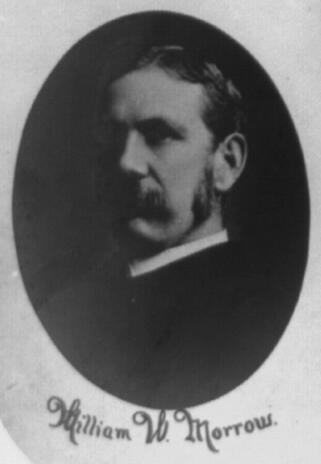
Here you will find contact information for Representative William W. Morrow, including email address, phone number, and mailing address.
| Name | William W. Morrow |
| Position | Representative |
| State | California |
| District | 4 |
| Party | Republican |
| Status | Former Representative |
| Term Start | December 7, 1885 |
| Term End | March 3, 1891 |
| Terms Served | 3 |
| Born | July 15, 1843 |
| Gender | Male |
| Bioguide ID | M001006 |
About Representative William W. Morrow
William W. Morrow (July 15, 1843 – July 24, 1929) was an American politician and judge who served at various times as a United States Representative from California, a United States District Judge of the United States District Court for the Northern District of California, and a United States Circuit Judge of the United States Court of Appeals for the Ninth Circuit and the United States Circuit Courts for the Ninth Circuit. A member of the Republican Party, he represented California in the United States Congress from 1885 to 1891, serving three consecutive terms during a significant period in American political and legal history.
Morrow was born on July 15, 1843, in Milton, Indiana. In 1845 he moved with his parents to Adams County, Illinois, where he attended the common schools and received private instruction. His mother, Margaret Tilley Morrow (1805–1864), was, according to her obituary, widowed twice; her second husband, Morrow’s father, was an Irishman who died only eight years after their marriage. In 1859 Morrow moved to Santa Rosa, California, where as a young man he taught school and explored mining regions, gaining early familiarity with the rapidly developing West.
With the outbreak of the American Civil War, Morrow went east in 1862 to join the Union Army. He served with the National Rifles of the District of Columbia, an independent militia unit that was attached to the Army of the Potomac. After the war, from 1865 to 1869, he served as a special agent for the United States Department of the Treasury and was detailed to California, where he undertook confidential assignments for the United States Secretary of the Treasury. During this period he read law and was admitted to the bar in 1869.
Morrow entered private legal practice in San Francisco, California, from 1869 to 1870, and soon thereafter joined the federal bar. He served as an Assistant United States Attorney for the District of California from 1870 to 1874. In 1872 he assisted in organizing the San Francisco Bar Association, an important step in the professionalization of the legal community in the region, and later served as its president in 1892 and 1893. He resumed private practice in San Francisco from 1874 to 1885, while at the same time becoming increasingly active in Republican Party politics. He was chairman of the Republican state central committee of California from 1879 to 1882, an attorney for the California State Board of Harbor Commissioners from 1880 to 1883, a special United States Attorney before the French and American Claims Commission from 1881 to 1883, and a special United States Attorney before the Alabama Claims Commission from 1882 to 1885. He was also a delegate to the Republican National Convention in 1884. Beyond his legal and political work, Morrow was one of the incorporators of the American Red Cross, reflecting his engagement in emerging national humanitarian institutions.
In his personal life, Morrow married Margaret Hulbert (October 1, 1847 – August 26, 1926), a native of Iowa, on June 18, 1865, in Sonoma, California. The couple had four children: William Hulbert Morrow (1868–1930), who married Katherine Dillon Hinkle (1870–1955) and had one daughter, Arabelle Morrow Mann (1893–1963); Maurice Morrow (1869–1870), who died in infancy; Maud Morrow (1873–1926), who married, on October 13, 1893, then Lieutenant (later Rear Admiral) Augustus F. Fechteler, a United States Navy officer who served in the Spanish–American War, the Philippine–American War, and World War I; and Eleanor Morrow (1879–1958), who married Henry Latrobe Roosevelt (1879–1936) on January 15, 1902; he later served as United States Assistant Secretary of the Navy from 1933 to 1936.
Morrow was elected as a Republican from California’s 4th congressional district to the United States House of Representatives in the 49th, 50th, and 51st Congresses, serving from March 4, 1885, to March 3, 1891. During his three terms in office he participated actively in the legislative process and represented the interests of his California constituents at a time of rapid economic expansion and significant social change. His service in Congress occurred during a critical period in American history marked by debates over immigration, labor, and federal authority. Morrow was at the forefront of the campaign to make federal laws restricting Chinese immigration more severe, aligning himself with the prevailing anti-Chinese sentiment in much of the West and supporting stricter enforcement and expansion of exclusionary policies. He was not a candidate for renomination in 1890 and, upon leaving Congress in March 1891, briefly returned to private practice in San Francisco.
Morrow’s congressional career was followed by a long and influential tenure on the federal bench. He received a recess appointment from President Benjamin Harrison on August 11, 1891, to a seat on the United States District Court for the Northern District of California vacated by Judge Ogden Hoffman Jr. Harrison formally nominated him to the same position on December 10, 1891, and the United States Senate confirmed him on January 11, 1892, with Morrow receiving his commission that same day. His service on the district court continued until June 1, 1897, when he was elevated to the Ninth Circuit. While serving on the district court, Morrow issued a notable ruling in the case of In re Wong Kim Ark, holding that Chinese children born in the United States were automatically United States citizens under the Fourteenth Amendment. This decision, later affirmed by the Supreme Court, became a landmark in the constitutional law of citizenship and birthright nationality.
On May 18, 1897, President William McKinley nominated Morrow to a joint seat on the United States Court of Appeals for the Ninth Circuit and the United States Circuit Courts for the Ninth Circuit, to fill the vacancy created by the elevation of Judge Joseph McKenna. The Senate confirmed him on May 20, 1897, and he received his commission the same day. He served concurrently on the Court of Appeals and the Circuit Courts until December 31, 1911, when the Circuit Courts were abolished and he thereafter sat solely on the Court of Appeals. Morrow assumed senior status on January 1, 1923, but continued to serve in a reduced capacity. He was the last appeals court judge in active service who had been appointed by President McKinley, underscoring the length of his judicial career and his continuity across several eras of federal jurisprudence.
Morrow resided in San Francisco, San Francisco County, California, during his later years and remained a prominent figure in the city’s legal and civic life. His service on the United States Court of Appeals for the Ninth Circuit terminated on July 24, 1929, upon his death in San Francisco. He was interred in Cypress Lawn Cemetery in Colma, California.