Representative William H. Natcher
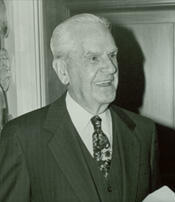
Here you will find contact information for Representative William H. Natcher, including email address, phone number, and mailing address.
| Name | William H. Natcher |
| Position | Representative |
| State | Kentucky |
| District | 2 |
| Party | Democratic |
| Status | Former Representative |
| Term Start | January 3, 1953 |
| Term End | January 3, 1995 |
| Terms Served | 21 |
| Born | September 11, 1909 |
| Gender | Male |
| Bioguide ID | N000009 |
About Representative William H. Natcher
William Huston Natcher (September 11, 1909 – March 29, 1994) was a Democratic congressman from Kentucky who served in the United States House of Representatives from January 3, 1953, until his death in 1994. Over the course of 21 consecutive terms, he became the second longest-serving member ever of the United States House of Representatives from the Commonwealth of Kentucky and established the all-time congressional record for a perfect voting streak, casting 18,401 consecutive roll-call votes. His service in Congress spanned more than four decades, during a significant period in American history, and he was known for his meticulous attention to legislative detail, his refusal to accept campaign contributions, and his steadfast representation of his constituents.
Natcher was born on September 11, 1909, in Bowling Green, Warren County, Kentucky. He grew up in south-central Kentucky and maintained a lifelong connection to his native region, which would later form the core of his congressional district. In 1930, he received a Bachelor of Arts degree from Western Kentucky State College (now Western Kentucky University) in Bowling Green. He went on to study law at Ohio State University in Columbus, earning an LL.B. in 1933. In 1937, Natcher married, and he and his wife had two daughters, balancing family life with an increasingly active legal and political career.
After completing his legal education, Natcher returned to Bowling Green to practice law. He quickly entered public service, serving from 1936 to 1937 as the U.S. Conciliation Commissioner for the Western District of Kentucky. He was elected Warren County Attorney, a position he held from 1938 to 1950, building a reputation as a diligent and methodical prosecutor. During this period he also became active in party politics, serving as president of Kentucky’s Young Democratic Clubs from 1941 to 1946, which enhanced his profile within the state Democratic Party and laid the groundwork for his later congressional career.
During World War II, Natcher served in the United States Navy, adding military service to his record of public commitment. Following the war, he resumed his legal and prosecutorial work in Kentucky. From 1951 to 1953 he served as Commonwealth’s Attorney for Kentucky’s Eighth Judicial District, further solidifying his standing as a respected legal figure in the state. His combination of local legal experience, party leadership, and military service positioned him as a strong candidate for national office at a time when Kentucky politics were dominated by the Democratic Party.
Natcher was elected as a Democrat to the United States House of Representatives in 1952 and took office on January 3, 1953, representing Kentucky’s 2nd Congressional District. He would hold this seat continuously until his death in 1994. Over his forty-one-year congressional career, he participated actively in the democratic process and represented the interests of his constituents through a period that encompassed the Cold War, the civil rights era, the Great Society, the Vietnam War, and the end of the Soviet Union. He became widely known for his extraordinary voting record: from his swearing-in in 1953 until March 3, 1994, he did not miss a single roll-call vote, casting 18,401 consecutive votes. This remains the longest perfect voting record in the history of Congress, covering nearly the entirety of his service. On the day of his last vote, March 3, 1994, he arrived at the Capitol from Bethesda Naval Hospital by ambulance and was wheeled onto the House floor on a gurney to cast his vote. On the following day he missed the first vote of his career when doctors advised him not to return to the Capitol, and he never again appeared on the House floor.
Within the House, Natcher developed a reputation as a master of procedure and a disciplined legislator. His deep knowledge of House rules in debate led Speaker Thomas P. “Tip” O’Neill Jr. to employ him frequently as a presiding officer during crucial debates. Over time, he rose in seniority on the powerful House Appropriations Committee, one of the most influential panels in Congress. In 1993 he became chairman of the House Appropriations Committee, a post he held until his death in 1994. Natcher was unusual among modern members of Congress in that he refused to accept campaign contributions, relying instead on his personal frugality, name recognition, and long-standing relationships with voters in his district.
Natcher’s voting record on civil rights legislation reflected a complex stance for a Southern Democrat of his era. He did not sign the 1956 Southern Manifesto, a document in which many Southern lawmakers opposed the Supreme Court’s decision in Brown v. Board of Education. He voted in favor of the Civil Rights Acts of 1960 and 1968, supported the 24th Amendment to the U.S. Constitution prohibiting poll taxes in federal elections, and backed the Voting Rights Act of 1965. At the same time, he voted against the Civil Rights Acts of 1957 and 1964. These positions placed him somewhat apart from the most hard-line segregationists of the South, while still reflecting the tensions and gradual evolution of civil rights policy among many legislators from border and Southern states during that period.
Transportation and infrastructure were central concerns of Natcher’s congressional career. He was a pro-highway congressman who strongly encouraged road projects both within Kentucky and in the nation’s capital. In Kentucky, he championed major transportation initiatives, including the construction of a cable-stayed bridge across the Ohio River near Owensboro. Through his efforts, the majority of federal funding was secured for the bridge that now carries U.S. Highway 231 between Maceo, Kentucky, and Rockport, Indiana; this structure was named the William H. Natcher Bridge in his honor before his death, though it was not completed until 2002. He also was instrumental in the development of the highway originally known as the Green River Parkway, a toll road running between Bowling Green and Owensboro that opened in 1972. The road was renamed the William H. Natcher Parkway in 1997 and later redesignated Interstate 165 in 2019 as the William H. Natcher Expressway.
Natcher’s advocacy for highways also shaped transportation policy in the Washington, D.C., region. From 1970 to 1973, he repeatedly held up federal funding for the Washington Metro system, delaying its construction. He refused to allow Metro funding to proceed until Arlington County, Virginia, officials agreed to route Interstate 66 through North Arlington neighborhoods. In addition, he pressed for construction of the controversial Three Sisters Bridge across the Potomac River, insisting that work on the bridge begin before funds could be released to the Washington Metropolitan Area Transit Authority (WMATA). Eventually, a coalition of members of Congress led by Representative Robert Giaimo circumvented Natcher’s efforts, preventing the bridge’s construction and allowing Metro funding to move forward.
Beyond transportation, Natcher was a passionate supporter of libraries and literacy. During his congressional service he consistently fought for continued federal funding for library construction and literacy initiatives, helping to sustain and expand programs that promoted reading and access to information. His legacy in this area is commemorated by the Kentucky Library Association’s William H. Natcher Award, presented annually for acts of philanthropy and support of libraries within the Commonwealth of Kentucky. His interest in education and public knowledge also extended to the federal research infrastructure; Building 45 of the National Institutes of Health (NIH) in Bethesda, Maryland, is named in his honor, reflecting his influence on federal appropriations for health and research.
In the final weeks of his life, Natcher’s long public service was formally recognized at the national level. On March 4, 1994, President Bill Clinton presented him with the Presidential Citizens Medal, one of the nation’s highest civilian honors, acknowledging his decades of dedicated service and his extraordinary commitment to his duties as a legislator. William Huston Natcher continued to serve in Congress until his death from heart failure on March 29, 1994, at Bethesda, Maryland. His death brought to a close one of the longest and most disciplined congressional careers in Kentucky’s history, and he is remembered both for his unwavering voting record and for his substantial influence on appropriations, transportation policy, and public institutions.