Representative William Augustus Newell
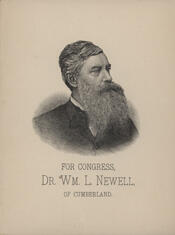
Here you will find contact information for Representative William Augustus Newell, including email address, phone number, and mailing address.
| Name | William Augustus Newell |
| Position | Representative |
| State | New Jersey |
| District | 2 |
| Party | Republican |
| Status | Former Representative |
| Term Start | December 6, 1847 |
| Term End | March 3, 1867 |
| Terms Served | 3 |
| Born | September 5, 1817 |
| Gender | Male |
| Bioguide ID | N000066 |
About Representative William Augustus Newell
William Augustus Newell (September 5, 1817 – August 8, 1901) was an American physician and politician who served as the 18th Governor of New Jersey, the 11th Governor of Washington Territory, and a three-term Representative from New Jersey in the United States House of Representatives. A member of the Republican Party for much of his public career, he is best known in Congress for sponsoring the Newell Act, which created the United States Life-Saving Service, a federal agency established to save the lives of shipwrecked mariners and passengers.
Newell was born in Franklin, New Jersey, on September 5, 1817. He pursued a classical and medical education in his youth, ultimately preparing for a career in medicine. After completing his medical studies, he established himself as a practicing physician. His medical background and interest in public welfare would later inform his legislative priorities, particularly in the areas of public safety and humanitarian relief.
Entering public life as a young man, Newell was first elected to the United States House of Representatives as a Representative from New Jersey in 1847. His service in Congress extended, with intervals, through 1867, encompassing three terms in the House during a period of profound national change and conflict. Serving initially as a Whig and later aligning with the emerging Republican Party, he participated in the legislative process at a time that spanned the years leading up to the Civil War, the conflict itself, and the early phase of Reconstruction. Throughout his tenure, he represented the interests of his New Jersey constituents while engaging in the broader national debates of the era.
Newell’s most enduring legislative achievement was the Newell Act, which laid the foundation for the United States Life-Saving Service. Drawing in part on his medical training and concern for human life, he advocated for a systematic, federally supported effort to rescue shipwrecked sailors and passengers along the nation’s coasts. The Life-Saving Service, created under this act, became a critical federal agency dedicated to maritime safety and rescue operations and later formed a key component of what would become the United States Coast Guard. His work on this legislation secured his reputation as a reform-minded lawmaker attentive to practical humanitarian needs.
In addition to his congressional service, Newell rose to prominence in state and territorial executive office. He served as the 18th Governor of New Jersey, where he oversaw state affairs during a time of political realignment and growing sectional tensions. Later, he was appointed the 11th Governor of Washington Territory, extending his public service to the Pacific Northwest. In that role he confronted the challenges of administering a developing territory, promoting settlement, and managing relations between federal authorities, settlers, and Indigenous peoples. His combined experience as a physician, legislator, and executive gave him a broad perspective on governance at both the state and territorial levels.
After leaving high public office, Newell returned to private life, remaining identified with the Republican Party and with the causes that had defined his career, particularly public safety and institutional reform. He continued to be remembered in New Jersey and beyond for his contributions to maritime rescue and for his leadership during a formative period in American history. William Augustus Newell died on August 8, 1901, closing a long life that spanned from the antebellum era through the turn of the twentieth century and leaving a legacy marked by humanitarian legislation and executive service on both the East and West Coasts of the United States.