Representative William Allan Oldfield
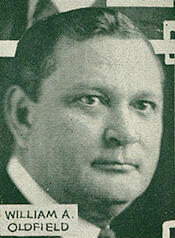
Here you will find contact information for Representative William Allan Oldfield, including email address, phone number, and mailing address.
| Name | William Allan Oldfield |
| Position | Representative |
| State | Arkansas |
| District | 2 |
| Party | Democratic |
| Status | Former Representative |
| Term Start | March 15, 1909 |
| Term End | March 3, 1929 |
| Terms Served | 10 |
| Born | February 4, 1874 |
| Gender | Male |
| Bioguide ID | O000062 |
About Representative William Allan Oldfield
William Allan Oldfield (February 4, 1874 – November 19, 1928) was an American lawyer and Democratic politician who served as a U.S. Representative from Arkansas from 1909 until his death. Over the course of ten consecutive terms in the United States Congress, he represented his Arkansas constituents during a significant period in American history and played an active role in the legislative process, including service in key leadership and committee positions.
Oldfield was born on February 4, 1874, in Franklin, Izard County, Arkansas, the son of blacksmith Milton Oldfield and Mary Ann (Matheny) Oldfield. He attended the public schools of Franklin and completed his secondary education at Melbourne High School, from which he graduated in 1892. After high school, he enrolled at Arkansas College in Batesville (later known as Lyon College), where he pursued a classical education and graduated in 1896. Following his graduation, Oldfield became a schoolteacher and later principal in Richmond, Arkansas, positions he held while simultaneously beginning the study of law, reflecting an early commitment to both education and public service.
With the outbreak of the Spanish–American War in 1898, Oldfield enlisted in the United States military, entering service as a private in Company M of the 2nd Arkansas Infantry Regiment. During his wartime service he rose through the enlisted ranks to first sergeant and subsequently received a commission as a first lieutenant. He was mustered out of the service in March 1899. This period of military service provided him with leadership experience and a broader national perspective that would later inform his political career.
After returning to civilian life, Oldfield continued his legal studies and enrolled in the law department of Cumberland University in Lebanon, Tennessee. He graduated from Cumberland University’s law school in 1900, was admitted to the bar the same year, and commenced the practice of law in Batesville, Arkansas. A member of the Democratic Party, he quickly entered public life at the local level. From 1902 to 1906 he served as prosecuting attorney of Independence County, Arkansas, gaining a reputation as an able lawyer and public official. In 1906, he sought higher office as a candidate for the United States House of Representatives, but his initial bid for Congress was unsuccessful.
Oldfield’s persistence in politics was rewarded two years later. In 1908, he was elected as a Democrat to the 61st Congress and took his seat in the U.S. House of Representatives on March 4, 1909. He was subsequently reelected ten times, serving continuously from March 4, 1909, until his death on November 19, 1928. During his long tenure in the House, Oldfield represented Arkansas through a transformative era that included the Progressive Era, World War I, and the early years of the 1920s, consistently participating in the democratic process and advocating for the interests of his constituents.
Within Congress, Oldfield held several important leadership and committee posts. He served as chairman of the House Committee on Patents during the 62nd and 63rd Congresses, where he helped oversee legislation related to intellectual property and innovation. He later rose to party leadership as the Democratic Minority Whip, a position he held from the 67th through the 70th Congress, playing a central role in organizing and directing the legislative strategy of House Democrats. In addition, he was a member of the influential Committee on Ways and Means, which is responsible for taxation and revenue measures, and he served as chairman of the Democratic Congressional Campaign Committee, helping to coordinate his party’s electoral efforts for the House of Representatives.
In his personal life, Oldfield married Fannie Pearl Peden in 1901. Known publicly as Pearl P. Oldfield, she was his partner throughout his political career, and the couple had no children. Oldfield’s final election came in 1928, when he won reelection to the 71st Congress. However, he did not live to begin that new term. He died in office in Washington, D.C., on November 19, 1928, having served nearly two decades in the House. After his death, his wife, Pearl P. Oldfield, was elected to succeed him and took his seat in the 71st Congress, continuing the representation of their Arkansas district.
William Allan Oldfield was buried in Oak Lawn Cemetery in Batesville, Arkansas. His career placed him among the members of the United States Congress who died in office between 1900 and 1949, and his long service, leadership roles, and influence within the Democratic Party left a notable imprint on Arkansas’s congressional history and on the national legislative record of the early twentieth century.