Senator William Alfred Peffer
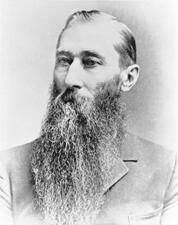
Here you will find contact information for Senator William Alfred Peffer, including email address, phone number, and mailing address.
| Name | William Alfred Peffer |
| Position | Senator |
| State | Kansas |
| Party | Populist |
| Status | Former Representative |
| Term Start | December 7, 1891 |
| Term End | March 3, 1897 |
| Terms Served | 1 |
| Born | September 10, 1831 |
| Gender | Male |
| Bioguide ID | P000188 |
About Senator William Alfred Peffer
William Alfred Peffer (September 10, 1831 – October 6, 1912) was an American lawyer, Union Army officer during the American Civil War, journalist, state legislator, and United States Senator from Kansas. A prominent figure in the People’s (Populist) Party, he was the first of six Populists—two of them from Kansas—elected to the United States Senate. In the Senate he was widely recognizable for his enormous flowing beard, and his name was raised as a possible third‑party presidential candidate in 1896. His single term in the Senate, from 1891 to 1897, coincided with a significant period of agrarian unrest and political realignment in American history.
Peffer was born in Cumberland County, Pennsylvania, where he attended public schools and began teaching at the age of fifteen. Drawn by the opportunities of the era, he followed the gold rush to San Francisco, California, in 1850. In the ensuing decade he moved frequently through the Midwest, settling in Penn Township, St. Joseph County, Indiana, in 1853, then in Missouri in 1859, and Illinois in 1862. These early experiences in frontier and rural communities helped shape his later identification with farmers and small producers, themes that would become central to his political and literary work.
During the American Civil War, Peffer enlisted in the Union Army as a private and rose through the ranks to second lieutenant. He served as regimental quartermaster and adjutant, post adjutant, and judge advocate of the military commission and department, gaining administrative and legal experience that would inform his postwar career. After the war he studied law and was admitted to the bar in 1865, commencing legal practice in Clarksville, Tennessee. In 1870 he moved to Fredonia, Kansas, where he continued the practice of law and entered journalism by purchasing and editing the Fredonia Journal, combining legal work with an emerging role as a public commentator.
Peffer’s political career began in Kansas state government. He served as a member of the Kansas Senate from 1874 to 1876. During this period he moved to Coffeyville, Kansas, where in 1875 he edited the Coffeyville Journal while continuing to practice law. His growing prominence in Republican politics led to his service as a presidential elector on the Republican ticket of James A. Garfield in 1880. In 1881 he became editor of the Topeka-based Kansas Farmer, a widely read agricultural journal, through which he articulated the concerns of farmers and helped build the agrarian reform movement that would feed into the Populist Party.
Elected as a Populist to the United States Senate by the Kansas Legislature, Peffer served from March 4, 1891, to March 3, 1897, completing one term in office. His campaign was materially strengthened by the organizing and oratorical work of Mary Elizabeth Lease, another leading Kansas Populist. As a member of the Senate during a period of economic distress and intense debate over monetary policy, railroad regulation, and agrarian reform, he participated in the legislative process and represented the interests of his Kansas constituents and the broader Populist movement. He served as chairman of the Committee to Examine Branches of the Civil Service during the Fifty-third and Fifty-fourth Congresses, reflecting Populist concerns with governmental efficiency and reform. His service in Congress occurred during a significant period in American history marked by the rise of third-party challenges to the two major parties.
Peffer was an unsuccessful candidate for reelection to the Senate in 1896, losing to fellow Populist William A. Harris. This made him the only Populist senator to be succeeded by another Populist. His name had been mentioned that same year as a possible third‑party presidential candidate, underscoring his national visibility within the movement. In 1898 he ran unsuccessfully for governor of Kansas, after which he withdrew from active electoral politics and devoted himself largely to writing and other literary pursuits.
In his later years, Peffer became known for his extensive literary output on politics, history, and agrarian issues. His works included the poem “Myriorama: a view of our people and their history, together with the principles underlying, and the circumstances attending the rise and progress of the American Union” (1868); “The Farmers’ Side – His Troubles and Their Remedy” (1890), a major statement of agrarian protest; and “Agricultural Depressions: Causes and Remedies” (1893), which analyzed the economic hardships facing rural America. He also authored “Populism: Its Rise and Fall,” published in 1899, later edited by Peter H. Argersinger and reissued by the University Press of Kansas, which provided an insider’s account of the People’s Party. Peffer died in Grenola, Kansas, on October 6, 1912, and was interred in Topeka Cemetery under a soldier’s government-issued tombstone, a final acknowledgment of his Civil War service as well as his long public career.