Representative William Pennington
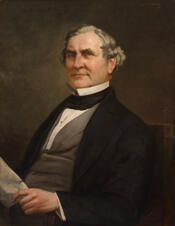
Here you will find contact information for Representative William Pennington, including email address, phone number, and mailing address.
| Name | William Pennington |
| Position | Representative |
| State | New Jersey |
| District | 5 |
| Party | Republican |
| Status | Former Representative |
| Term Start | December 5, 1859 |
| Term End | March 3, 1861 |
| Terms Served | 1 |
| Born | May 4, 1796 |
| Gender | Male |
| Bioguide ID | P000214 |
About Representative William Pennington
William Pennington (May 4, 1796 – February 16, 1862) was an American politician and lawyer who served as a Representative from New Jersey in the United States Congress from 1859 to 1861. A member of the Republican Party in his later career, he was the 13th governor of New Jersey from 1837 to 1843 and, during his single term in the United States House of Representatives, served as the first Republican Speaker of the House from 1860 to 1861. His service in Congress occurred during a significant period in American history on the eve of the Civil War, during which he participated in the legislative and democratic processes and represented the interests of his New Jersey constituents.
Pennington was born in Newark, New Jersey, on May 4, 1796, into a politically prominent family. His father, William Sanford Pennington, was a veteran of the American Revolutionary War and later served as governor of New Jersey from 1813 to 1815 before being appointed a federal judge of the United States District Court for the District of New Jersey by President James Madison. Growing up in this environment, the younger Pennington was exposed early to public affairs and the law, influences that shaped his own professional and political trajectory.
Pennington pursued higher education at the College of New Jersey (now Princeton University), from which he graduated in 1813. Following his graduation, he read law under the tutelage of Theodore Frelinghuysen, a prominent New Jersey lawyer and future United States senator and vice-presidential candidate. Pennington was admitted to the bar in 1817. That same year he began service as clerk of the United States District Court for the District of New Jersey, where his father sat as judge, a position he held from 1817 to 1826. Through this work he gained extensive practical experience in federal legal procedure and administration, complementing his formal legal training.
Entering public life as a member of the Whig Party, Pennington was elected to the New Jersey General Assembly in 1828. His legislative service helped establish his reputation as a capable Whig leader in the state. In 1837 he was elected governor of New Jersey, and he was subsequently re‑elected annually, serving continuously as the state’s 13th governor from 1837 to 1843. His tenure as governor was marked by the “Broad Seal War,” a major political controversy arising from a disputed election for New Jersey’s congressional delegation. In that dispute, Pennington certified the election of five Whig candidates, while the Democratic secretary of state certified five Democratic candidates. After a prolonged contest in the U.S. House of Representatives, the Democratic claimants were ultimately seated, highlighting the intense partisan struggles of the era and placing Pennington at the center of a nationally watched conflict over electoral legitimacy.
After several years out of high office, Pennington returned to national politics in the 1850s as the Whig Party collapsed and the Republican Party emerged. In November 1858 he was elected as a Republican to represent New Jersey’s 5th congressional district in the U.S. House of Representatives for the 36th Congress, serving from 1859 to 1861. When the House convened in December 1859 amid rising sectional tensions, the election of a Speaker became a protracted and contentious battle. After 44 ballots over eight weeks, from December 5, 1859, to February 1, 1860, Pennington was chosen Speaker of the House. His election was historically notable: it was only the second time since 1789 that the House selected a freshman representative as Speaker, the first having been Henry Clay in 1811, and this circumstance has not been repeated since. As the first Republican Speaker, Pennington presided over a deeply divided House during the critical months leading up to the secession crisis.
During his term in Congress, Pennington engaged in the legislative debates of a nation on the brink of civil war. In March 1861, shortly before the outbreak of hostilities, he signed the Corwin Amendment, a proposed amendment to the United States Constitution intended to protect state “domestic institutions”—a contemporary euphemism for slavery—from future constitutional amendments and from abolition or interference by Congress. The amendment was submitted to the states for ratification but was never adopted by the requisite number of states. Pennington’s support for the measure reflected the efforts of many contemporaries to avert disunion through constitutional compromise, even as sectional tensions proved irreconcilable. He ran unsuccessfully for reelection in 1860 to the 37th Congress, and his service in the House concluded in March 1861 at the end of his single term.
After leaving Congress, Pennington returned to New Jersey and resumed private life in Newark. His long public career had spanned service in state and federal offices during a transformative period in American political history, from the early republic through the rise of the Republican Party and the approach of civil war. He died in Newark on February 16, 1862, from an unintentional morphine overdose. William Pennington was interred at Mount Pleasant Cemetery in Newark, New Jersey, closing the life of a figure who had held both the governorship of his state and the speakership of the national House of Representatives during some of the most contentious decades of the nineteenth century.