Representative William Townsend Pheiffer
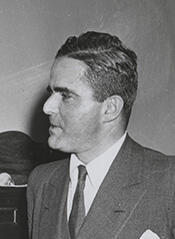
Here you will find contact information for Representative William Townsend Pheiffer, including email address, phone number, and mailing address.
| Name | William Townsend Pheiffer |
| Position | Representative |
| State | New York |
| District | 16 |
| Party | Republican |
| Status | Former Representative |
| Term Start | January 3, 1941 |
| Term End | January 3, 1943 |
| Terms Served | 1 |
| Born | July 15, 1898 |
| Gender | Male |
| Bioguide ID | P000288 |
About Representative William Townsend Pheiffer
William Townsend Pheiffer (July 15, 1898 – August 16, 1986) was an American lawyer, Republican politician, and diplomat who served as a Representative from New York in the 77th Congress from 1941 to 1943 and later as United States Ambassador to the Dominican Republic. A member of the Republican Party, he contributed to the legislative process during one term in the House of Representatives, representing a Manhattan district during a significant period in American history and participating in the democratic process on behalf of his constituents.
Pheiffer was born on July 15, 1898, in Purcell, Indian Territory (now Purcell, Oklahoma), the son of attorney William Pfeiffer (born 1869) and Susan Garfinkel (born 1869). He had one brother, Harry R. Pfeiffer (born 1896). Through his mother, he was a nephew of Julius Garfinckel, the prominent Washington, D.C., merchant and founder of the Garfinckel’s department store. He attended public schools in Purcell, Ardmore, and Oklahoma City, Oklahoma, before pursuing higher education at the University of Southern California, where he became a member of the Chi Phi fraternity.
During World War I, Pheiffer served in the United States Army as a private in the cavalry in 1918. After his military service, he returned to his studies and earned a law degree from the law school of the University of Oklahoma in 1919. That same year he was admitted to the bar and began a general law practice, following in his father’s professional footsteps. From 1923 to 1926 he practiced law in Sayre, Oklahoma, and in 1924 he was a candidate for the 2nd District in the Oklahoma State Senate, marking his early entry into Republican politics.
In 1926, Pheiffer moved to Amarillo, Texas, where he continued the practice of law and became active in Republican Party affairs. He served as an alternate delegate from Texas to the 1932 Republican National Convention in Chicago, Illinois, and was a delegate to Republican state conventions in 1936 and 1942. In 1939 he relocated to New York City, establishing himself professionally and politically on the East Side of Manhattan. In the 1940 election he won a seat in the U.S. House of Representatives as a Republican from New York’s 16th Congressional District, a traditionally Democratic district, becoming the first Republican to carry the district. He defeated the Democratic incumbent, James Fay, and served in the 77th Congress from January 3, 1941, to January 3, 1943. His congressional service coincided with the early years of World War II, during which he represented the interests of his Manhattan constituents and participated in national legislative deliberations. In the 1942 election he was narrowly defeated for reelection by Fay, losing by a margin of 80 votes. The 16th District itself was later merged with other districts in a 1944 reapportionment.
Following his term in Congress, and during World War II, Pheiffer again entered military service. He was commissioned as a captain in the cavalry and served in the United States Army from March 12, 1943, to April 22, 1944. On August 1, 1944, he was appointed counsel to the Petroleum Administration for War in Washington, D.C., a position he held until February 8, 1945, contributing legal expertise to the wartime management of vital energy resources. After leaving that post, he resumed private practice as a member of the New York and Washington, D.C., law firm of Pheiffer, Stephens & Weaver. At the same time, he remained deeply involved in Republican national politics, serving from 1945 to 1948 as an executive assistant in charge of the New York headquarters of the Republican National Committee.
Pheiffer’s diplomatic career began under President Dwight D. Eisenhower, who appointed him Ambassador Extraordinary and Plenipotentiary of the United States to the Dominican Republic on May 28, 1953. He presented his credentials on June 29, 1953, and served as the chief U.S. envoy in Ciudad Trujillo (now Santo Domingo) during a period marked by the authoritarian rule of Rafael Trujillo and complex U.S.–Caribbean relations. On March 20, 1954, while serving in this post, he married Frances Margaret Laacke (September 30, 1892 – July 8, 1993) at the Everglades Club in Palm Beach, Florida. She had previously been married to and divorced from physician Samuel G. Higgins and was the widow of Milwaukee brewer and real estate dealer George E. Uihlein. After their marriage, the couple returned to the Dominican Republic and took up residence together at the U.S. Embassy in Ciudad Trujillo. Pheiffer continued as ambassador until June 2, 1957.
After concluding his diplomatic service, Pheiffer and his wife returned to New York, where he resumed the practice of law. He maintained his legal office at 645 Madison Avenue in Manhattan and continued to be associated with Republican political circles and public affairs. William Townsend Pheiffer died at age 88 on August 16, 1986, at his home in New York City, having spent a long career as a lawyer, legislator, party official, and diplomat.