Representative William Cox Redfield
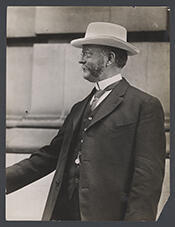
Here you will find contact information for Representative William Cox Redfield, including email address, phone number, and mailing address.
| Name | William Cox Redfield |
| Position | Representative |
| State | New York |
| District | 5 |
| Party | Democratic |
| Status | Former Representative |
| Term Start | April 4, 1911 |
| Term End | March 3, 1913 |
| Terms Served | 1 |
| Born | June 18, 1858 |
| Gender | Male |
| Bioguide ID | R000105 |
About Representative William Cox Redfield
William Cox Redfield (June 18, 1858 – June 13, 1932) was a Democratic politician from New York who served both in the United States Congress and as the first United States Secretary of Commerce. Born in 1858, he came of age during the post–Civil War industrial expansion, an era that would shape his later interests in manufacturing, labor relations, and economic policy. Although detailed records of his early family life and schooling are sparse, his subsequent public career reflected a sustained engagement with the challenges of industrialization and the organization of modern commerce.
Redfield’s formal education and early professional pursuits prepared him for a life in public service and industry, and he developed a particular expertise in industrial organization and labor issues. By the early twentieth century he had established himself as a figure knowledgeable about manufacturing and the conditions of working men, interests that would inform both his writings and his political positions. His growing prominence in civic and economic affairs in New York laid the groundwork for his entry into municipal and then national politics.
Before his service in the federal government, Redfield held local office as Commissioner of Public Works for Brooklyn, New York. In that capacity he was involved in the administration of public infrastructure and urban services at a time when Brooklyn was rapidly growing and integrating more fully into the greater New York metropolitan area. His experience in managing public works and dealing with the practical problems of a large city helped to shape his views on efficient administration, public investment, and the relationship between government and industry.
Redfield entered national politics as a member of the Democratic Party and was elected to the United States House of Representatives from New York’s 5th congressional district. He served as a Representative from New York in the United States Congress from 1911 to 1913, completing one term in office. His service in Congress occurred during a significant period in American history, as the nation grappled with issues of industrial regulation, tariff policy, and social reform in the years immediately preceding World War I. As a member of the House of Representatives, Redfield participated in the legislative process and represented the interests of his constituents, contributing to debates over economic and labor policy consistent with his background in industry and his support for labor rights.
While serving in Congress, Redfield became a figure of national prominence within the Democratic Party. In 1912 he was an unsuccessful candidate for the Democratic vice presidential nomination, reflecting his rising stature among party leaders during the pivotal election that brought Woodrow Wilson to the presidency. His advocacy for labor rights and his interest in industrial reform aligned with progressive currents within the party and positioned him as a spokesman for a more modern, regulated industrial economy.
Redfield’s most significant federal service came in the executive branch. Appointed by President Woodrow Wilson, he served as the first Secretary of Commerce from 1913 to 1919, following the division of the Department of Commerce and Labor into two separate departments. As Secretary of Commerce, he oversaw the newly independent department during a period marked by rapid industrial growth, expanding international trade, and the economic mobilization associated with World War I. In this role he worked to improve the collection and use of commercial statistics, to foster American manufacturing and export trade, and to mediate between business and labor in an era of increasing federal involvement in economic affairs.
In addition to his public offices, Redfield was an author and commentator on industrial and international economic issues. In 1912 he published “The New Industrial Day, a Book for Men Who Employ Men,” in which he set out his views on labor, management, and the responsibilities of employers in a modern industrial society. That same year he contributed an article, “The Progress of Japanese Industry,” to The Journal of Race Development, reflecting his interest in comparative industrial development and the rise of non-Western manufacturing powers. After his cabinet service, he continued to reflect on his experiences and on world affairs in two later books: “With Congress and Cabinet” (1924), a memoir and analysis of his years in legislative and executive office, and “We and the World” (1927), which addressed broader questions of America’s place in international economic and political life.
William Cox Redfield died on June 13, 1932, just days before his seventy-fourth birthday. His career spanned local administration in Brooklyn, legislative service in the House of Representatives from 1911 to 1913, and a formative tenure as the first Secretary of Commerce from 1913 to 1919. Through his public offices and his writings, he helped shape early twentieth-century American thinking about industry, labor, and the role of the federal government in managing and promoting commerce at home and abroad.