Senator William Chapman Revercomb
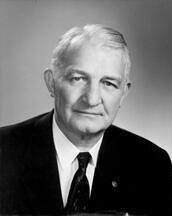
Here you will find contact information for Senator William Chapman Revercomb, including email address, phone number, and mailing address.
| Name | William Chapman Revercomb |
| Position | Senator |
| State | West Virginia |
| Party | Republican |
| Status | Former Representative |
| Term Start | January 6, 1943 |
| Term End | January 3, 1959 |
| Terms Served | 2 |
| Born | July 20, 1895 |
| Gender | Male |
| Bioguide ID | R000167 |
About Senator William Chapman Revercomb
William Chapman Revercomb (July 20, 1895 – October 6, 1979) was an American politician and lawyer who served as a United States Senator from West Virginia. A member of the Republican Party, he served two separate terms in the Senate, participating in the legislative process during a significant period in American history and representing the interests of his West Virginia constituents.
Revercomb was born on July 20, 1895, in Covington, Virginia, the son of Elizabeth Forrer (Chapman) and George Anderson Revercomb. He was raised in the Alleghany Highlands region and received his early education locally before pursuing higher studies. He attended Washington and Lee University in Lexington, Virginia, where he began preparing for a professional career before the outbreak of World War I interrupted his education.
During World War I, Revercomb entered the United States Army and served as a corporal. His military service occurred during the final phases of the conflict, and, like many of his generation, he returned from the war with a determination to complete his education and enter public life. After his discharge, he transferred to the law school at the University of Virginia, from which he graduated in 1919. Upon admission to the bar, he began practicing law in his hometown of Covington, Virginia, where he worked for several years before relocating in 1922 to Charleston, West Virginia, to continue his legal career. His move to Charleston marked the beginning of his long association with West Virginia, both professionally and politically.
Revercomb’s political career reached the national stage when he was elected to the United States Senate in 1942 as a Republican from West Virginia. His first term in the Senate began on January 3, 1943, placing him in Congress during World War II and the early years of the postwar era. During this period, he contributed to the legislative process over what is often broadly described as service from 1943 to 1959, encompassing his two nonconsecutive terms. In the Senate, Revercomb became known for his opposition to several foreign and domestic policies of President Harry S. Truman’s administration. He was one of seven senators in 1945 who opposed full United States entry into the United Nations, reflecting his skepticism about certain aspects of postwar international commitments. At the same time, he emerged as a stalwart supporter of civil rights and aligned himself with the national Republican Party’s civil rights policies, a stance that would significantly shape his subsequent electoral fortunes.
Revercomb’s advocacy of civil rights proved controversial in West Virginia politics of the mid‑twentieth century. In 1948, he was defeated for re-election to the Senate, and in 1952 he lost a race for the state’s other Senate seat. In both contests, his support for the national Republican Party’s civil rights program became a major campaign issue and contributed to his defeats. Despite these setbacks, he remained an influential figure within the state Republican Party and continued his legal practice in Charleston while staying active in public affairs.
Revercomb returned to the Senate following a special election in 1956, which he won to fill the vacancy created by the death of Democratic Senator Harley M. Kilgore, who had been his opponent in the 1952 Senate race. His second tenure in the Senate extended from 1956 through the end of 1958. During this period, he again played a role in significant national debates, most notably by voting in favor of the Civil Rights Act of 1957, the first major federal civil rights legislation enacted since Reconstruction. His support for this landmark measure was consistent with his long-standing commitment to civil rights and further distinguished him within the political landscape of his state.
In 1958, Revercomb sought re-election but was defeated in a landslide by Congressman Robert C. Byrd in another racially charged campaign. Byrd would go on to hold the seat until his death in 2010, becoming the first U.S. senator to serve uninterrupted for more than 50 years. Revercomb’s 1956–1959 term made him the last Republican to represent West Virginia in the United States Senate until the inauguration of Shelley Moore Capito in 2015, underscoring the long-term shift in the state’s senatorial representation that followed his departure from office.
After leaving the Senate, Revercomb remained engaged in state politics for a brief period. He sought the Republican nomination for governor of West Virginia in 1960 but was unsuccessful. Following this defeat, he retired from active political life and devoted himself primarily to his law practice in Charleston. He continued to practice law there for the remainder of his career, maintaining a respected position in the state’s legal community.
William Chapman Revercomb died on October 6, 1979, in West Virginia. He was interred at Sunset Memorial Park in South Charleston, West Virginia. His career spanned military service in World War I, decades of legal practice, and two nonconsecutive terms in the United States Senate, during which he became particularly noted for his positions on civil rights and his role in mid‑twentieth‑century West Virginia and national politics.