Senator William Nathaniel Roach
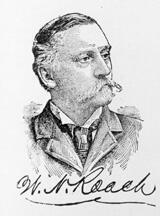
Here you will find contact information for Senator William Nathaniel Roach, including email address, phone number, and mailing address.
| Name | William Nathaniel Roach |
| Position | Senator |
| State | North Dakota |
| Party | Democratic |
| Status | Former Representative |
| Term Start | August 7, 1893 |
| Term End | March 3, 1899 |
| Terms Served | 1 |
| Born | September 25, 1840 |
| Gender | Male |
| Bioguide ID | R000290 |
About Senator William Nathaniel Roach
William Nathaniel Roach (September 25, 1840 – September 7, 1902) was a United States senator from North Dakota who served one term in the U.S. Senate from 1893 to 1899. A member of the Democratic Party, he participated actively in the legislative process during a significant period in American history, representing the interests of his constituents in the newly admitted state of North Dakota.
Roach was born in Washington, D.C., to Edward Roach and Catherine (née Manning) Roach and was one of five children. His father died in 1861, shortly after the outbreak of the Civil War. Roach attended the public schools of Washington, D.C., and continued his education at Gonzaga College High School and Georgetown University. This early exposure to the political and administrative life of the nation’s capital, combined with a solid formal education, helped shape his later career in public service.
During the Civil War, Roach served as a clerk in the quartermaster’s department, contributing to the logistical support of Union forces. After the war, he remained in Washington for a time before seeking new opportunities in the West. In 1879 he moved to Dakota Territory and settled in Larimore, where he became involved in business activities, particularly in securing and managing mail contracts. His work in this field connected him with the region’s developing infrastructure and commerce at a time when the northern plains were undergoing rapid settlement and economic change.
Roach soon entered territorial politics. In 1885 he served as a member of the Dakota Territorial House of Representatives, participating in the governance of the territory in the years leading up to statehood. As the movement toward statehood advanced, he emerged as a prominent Democrat in the region. He was an unsuccessful Democratic candidate for governor at the first state election in 1889, following North Dakota’s admission to the Union, and again in 1891, reflecting both his party’s minority status in the new state and his persistence as a political figure.
In 1893 Roach was elected to the United States Senate from North Dakota as a Democrat and served from March 4, 1893, to March 3, 1899. His tenure coincided with a period marked by economic upheaval, including the Panic of 1893, and intense national debates over monetary policy, agricultural distress, and the role of the federal government. As a member of the Senate, William Nathaniel Roach contributed to the legislative process during his single term in office and took part in the broader democratic process at a time when North Dakota was still defining its place within the Union.
Roach’s Senate service was overshadowed by a controversy that arose soon after he took office. In 1893 a Senate subcommittee was convened to hear evidence that he had embezzled funds while acting as an officer of a bank years earlier. The matter prompted consideration of his possible expulsion from the Senate. After reviewing the evidence, the subcommittee concluded that the alleged misconduct was too remote in time to warrant expulsion, and no formal action was taken. Roach completed his term but was an unsuccessful candidate for reelection in 1899.
Following his departure from the Senate, Roach discontinued active business pursuits and lived in retirement in Washington, D.C. He was married to Verona E. (née Larkin) Roach, and the couple had one daughter, Catherine Herron. Roach died suddenly on September 7, 1902, while on a trip to New York City. His career spanned the Civil War era, the settlement of the Dakota Territory, and the formative years of North Dakota’s statehood, and his single term in the Senate placed him among the early federal representatives of the state in the United States Congress.