Representative William A. Rowan
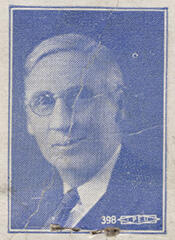
Here you will find contact information for Representative William A. Rowan, including email address, phone number, and mailing address.
| Name | William A. Rowan |
| Position | Representative |
| State | Illinois |
| District | 2 |
| Party | Democratic |
| Status | Former Representative |
| Term Start | January 6, 1943 |
| Term End | January 3, 1947 |
| Terms Served | 2 |
| Born | November 24, 1882 |
| Gender | Male |
| Bioguide ID | R000473 |
About Representative William A. Rowan
William A. Rowan (November 24, 1882 – May 31, 1961) of Chicago was an American politician, newspaperman, and public official who served as a U.S. Representative from Illinois from 1943 to 1947. A lifelong resident of Chicago’s East Side community, he became a prominent figure in the city’s political life through his long tenure in the Chicago City Council from 1927 to 1942 and his subsequent service in the United States Congress.
Rowan was born in Chicago, Illinois, and spent his formative years in the city that would remain the center of his personal and professional life. He was educated in local Catholic schools, graduating from St. Patrick Grade School and St. Patrick High School. He then attended the University of Chicago, pursuing higher education in an era when relatively few working-class Chicagoans did so. After his schooling, he worked in a steel plant, gaining firsthand experience with industrial labor and the economic conditions that shaped the lives of many of his future constituents on Chicago’s heavily industrial East Side.
Rowan’s early career was rooted in journalism and community affairs. He became associated with a daily community newspaper in Chicago, where he worked from 1907 to 1927. During this twenty-year period he advanced through the ranks of the paper, serving as city editor and later as editor. His work in the press brought him into close contact with civic issues, neighborhood concerns, and local political developments, and helped establish his reputation as an informed and engaged voice in public life. This background in journalism provided him with both the visibility and the practical knowledge of municipal affairs that would facilitate his entry into elective office.
In 1927 Rowan was elected alderman of the Tenth Ward of Chicago, representing a district that included parts of the East Side and surrounding neighborhoods. He served continuously on the Chicago City Council from 1927 to 1942. As an alderman, he participated in the governance of a rapidly growing and changing city, dealing with issues of urban infrastructure, public services, and the welfare of working families in an area dominated by steel mills and related industries. His fifteen years on the council coincided with the Great Depression and the New Deal era, and he became identified with efforts to address local economic hardship and improve neighborhood conditions.
Rowan moved to the national stage in 1942, when he was elected as a Democrat to the Seventy-eighth Congress, taking office on January 3, 1943, as a U.S. Representative from Illinois. He was reelected to the Seventy-ninth Congress and served in the House of Representatives until January 3, 1947. During his two terms in Congress, which spanned the final years of World War II and the beginning of the postwar period, he supported legislation aimed at improving the health, welfare, education, and recreational opportunities available to children and families, reflecting the concerns he had championed as a local official. He was an unsuccessful candidate for reelection in 1946 to the Eightieth Congress, ending his congressional career after four years of service.
Following his departure from Congress, Rowan continued his public service in a federal administrative role. On January 21, 1947, he was appointed United States Comptroller of Customs at Chicago. In this capacity he oversaw customs operations in one of the nation’s principal transportation and commercial hubs, a post that involved supervision of revenue collection and enforcement of customs regulations at the port of Chicago. He held this position until 1953, extending his record of public service at the municipal, legislative, and federal executive levels over more than a quarter-century.
Rowan’s contributions to his community were recognized in various ways, including the dedication of a park in Chicago’s East Side in his honor, commemorating his advocacy for recreational spaces and improved living conditions for children and families. In his personal life, he was married to Mary Isabel Dunne, with whom he raised five children: Miriam, Richard, Patricia, and William Jr. William A. Rowan died on May 31, 1961, and was interred in Holy Sepulchre Cemetery in Worth, Illinois, closing a life closely intertwined with the civic and political history of Chicago and the state of Illinois.