Senator William B. Saxbe
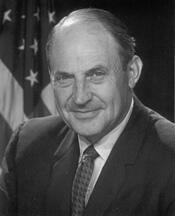
Here you will find contact information for Senator William B. Saxbe, including email address, phone number, and mailing address.
| Name | William B. Saxbe |
| Position | Senator |
| State | Ohio |
| Party | Republican |
| Status | Former Representative |
| Term Start | January 3, 1969 |
| Term End | January 3, 1975 |
| Terms Served | 3 |
| Born | June 24, 1916 |
| Gender | Male |
| Bioguide ID | S000096 |
About Senator William B. Saxbe
William Bart Saxbe (SAKS-bee; June 24, 1916 – August 24, 2010) was an American diplomat, lawyer, and Republican politician who served as a United States Senator from Ohio, Attorney General of the United States under Presidents Richard M. Nixon and Gerald R. Ford, and United States Ambassador to India. A prominent figure in mid‑20th‑century Ohio and national politics, he held major offices at the state and federal levels and remained active in public life over several decades. At the time of his death, Saxbe was the oldest living Republican former Senator and the second-oldest living former Senator overall, after Harry F. Byrd Jr. of Virginia.
Saxbe was born on June 24, 1916, in Mechanicsburg, Ohio, the son of Faye Henry “Maggie” (née Carey) Saxbe and Bart Rockwell Saxbe. He grew up in rural central Ohio, where his family had longstanding local roots, and attended public schools in Mechanicsburg. He went on to The Ohio State University, where he received a bachelor’s degree in 1940 and was a member of the Chi Phi fraternity. His early adulthood coincided with the onset of World War II, and his education and career were soon shaped by military service.
In 1940 Saxbe entered the U.S. Army Air Forces, serving during World War II from 1940 to 1945. After the war he returned to Ohio and enrolled in the Ohio State University College of Law. While still a law student, he entered politics, campaigning successfully in 1947 for a seat in the Ohio House of Representatives. He completed his legal studies while serving in the legislature and received his law degree in 1948. Saxbe remained in the Ohio National Guard and was called to active duty during the Korean War, serving from 1951 to 1952. He was ultimately discharged from the reserve in 1963 with the rank of colonel, reflecting a lengthy parallel career in military service.
Saxbe’s state legislative career advanced rapidly. In the Ohio House of Representatives he served as majority leader in 1951 and 1952 and as speaker of the House in 1953 and 1954. Building on this leadership experience, he sought statewide office and in 1957 was elected Ohio Attorney General, defeating Democrat Stephen M. Young. He was re-elected three times and held the office through 1968. As attorney general he became known for his involvement in high-profile litigation, most notably arguing before the United States Supreme Court in 1966 in the murder case of Dr. Sam Sheppard, opposing Sheppard’s attorney, F. Lee Bailey. Saxbe also served as a member of the Ohio Crime Commission from 1967 to 1968, reflecting his ongoing engagement with law enforcement and criminal justice policy.
In 1968 Saxbe was elected to the United States Senate from Ohio as a Republican, defeating Democratic candidate John J. Gilligan, a former U.S. Representative. He served one term, from 1969 until his resignation on January 3, 1974. His Senate tenure coincided with a turbulent period in American history marked by the Vietnam War, social unrest, and the unfolding Watergate scandal. As a Senator, William Bart Saxbe contributed to the legislative process during his single term in office and represented the interests of his Ohio constituents. He emerged as a prominent Republican supporter of national health insurance, co-sponsoring the Kennedy–Griffiths universal healthcare program in 1971 alongside fellow Republican Senators Jacob Javits of New York, Clifford Case of New Jersey, and John Sherman Cooper of Kentucky. He also demonstrated independence in foreign policy; when President Nixon resumed bombing North Vietnam in late 1972, Saxbe publicly declared that the President had “lost his senses.”
Saxbe left the Senate when President Nixon appointed him Attorney General of the United States in the midst of the Watergate crisis. He resigned his Senate seat effective January 3, 1974, to assume the post as the permanent replacement for Elliot Richardson, who had been dismissed during the so‑called “Saturday Night Massacre.” Saxbe succeeded Solicitor General Robert Bork, who had been serving as acting Attorney General after Richardson’s dismissal. His appointment raised an issue under the Constitution’s Ineligibility Clause, which bars legislators from being appointed to executive positions whose salaries were increased during their term. To address this, Nixon and Congress arranged to reduce the Attorney General’s salary to $35,000, its level before Saxbe’s Senate term began. This legislative maneuver, which had only one prior precedent in the 1909 appointment of Senator Philander C. Knox as Secretary of State, became known as the “Saxbe fix.” Because there was no perception that the salary change was engineered to benefit Saxbe personally, the controversy was relatively muted. As Attorney General, he oversaw, among other matters, the antitrust suit that ultimately led to the breakup of the Bell System telephone monopoly.
Saxbe’s departure from the Senate prompted political changes in Ohio. John J. Gilligan, whom Saxbe had defeated in 1968 and who had been elected Governor of Ohio in 1970, appointed Democrat Howard Metzenbaum to fill the vacancy created by Saxbe’s resignation. Later in 1974, former astronaut John Glenn, also a Democrat, was elected to the seat in his own right, succeeding to the position Saxbe had once held. Saxbe continued to serve as Attorney General into the early months of the Ford administration, providing continuity at the Department of Justice during the transition following Nixon’s resignation in August 1974. He resigned as Attorney General in early 1975 when President Ford appointed him United States Ambassador to India.
From 1975 to 1977 Saxbe served as U.S. Ambassador to India, representing American interests in New Delhi during a period that included the latter part of Prime Minister Indira Gandhi’s Emergency rule. After completing his diplomatic service in 1977, he returned to his hometown of Mechanicsburg, Ohio, and resumed the practice of law. Over the course of his long public career, he was also known for his plain-spoken manner and sharp wit. Commenting on Senator Bob Dole’s standing among colleagues at one point, Saxbe quipped that Dole was so unpopular with fellow senators that he “couldn’t sell beer on a troop ship.”
In his personal life, Saxbe married Ardath Louise “Dolly” Kleinhans in 1940. The couple had three children: William Bart Saxbe Jr.; Juliet Louise “Juli” Saxbe Spitzer; and Charles Rockwell “Rocky” Saxbe. Charles Saxbe followed his father into public service, serving four terms in the Ohio House of Representatives before entering private legal practice. William Bart Saxbe died in his hometown of Mechanicsburg, Ohio, on August 24, 2010, at the age of 94, closing a life that spanned military service in two wars, leadership in Ohio state government, a term in the United States Senate, service as Attorney General during a constitutional crisis, and diplomatic service abroad.