Representative William Edgar Simonds
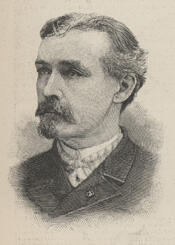
Here you will find contact information for Representative William Edgar Simonds, including email address, phone number, and mailing address.
| Name | William Edgar Simonds |
| Position | Representative |
| State | Connecticut |
| District | 1 |
| Party | Republican |
| Status | Former Representative |
| Term Start | December 2, 1889 |
| Term End | March 3, 1891 |
| Terms Served | 1 |
| Born | November 24, 1842 |
| Gender | Male |
| Bioguide ID | S000424 |
About Representative William Edgar Simonds
William Edgar Simonds (November 24, 1842 – March 14, 1903) was a United States Representative from Connecticut, a member of the Republican Party, and a recipient of the U.S. military’s highest award, the Medal of Honor, for his actions as a soldier in the American Civil War. He served one term in the United States Congress from 1889 to 1891, during a significant period in American political and economic development, and was later United States Commissioner of Patents.
Simonds was born in Collinsville, a neighborhood of Canton, Connecticut, where he attended the local public schools and Collinsville High School. Demonstrating an early interest in education, he enrolled at the Connecticut State Normal School at New Britain, an institution dedicated to training teachers, and graduated in 1860. Following his graduation, he became a teacher, beginning his professional life in the field of education before the outbreak of the Civil War redirected his career and ambitions.
With the onset of the Civil War, Simonds enlisted on August 18, 1862, as a private in Company A, 25th Connecticut Volunteer Infantry. Before his regiment was mustered into federal service, he was promoted to sergeant major, the senior noncommissioned officer of the regiment. On April 14, 1863, he took part in the Battle of Irish Bend in Louisiana, where he displayed notable bravery under heavy enemy fire. Ten days after that engagement, he received a commission as a second lieutenant and was reassigned to Company I of the 25th Connecticut Infantry. He mustered out with his regiment in August 1863, concluding a year of active service in the Union Army.
After his military service, Simonds pursued legal studies at Yale Law School, from which he graduated in 1865. That same year he was admitted to the bar and commenced the practice of law in Hartford, Connecticut. His legal career developed alongside growing involvement in public affairs. He was elected to the Connecticut House of Representatives, serving terms in 1883 and 1885. During his second term in 1885, he was chosen as Speaker of the Connecticut House, a position that reflected his standing within the state Republican Party and his skill in legislative leadership.
Simonds was elected as a Republican to the Fifty-first United States Congress and served as a Representative from Connecticut from March 4, 1889, to March 3, 1891. During his single term in the House of Representatives, he participated in the legislative process and represented the interests of his Connecticut constituents at a time when issues of industrial growth, tariffs, and veterans’ affairs were prominent in national debate. He was an unsuccessful candidate for reelection in 1890 to the Fifty-second Congress, ending his brief but notable tenure in federal elective office.
Following his congressional service, Simonds was appointed United States Commissioner of Patents, serving from 1891 to 1893. In this role he oversaw the administration of the nation’s patent system during a period of rapid technological innovation and industrial expansion, applying his legal expertise to matters of intellectual property and invention. He also remained active in educational governance in Connecticut, serving on the board of trustees of the Connecticut Agricultural College (later the University of Connecticut). In that capacity he played a decisive role in the 1898 removal of President Benjamin F. Koons and the appointment of his friend and fellow Collinsville resident, George Washington Flint, as the new president of the college.
Simonds’s Civil War service was formally recognized decades after the conflict. On February 25, 1899, he was issued the Medal of Honor for his conduct at the Battle of Irish Bend on April 14, 1863, while serving as sergeant major of the 25th Connecticut Infantry. His official citation noted that he “displayed great gallantry, under a heavy fire from the enemy, in calling in the skirmishers and assisting in forming the line of battle.” He had entered service from Canton, Connecticut, and his decoration placed him among the ranks of American Civil War Medal of Honor recipients whose actions were recognized many years after the war’s end.
In his later years, after leaving federal office and completing his service as Commissioner of Patents, Simonds resumed the practice of law in Hartford. He continued to be a figure of local and state prominence, associated with both his legal work and his contributions to public service and higher education in Connecticut. William Edgar Simonds died in Hartford on March 14, 1903. He was buried in Village Cemetery in his hometown of Canton, Connecticut, closing a life that spanned roles as educator, soldier, lawyer, legislator, federal administrator, and decorated veteran.