Representative William Henry Sproul
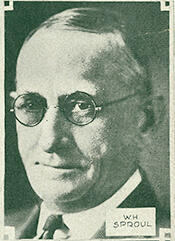
Here you will find contact information for Representative William Henry Sproul, including email address, phone number, and mailing address.
| Name | William Henry Sproul |
| Position | Representative |
| State | Kansas |
| District | 3 |
| Party | Republican |
| Status | Former Representative |
| Term Start | December 3, 1923 |
| Term End | March 3, 1931 |
| Terms Served | 4 |
| Born | October 14, 1867 |
| Gender | Male |
| Bioguide ID | S000759 |
About Representative William Henry Sproul
William Henry Sproul (October 14, 1867 – December 27, 1932) was an American businessman, lawyer, and Republican politician who served four terms as a U.S. Representative from Kansas from 1923 to 1931. Over the course of his congressional service, he represented the interests of his Kansas constituents and contributed to the legislative process during a significant period in American history.
Sproul was born on a farm near Livingston, Overton County, Tennessee, where he attended public schools and Alpine Academy. In 1883 he moved with his parents to Kansas, and the family settled in Cherokee County. During his youth he worked on a farm and in the mines, gaining early experience in agricultural and industrial labor that would later inform his public service. He continued his education at the high school in Columbus, Kansas, and later attended Kansas Normal College at Fort Scott.
Before entering the legal profession, Sproul taught school in Columbus from 1888 to 1892. He then pursued formal legal studies and graduated from the law department of the University of Kansas (often referred to as Kansas State University Law School at the time) in 1894. That same year he was admitted to the bar and commenced the practice of law in Sedan, Chautauqua County, Kansas, establishing himself as an attorney in the growing community.
Sproul quickly became active in local public affairs. He served as prosecuting attorney of Chautauqua County from 1897 to 1901, gaining experience in criminal law and county administration. In addition to his legal work, he engaged in agricultural pursuits and stock raising, and he developed business interests in the oil and gas industry, sectors that were increasingly important to the regional economy. His involvement in both agriculture and energy complemented his legal and political activities and broadened his understanding of the economic concerns of his constituents.
Sproul’s prominence in Sedan led to his election as mayor of the city, a position he held from 1921 to 1923. As mayor, he was responsible for municipal governance at a time of post–World War I adjustment and local development. His record in local office helped to propel him to national politics and laid the groundwork for his subsequent congressional career.
In 1922 Sproul was elected as a Republican to the Sixty-eighth Congress and was subsequently reelected to the three succeeding Congresses, serving from March 4, 1923, to March 3, 1931. During his four terms in the U.S. House of Representatives, he participated actively in the democratic process and represented Kansas during a transformative era that included the Roaring Twenties and the onset of the Great Depression. In the Seventy-first Congress he served as chairman of the Committee on Mines and Mining, a role that drew on his familiarity with mining and energy issues and placed him in a key position to influence legislation affecting natural resources and industrial development.
Sproul chose not to be a candidate for renomination to the House in 1930, instead seeking higher office. That year he was an unsuccessful candidate for the Republican nomination for United States Senator from Kansas. After leaving Congress, he resumed his former business pursuits, returning to his legal practice and to his interests in agriculture, stock raising, and the oil and gas business.
William Henry Sproul died in a hospital in Kansas City, Missouri, on December 27, 1932. He was interred in Greenwood Cemetery in Sedan, Kansas, the community where he had long lived and practiced law, and which had served as the base for his local, business, and political activities.