Representative William Brickly Stokes
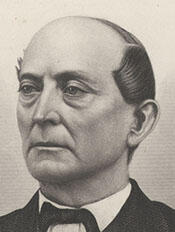
Here you will find contact information for Representative William Brickly Stokes, including email address, phone number, and mailing address.
| Name | William Brickly Stokes |
| Position | Representative |
| State | Tennessee |
| District | 3 |
| Party | Republican |
| Status | Former Representative |
| Term Start | December 5, 1859 |
| Term End | March 3, 1871 |
| Terms Served | 4 |
| Born | September 9, 1814 |
| Gender | Male |
| Bioguide ID | S000950 |
About Representative William Brickly Stokes
William Brickly Stokes (September 9, 1814 – March 14, 1897) was an American politician, lawyer, and Union Army officer who represented Tennessee in the United States House of Representatives during the turbulent years surrounding the Civil War and Reconstruction. A member of the Republican Party in his later national service, he served four terms in Congress between 1859 and 1871 and played a role in the legislative process during a significant period in American history. He also served as colonel of the 5th Regiment Tennessee Volunteer Cavalry in the Union Army and was later brevetted a brigadier general.
Stokes was born on September 9, 1814, in Chatham County, North Carolina. He attended the common schools of his native state before moving with his family to Temperance Hall, Tennessee. In Tennessee he engaged in agricultural pursuits, establishing himself as a farmer. Like many landholders of his era and region, Stokes was a slaveholder and is recorded as having owned between seven and ten enslaved people in Tennessee. His early life in a rural, agrarian community and his experience as a farmer informed his later political perspectives and his representation of a largely agricultural constituency.
Stokes’s public career began in Tennessee state politics. He was elected to the Tennessee House of Representatives, where he served from 1849 to 1852. He subsequently advanced to the Tennessee Senate, serving there in 1855 and 1856. These years in the state legislature provided him with legislative experience and a platform that would lead to national office. His work at the state level coincided with the intensifying national debate over slavery and sectionalism that would soon culminate in the Civil War.
At the national level, Stokes was first elected to the United States House of Representatives as a member of the Opposition Party, representing Tennessee’s 4th congressional district in the Thirty-sixth Congress. He served in this initial term from March 4, 1859, to March 4, 1861. His early congressional service took place on the eve of the Civil War, during a period of deepening national crisis. After Tennessee’s secession and the outbreak of war, Stokes left Congress and entered military service on the Union side, reflecting his strong Unionist convictions despite representing a Southern state.
On May 15, 1862, Stokes entered the Union Army as a major of the Tennessee Volunteers. He was soon appointed colonel of the 5th Regiment Tennessee Volunteer Cavalry, a Union regiment raised in a state largely aligned with the Confederacy. He commanded this regiment until his resignation on March 10, 1865. During his military service he briefly held temporary brigade command in the Army of the Ohio between June 17, 1863, and August 6, 1863. In recognition of his service, President Andrew Johnson nominated him on December 24, 1866, for the honorary grade of brevet brigadier general of volunteers, to rank from March 13, 1865; the United States Senate confirmed this brevet appointment on February 21, 1867. His Civil War service, particularly his leadership of Union forces from Tennessee, enhanced his standing among Unionists during and after the conflict.
With the end of the Civil War and the readmission of Tennessee to representation in Congress, Stokes resumed his national legislative career. Upon Tennessee’s readmission, he was elected as an Unconditional Unionist to the Thirty-ninth Congress from Tennessee’s 3rd congressional district. He was subsequently re-elected as a Republican to the Fortieth and Forty-first Congresses. In this period he served in the U.S. House of Representatives from July 24, 1866, to March 4, 1871, completing four terms in Congress when combined with his prewar service. As a member of the House of Representatives during Reconstruction, Stokes participated in the democratic process and represented the interests of his constituents in a time of political realignment, the reintegration of former Confederate states, and the redefinition of civil and political rights. He was an unsuccessful candidate for re-election in 1870 to the Forty-second Congress, which ended his congressional tenure in March 1871.
During and after his later congressional service, Stokes broadened his professional pursuits. He studied law and was admitted to the bar in 1867, beginning the practice of law in Alexandria, DeKalb County, Tennessee. In addition to his legal practice, he also served as supervisor of internal revenue for Tennessee, a federal administrative position that involved oversight of tax collection and revenue enforcement during the Reconstruction era. These roles reflected his continued engagement in public affairs even after leaving elective office.
In his later years, Stokes resided in Alexandria, Tennessee, where he continued his legal work and remained a figure of local prominence. He died there on March 14, 1897. William Brickly Stokes was interred in East View Cemetery in Alexandria. His life encompassed service at the state and national levels, military command in the Union Army, and participation in the critical legislative struggles of the Civil War and Reconstruction eras, marking him as a significant, if regionally focused, figure in nineteenth-century American political history.