Representative William Halstead Sutphin
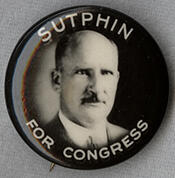
Here you will find contact information for Representative William Halstead Sutphin, including email address, phone number, and mailing address.
| Name | William Halstead Sutphin |
| Position | Representative |
| State | New Jersey |
| District | 3 |
| Party | Democratic |
| Status | Former Representative |
| Term Start | December 7, 1931 |
| Term End | January 3, 1943 |
| Terms Served | 6 |
| Born | August 30, 1887 |
| Gender | Male |
| Bioguide ID | S001086 |
About Representative William Halstead Sutphin
William Halstead Sutphin (August 30, 1887 – October 14, 1972) was an American military officer, businessman, and Democratic Party politician who represented New Jersey’s 3rd congressional district for six terms in the United States House of Representatives from 1931 to 1943. His congressional service, spanning the Great Depression and the early years of World War II, placed him at the center of a significant period in American history, during which he contributed to the legislative process and represented the interests of his New Jersey constituents.
Sutphin was born on August 30, 1887, in the Browntown section of Old Bridge Township, New Jersey. He attended the public schools of nearby Matawan, New Jersey, where he grew up, and pursued further studies at Woods Business College in Brooklyn, New York. His early education prepared him for both business and public service, and in 1915 he attended the officers’ training camp at Plattsburgh, New York, reflecting an early commitment to military service and national defense.
Before entering national politics, Sutphin was active in local government and military affairs. He was elected mayor of Matawan, New Jersey, serving from 1915 to 1916 and again from 1921 to 1926. In 1916 he served on the United States–Mexico border with B Troop, First Squadron, New Jersey Cavalry, during the period of the Pancho Villa Expedition, gaining practical military experience in a time of heightened tensions along the border. During World War I, he served in France from December 1917 to May 1919 in the Air Service and was discharged with the rank of captain, underscoring his leadership responsibilities in the wartime military. After the war, he entered private business as a factory representative for asphalt roofing, a position he held from 1920 to 1931.
Sutphin’s business experience and record of local public service formed the foundation for his election to Congress. A member of the Democratic Party, he was elected to the Seventy-second Congress and to the five succeeding Congresses, serving from March 4, 1931, to January 3, 1943, as the representative of New Jersey’s 3rd congressional district. Over the course of six consecutive terms, he participated actively in the democratic process, contributing to national legislation during the New Deal era and the nation’s mobilization for World War II. His tenure coincided with major federal efforts to address economic hardship and prepare for global conflict, and he consistently represented the concerns and interests of his New Jersey constituents in the House of Representatives.
In 1942, Sutphin was an unsuccessful candidate for reelection to the Seventy-eighth Congress, bringing his twelve-year congressional career to a close on January 3, 1943. Following his departure from public office, he returned to private enterprise, becoming vice president of the M.J. Merkin Paint Company in New York City. He remained in that position until his retirement in 1951, after which he took up residence in Berlin, Maryland.
In his later years, Sutphin lived quietly in Maryland, retaining the distinction of a former congressman, military officer, and local official whose career had bridged municipal government, wartime service, and national legislative responsibility. He died in Salisbury, Maryland, on October 14, 1972. In recognition of his military service, he was interred in Arlington National Cemetery, closing a life marked by service in uniform, in business, and in the halls of Congress.