Representative William Aubrey Thomas
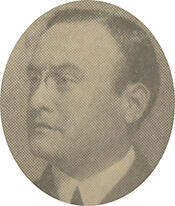
Here you will find contact information for Representative William Aubrey Thomas, including email address, phone number, and mailing address.
| Name | William Aubrey Thomas |
| Position | Representative |
| State | Ohio |
| District | 19 |
| Party | Republican |
| Status | Former Representative |
| Term Start | November 9, 1903 |
| Term End | March 3, 1911 |
| Terms Served | 4 |
| Born | June 7, 1866 |
| Gender | Male |
| Bioguide ID | T000186 |
About Representative William Aubrey Thomas
William Aubrey Thomas (June 7, 1866 – September 8, 1951) was an American scientist, industrialist, and Republican politician who served as a U.S. Representative from Ohio from 1903 to 1911, with his congressional tenure specifically recorded as running from November 8, 1904, to March 3, 1911. His service in the House of Representatives spanned four terms and occurred during a significant period in American history, when the nation was undergoing rapid industrial growth and political reform.
Thomas was born in Y Bynea, near Llanelli, Carmarthenshire, Wales, on June 7, 1866. In 1868 he immigrated to the United States with his parents, who settled in Niles, Trumbull County, Ohio. Raised in this industrial community, he attended the public schools of Niles, laying the foundation for a career that would combine scientific training with business and public service. His early life as an immigrant in a growing Ohio town helped shape his familiarity with the concerns of working communities and industrial enterprises.
Pursuing higher education, Thomas attended Mount Union College in Alliance, Ohio, and later enrolled at Rensselaer Polytechnic Institute in Troy, New York. At Rensselaer he majored in metallurgical chemistry, a field closely tied to the expanding iron and steel industries of the late nineteenth century. This scientific and technical education prepared him for a professional life in analytical work and industrial management at a time when metallurgy and materials science were central to American economic development.
After completing his studies, Thomas returned to Ohio and worked as an analytical chemist in Niles from 1886 to 1888. He soon became engaged more broadly in the iron and steel business, rising to positions of leadership in local industry. He served as president of The Mahoning Valley Steel Company, a significant enterprise in the region’s steel production, and as secretary and director of the Niles Firebrick Company, which manufactured refractory materials essential to heavy industry. These roles established him as a prominent figure in the industrial economy of northeastern Ohio and provided practical experience that informed his later legislative interests.
Beyond his professional and business pursuits, Thomas was active in civic and fraternal life. He became a Mason in 1887 and, at a notably young age, was elected Master of his lodge, becoming the youngest Master in Ohio and serving in that capacity for two terms. He joined the Benevolent and Protective Order of Elks in 1892 and was a member of the Presbyterian Church. These affiliations reflected his engagement with community institutions and broadened his connections among both business and civic leaders in his region.
Thomas entered national politics as a member of the Republican Party. He was elected as a Republican to the Fifty-eighth Congress to fill the vacancy caused by the resignation of Representative Charles W. F. Dick upon Dick’s election to the United States Senate. Thomas’s service in Congress is recorded as beginning on November 8, 1904. He was subsequently reelected to the Fifty-ninth, Sixtieth, and Sixty-first Congresses, serving continuously until March 3, 1911. Over the course of these four terms, he participated in the legislative process during an era marked by debates over tariffs, regulation of industry, and other issues of importance to his industrial Ohio constituency. Although specific committee assignments are not detailed here, his background in metallurgy and manufacturing positioned him to represent effectively the interests of a district shaped by iron, steel, and related industries. He was an unsuccessful candidate for reelection in 1910 to the Sixty-second Congress, bringing his period of congressional service to a close in early 1911.
After leaving Congress, Thomas returned to private life and continued his involvement in industrial enterprises. In 1918 he moved to Alabama, where he remained active in the manufacture of iron, steel, and firebrick. He served as president of the Jenifer Iron Company, extending his influence from Ohio’s Mahoning Valley to the industrial regions of the American South. His later years thus continued the pattern of combining scientific knowledge, industrial leadership, and public engagement that had characterized his earlier career.
William Aubrey Thomas died in Talladega, Alabama, on September 8, 1951, at the age of 85. Although he had spent his final decades in the South, he was interred in Oak Hill Cemetery in Youngstown, Ohio, reflecting his enduring ties to the region where he had grown up, built his early career, and first entered public life.