Representative William Isham Traeger
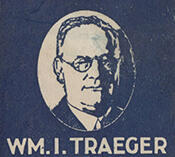
Here you will find contact information for Representative William Isham Traeger, including email address, phone number, and mailing address.
| Name | William Isham Traeger |
| Position | Representative |
| State | California |
| District | 15 |
| Party | Republican |
| Status | Former Representative |
| Term Start | March 9, 1933 |
| Term End | January 3, 1935 |
| Terms Served | 1 |
| Born | February 26, 1880 |
| Gender | Male |
| Bioguide ID | T000349 |
About Representative William Isham Traeger
William Isham Traeger (February 26, 1880 – January 20, 1935) was an American law enforcement official, attorney, educator, and politician who served as sheriff of Los Angeles County from 1921 to 1932 and as a Republican Representative from California in the United States Congress from 1933 to 1935. Over the course of a varied public career, he also gained prominence as a college football player and coach, serving as head football coach at Pomona College in 1902 and at the University of Southern California (USC) in 1908.
Traeger was born in Porterville, Tulare County, California, the oldest of five children of Augustus Traeger, a blacksmith who had migrated from Wisconsin in 1872, and Martha Ellen (Dunn) Traeger, who had come to California from Arkansas in 1874. He attended elementary and high schools in Porterville, where he also assisted his father in his blacksmith trade. His mother died in 1895, when he was a teenager. During the Spanish–American War, Traeger enlisted in the 6th California Volunteer Infantry and served as a private and corporal from May 11 to December 15, 1898, gaining early experience in military discipline and public service.
After his wartime service, Traeger enrolled at Stanford University, where he studied law and earned his undergraduate degree in 1901. At Stanford he distinguished himself as an athlete, starring as a tackle on the football team. In the 1900 Big Game rivalry, he kicked a field goal that gave Stanford a 5–0 victory over the University of California at Berkeley, at a time when field goals were worth five points. He captained the Stanford team that played in the first Rose Bowl Game on January 1, 1902, and, despite tearing a shoulder ligament during the contest, continued to play, reinforcing his reputation for toughness and leadership on the field.
In 1902 Traeger moved to Los Angeles, where he quickly became involved in collegiate athletics and public service. That year he served as head football coach at Pomona College, leading the team to a 3–2 record, and in 1903 he coached at Occidental College. He also coached Los Angeles High School in 1906. At the same time, he began his career in federal and local law enforcement, serving as a deputy United States marshal from April 1903 through 1906 and as a deputy sheriff for Los Angeles County from January 1907 to 1911. He worked for a period with a general contracting company, broadening his experience in private enterprise. During his tenure as a deputy marshal he married Alice Collier; she died in 1908 from tuberculosis, leaving him a widower with one daughter.
Traeger pursued formal legal training at the University of Southern California law school while continuing his involvement in athletics. In 1908 he served as head coach of the USC football team—then known as the Methodists, before the Trojans nickname was adopted in 1912—compiling a 3–1–1 record against a schedule composed entirely of southern California opponents, including Pomona, Occidental, Los Angeles High School, and a San Bernardino County athletic club. He was succeeded in 1909 by track coach Dean Cromwell. Traeger was admitted to the California bar in 1909 and entered private legal practice. In 1911 he began serving as deputy clerk for the Supreme Court of California, a position he held until 1921. During World War I he enlisted in the United States Army and attended an officers’ training camp, furthering his military credentials. In 1912 he married his second wife, Ruth McAllister, a schoolteacher; they would have one daughter together.
In 1921 Traeger was appointed sheriff of Los Angeles County, launching the phase of his career for which he became best known locally. He was subsequently elected to four-year terms in 1922, 1926, and 1930, serving continuously as sheriff until December 1932. As sheriff he undertook significant administrative reforms, reorganizing the county jail system, establishing honor camps for first-time misdemeanor offenders, and creating an employment contact office to help prisoners secure work after their release, reflecting an interest in rehabilitation as well as custody. In 1929 he became the first president of the Los Angeles County Peace Officers’ Association, a professional body for local law enforcement officials. During this period, contemporary reporting later revealed that Traeger had been a member of the Ku Klux Klan along with other local officials; he stated that he had resigned from the organization following public exposure of its activities.
Traeger’s prominence in law enforcement and his long-standing Republican affiliation led to his election to the United States House of Representatives. In 1932, amid a national Democratic landslide during the Great Depression, he was elected as a Republican to the 73rd Congress, serving from March 4, 1933, to January 3, 1935. As a member of the House of Representatives, he participated in the legislative process during a critical period in American history, representing the interests of his California constituents while the nation grappled with economic crisis and the early New Deal. His service in Congress encompassed one full term, after which he was defeated for reelection in 1934 by Democrat John M. Costello.
Shortly after leaving office, Traeger’s health declined. He became ill in late December 1934 and died on January 20, 1935, at age 54, of a liver disorder at the Wadsworth Hospital in Los Angeles, just two weeks after his congressional term ended. He was survived by his second wife, Ruth McAllister Traeger, and by one daughter from each of his two marriages. William Isham Traeger was interred at Rosedale Cemetery in Los Angeles, closing a career that had spanned military service, collegiate athletics, the practice of law, county administration, and national legislative office.