Representative William Vandever
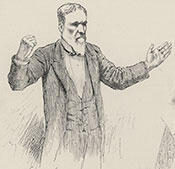
Here you will find contact information for Representative William Vandever, including email address, phone number, and mailing address.
| Name | William Vandever |
| Position | Representative |
| State | California |
| District | 6 |
| Party | Republican |
| Status | Former Representative |
| Term Start | December 5, 1859 |
| Term End | March 3, 1891 |
| Terms Served | 4 |
| Born | March 31, 1817 |
| Gender | Male |
| Bioguide ID | V000031 |
About Representative William Vandever
William Vandever (March 31, 1817 – July 23, 1893) was a United States Representative from Iowa and later from California, and a general in the Union Army during the American Civil War. A member of the Republican Party, he served multiple terms in the House of Representatives and contributed to the legislative process during a significant period in American history, representing the interests of his constituents while the nation confronted sectional conflict, civil war, and postwar development.
Vandever was born on March 31, 1817, in Baltimore, Maryland. He spent his early years in that city before moving west as a young man, part of the broader migration that was reshaping the United States in the first half of the nineteenth century. His relocation placed him on the expanding American frontier, where new communities, political institutions, and economic opportunities were emerging and where he would eventually establish himself professionally and politically.
After settling in the West, Vandever pursued a career that combined surveying, engineering, and public affairs, gaining familiarity with land issues and infrastructure that were central to the development of the region. This background helped prepare him for public service and gave him insight into the needs of growing communities. By the late 1850s, he had become sufficiently prominent to seek and win elective office, aligning himself with the newly formed Republican Party, which opposed the expansion of slavery and advocated for free labor and internal improvements.
In 1858 Vandever was elected as a Republican to represent Iowa’s 2nd congressional district in the Thirty-sixth Congress, and he was re-elected in 1860 to represent the same district in the Thirty-seventh Congress. His service in Congress thus began before the outbreak of the Civil War and continued into the early war years. In 1861 he was a member of the peace conference held in Washington, D.C., an eleventh-hour effort by leaders from various states to devise means to prevent the impending conflict between North and South. As a member of the House of Representatives during this turbulent era, Vandever participated in the democratic process at a time when the Union was under severe strain.
During the Civil War, Vandever also served as a general in the Union Army, reflecting the common pattern of mid-nineteenth-century politicians who took up military commands in defense of the Union. His dual role as legislator and soldier placed him at the intersection of policy and combat, as Congress debated war measures and the army implemented them in the field. His military service contributed to the Union war effort and further enhanced his public standing in the years that followed.
After the war, Vandever continued his political career and later represented California in the United States Congress. He served as a Representative from California in the United States Congress from 1859 to 1891, holding office for four terms and contributing to the legislative process over an extended period. As a California representative, he participated in shaping national policy during the postwar and Gilded Age years, when questions of reconstruction, western development, economic growth, and federal authority were at the forefront of congressional debate. Throughout his time in the House, both from Iowa and later from California, Vandever remained aligned with the Republican Party and its evolving program.
In his later years, Vandever resided in California, where he continued to be associated with public life and the legacy of his wartime and congressional service. He died in Ventura, California, on July 23, 1893. He was buried in Ventura Cemetery, marking his final resting place in the state he had represented in Congress. His name is preserved in various historical references, including lists of Union generals of the American Civil War, and in geographic features such as Vandever Mountain, reflecting the enduring recognition of his role in both military and political history.