Representative William C. Wampler
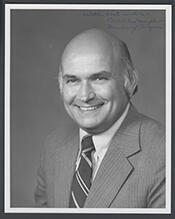
Here you will find contact information for Representative William C. Wampler, including email address, phone number, and mailing address.
| Name | William C. Wampler |
| Position | Representative |
| State | Virginia |
| District | 9 |
| Party | Republican |
| Status | Former Representative |
| Term Start | January 3, 1953 |
| Term End | January 3, 1983 |
| Terms Served | 9 |
| Born | April 21, 1926 |
| Gender | Male |
| Bioguide ID | W000121 |
About Representative William C. Wampler
William Creed Wampler Sr. (April 21, 1926 – May 23, 2012) was an American newspaperman, businessman, and Republican politician who served as a Representative from Virginia in the United States Congress from 1953 to 1955 and again from 1967 to 1983. Over the course of nine terms in office, he contributed to the legislative process during a significant period in American history, representing the interests of his constituents in southwestern Virginia and participating actively in the democratic process as a member of the House of Representatives.
Wampler was born in Pennington Gap, near the center of Lee County, Virginia, on April 21, 1926, to hardware store proprietor John Sevier Wampler and his wife, the former Lilian May Wolfe, a schoolteacher. Nicknamed “Bill,” he grew up during the Great Depression with two older brothers, John S. Wampler Sr. and James A. Wampler. As the Depression eased, the family’s circumstances improved to the point that they maintained a live‑in maid and lodger. Wampler attended the public schools in Bristol, Virginia, where the family later settled, and his early years in this border region between Virginia and Tennessee helped shape his familiarity with the concerns of Appalachian communities he would later represent.
When he became old enough to enlist during World War II, Wampler joined the United States Navy on May 21, 1943. He served as a seaman for twenty‑eight months, seeing active duty until his discharge on September 29, 1945. After leaving active service, he remained for many years in the Naval Reserve, V‑6. Taking advantage of the GI Bill, he resumed his education and enrolled at Virginia Polytechnic Institute in Blacksburg, Virginia, where he earned a degree in political science in 1948. He then pursued legal studies at the University of Virginia from 1948 to 1950, but left before completing a law degree, turning instead toward journalism and politics.
Wampler began his professional career in journalism. In 1950 and 1951 he worked as a reporter for The Tennessean in Nashville, Tennessee. In 1951 he returned to southwestern Virginia as a reporter and editorial writer for the Big Stone Gap Post. Later that year he moved to Bristol, on the Virginia–Tennessee line, to serve as a reporter and copy editor for the Bristol Herald Courier, a position he held through 1952. At the same time, he was becoming increasingly active in Republican Party politics. He served as Republican assistant campaign manager for the 9th congressional district elections in 1948 and, in 1950, was president of the Young Republican Federation of Virginia. That same year he was both keynote speaker and permanent chairman of the 9th District Republican Convention, establishing himself as a rising figure in a region long dominated by conservative Democrats.
Wampler first entered Congress as a Republican from Virginia’s 9th District when he was elected to the 83rd Congress, serving from January 3, 1953, to January 3, 1955. During this initial term he was the youngest member of the House of Representatives. His service in Congress began during the administration of President Dwight D. Eisenhower, at the outset of the Cold War and in the early years of the modern civil rights era. After losing his 1954 bid for reelection to the 84th Congress, he accepted a position with the U.S. Atomic Energy Commission, serving from January 1955 to March 1956. He then returned to Virginia to assist in the family’s business enterprises and to continue his political efforts. Wampler ran again for Congress in 1956 but lost to Democrat William Pat Jennings, receiving about 45 percent of the vote.
Following these defeats, Wampler concentrated on business and party-building. From 1957 to 1960 he served as vice president and general manager of Wampler Brothers Furniture Company in Bristol. He then became vice president and general manager of Wampler Carpet Company, a position he held from 1961 to 1966. During these years he remained active in Republican politics, working on the campaigns of other GOP candidates as the party slowly gained strength in Virginia. As the Byrd Organization’s dominance waned and its policy of “massive resistance” to the Supreme Court’s 1954 and 1955 Brown v. Board of Education school desegregation decisions collapsed, political realignment in the state opened new opportunities for Republican candidates like Wampler.
In 1966 Wampler successfully reclaimed the 9th District seat, defeating William Pat Jennings and winning election to the 90th Congress with 53.7 percent of the vote. He took office on January 3, 1967, and was subsequently re‑elected to seven succeeding Congresses, serving continuously until January 3, 1983. His electoral margins reflected both his personal popularity and shifting partisan loyalties in the region: he won re‑election in 1968 with 59.9 percent of the vote, in 1970 with 62.5 percent, in 1972 with 71.9 percent, and, despite the national backlash against Republicans following the Watergate scandal, narrowly retained his seat in 1974 with 50.9 percent. He increased his share to 57.3 percent in 1976, won with 61.9 percent in 1978, and secured 69.4 percent of the vote in 1980. In Congress, Wampler advocated for Appalachian coal miners and the economic development of his largely rural district, and he served on the House Agriculture Committee, where he worked on issues affecting farmers, rural infrastructure, and resource-based industries central to southwestern Virginia.
Wampler’s long tenure came to an end in the 1982 election, when Democrat Frederick C. “Rick” Boucher narrowly defeated the sixteen‑year incumbent, winning 50.4 percent of the vote and a margin of roughly 1,100 votes. After this defeat, Wampler did not seek public office again on his own behalf, but he remained active in politics behind the scenes, supporting Republican candidates and advising on campaigns. His son, William C. Wampler Jr., was elected as a Republican from Bristol to the Virginia Senate in 1988 and won re‑election repeatedly until 2012, extending the family’s political influence in the region. Wampler’s grandson, William C. Wampler III, continued the family’s public service tradition by winning a seat in the Virginia House of Delegates in 2019.
In his personal life, Wampler married Mary Elizabeth Baker on August 23, 1953, in Scott County, Tennessee. The couple had two children, a daughter, Barbara Wampler, and a son, William Creed Wampler Jr., before divorcing in 1976. On July 25, 1977, he married Mary Lee McCall Frackelton in an Episcopal ceremony in Bristol. Outside of elective office, he also contributed to higher education and civic life in the region, serving on the board of visitors of Emory and Henry College in Emory, Virginia, reflecting his long-standing interest in education and community development.
William Creed Wampler Sr. died in Bristol, Virginia, on May 23, 2012. In recognition of his decades of public service and his advocacy for southwestern Virginia, the section of Interstate 81 from the Tennessee state line to the Christiansburg exit was renamed in his honor. His career as a newspaperman, businessman, and legislator, together with the continued public service of his descendants, left a lasting imprint on the political and civic life of Virginia’s 9th Congressional District.