Representative William Woodburn
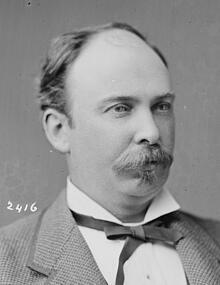
Here you will find contact information for Representative William Woodburn, including email address, phone number, and mailing address.
| Name | William Woodburn |
| Position | Representative |
| State | Nevada |
| District | At-Large |
| Party | Republican |
| Status | Former Representative |
| Term Start | December 6, 1875 |
| Term End | March 3, 1889 |
| Terms Served | 3 |
| Born | April 14, 1838 |
| Gender | Male |
| Bioguide ID | W000710 |
About Representative William Woodburn
William Woodburn (April 14, 1838 – January 15, 1915) was an American lawyer and Republican politician who represented Nevada in the United States House of Representatives during three nonconsecutive terms in the late nineteenth century. Born in County Wicklow, Ireland, he immigrated with his parents to the United States in 1849, part of the broader mid-nineteenth-century wave of Irish migration. The family eventually settled in the United States at a time of rapid westward expansion and political change, circumstances that would later shape Woodburn’s professional and political opportunities.
Woodburn pursued his education at St. Charles College in Maryland, a Catholic institution that provided classical and collegiate training to young men. After completing his studies there, he read law, following the then-common practice of legal apprenticeship rather than formal law school. He was admitted to the bar in 1866. Drawn by the opportunities of the post–Civil War West and the booming mining economy, he moved to Nevada and commenced the practice of law in Virginia City, a major center of the Comstock Lode silver-mining district.
Establishing himself quickly in his adopted state, Woodburn gained public prominence through legal and local office. In 1871 and 1872 he served as district attorney of Storey County, Nevada, which included Virginia City and was one of the most important mining jurisdictions in the region. In that role he was responsible for prosecuting criminal cases and advising county officials, experience that enhanced his reputation as a capable attorney and helped launch his political career within the Republican Party.
Woodburn was elected as a Republican to the Forty-fourth Congress, serving from March 4, 1875, to March 3, 1877, as a Representative from Nevada. His initial term in the House of Representatives occurred during the turbulent post-Reconstruction era, when Congress grappled with issues of national economic policy, western development, and the integration of new states and territories into the Union. After a period back in private practice, he returned to national office when he was elected again to the Forty-ninth and Fiftieth Congresses, serving from March 4, 1885, to March 3, 1889. Across these three terms, from 1875 to 1877 and from 1885 to 1889, he represented Nevada’s interests in mining, land, and infrastructure matters and participated in the legislative process during a significant period in American political and economic history.
Following the conclusion of his final congressional term in 1889, Woodburn resumed the practice of law in Virginia City, continuing his long association with Nevada’s legal and mining communities. He remained active in politics and sought to return to Congress, but he was an unsuccessful candidate for election in 1892 to the Fifty-third Congress. Despite this defeat, he retained a respected position in state Republican circles and in the broader legal community.
Woodburn’s public service continued at the state level in the early twentieth century. On January 15, 1901, Governor Reinhold Sadler appointed him Attorney General of Nevada, succeeding William D. Jones, who had resigned to become a state district court judge. As attorney general, Woodburn served as the chief legal officer of the state, advising the governor and state agencies and representing Nevada in legal matters. He served the remainder of Jones’s term, which expired in January 1903, after which he returned once more to private legal practice, maintaining his professional ties in Nevada during his later years.
William Woodburn died on January 15, 1915, in Carson City, Nevada. He was interred in St. Theresa Cemetery, reflecting his long residence and enduring connection to the state he had served in both federal and state office. His career spanned the formative decades of Nevada’s development from a mining frontier to a more established state, and his service in Congress and as attorney general placed him among the notable public figures in Nevada’s early political history.